Analytics / Paid
Why Is My ROAS Dropping? A Diagnostic Checklist
// is the drop even real?

By Fracto Solutions
September 24, 2026
The short answer
Your ROAS is usually dropping for one of five reasons: broken tracking or an attribution change (so sales aren’t being counted), creative fatigue, rising ad costs, audience saturation, or a site or listing that stopped converting. Check tracking first, because a “ROAS drop” is often a measurement problem, not a real one.
5
1st
After
Is my ROAS actually dropping, or is it a tracking problem?
Check this first. A large share of sudden ROAS “drops” are really tracking or attribution problems, the sales are still happening, but your platform stopped counting them correctly. Confirm the drop is real in your actual revenue before blaming the ads.
Before you touch a single campaign, rule out measurement. ROAS is ad-attributed revenue divided by ad spend, so anything that breaks the “revenue” half makes ROAS look worse without any real change in sales. Common culprits: a broken conversion pixel or tag (after a site or checkout change), an attribution-window or model change (Google and platforms adjust these), or consent and privacy changes that stop some conversions being tracked. The test is simple: compare your platform-reported revenue against your actual total revenue in Shopify for the same period. If Shopify sales are steady but platform-reported ROAS crashed, you have a tracking problem, not an ads problem. This is exactly the kind of thing covered in seven signs your analytics setup is broken.
Could it be creative fatigue?
Very possibly. When your audience has seen the same ads too many times, performance decays, click-through falls, costs rise, and ROAS drops, often gradually enough that it’s blamed on the algorithm instead. Rising ad frequency alongside falling ROAS is the tell.
Creative fatigue is one of the most common real causes of a declining ROAS. As the same creative is shown repeatedly, engagement drops, the platform charges more to keep delivering it, and your return quietly erodes. The signals to check: is your ad frequency climbing? Has click-through rate fallen on ads that used to perform? Are costs per click and per acquisition creeping up on the same creative? When those move together, fatigue is the likely driver, and the fix is refreshing the creative and maintaining a pipeline of new concepts. This is covered in depth in ad creative fatigue: how to know when it’s hurting you.
Are my ad costs simply rising?
Often, yes. Ad platform costs (cost per click and per thousand impressions) have risen for years and spike during competitive periods. If your costs went up and your conversion rate held, your ROAS falls purely because each sale cost more to acquire, nothing in your funnel actually broke.
Sometimes a ROAS drop is just the market. Cost per click on the major platforms trends upward over time and rises sharply in competitive windows (holidays, big sales periods) as more advertisers bid for the same attention. If your costs climbed while your conversion rate and average order value held steady, your ROAS mechanically declines, you’re paying more for the same result. This isn’t a failure in your ads or your site; it’s rising input costs. The response isn’t panic but efficiency: improve what you control (conversion, AOV, creative) so each expensive click is worth more, which is the core logic of how CRO lowers CAC. You can’t control the auction, but you can control what happens after the click.
Have I saturated my audience?
Possibly, especially if you’ve been scaling spend. As you spend more to reach more of an audience, you eventually reach less responsive people, so efficiency (and ROAS) falls even though total sales may still rise. It’s a natural ceiling, not a bug.
Audience saturation is the ROAS drop that comes from success. When you increase budget, you first reach your most responsive prospects; push further and you’re paying to reach people less likely to buy, so each additional dollar returns less. This shows up as declining ROAS as spend climbs, and it’s often confused with something being “broken.” It isn’t, it’s the diminishing-returns curve every channel has. The signals: ROAS falling specifically as you scaled budget, and rising frequency against the same audience. The responses are to expand into new audiences, refresh creative to re-engage, or accept that the profitable ceiling for that audience has been reached and rebalance spend. Knowing your true limit ties back to attribution and blended economics, covered in the attribution pillar.
Did my site or listing stop converting?
Check it. Ads send traffic, but your site or product page does the converting, so if conversion dropped (a checkout bug, a slower page, a price change, a broken mobile layout), your ROAS falls even with perfectly healthy ads. The ads didn’t change; the destination did.
This is the cause people forget, because they’re staring at the ad account. ROAS depends on the whole chain: ad to click to landing page to checkout to purchase. If anything after the click breaks or worsens, a checkout error, a speed regression, a mobile layout issue, an out-of-stock bestseller, fewer of the same clicks convert, and ROAS drops with no change in the ads themselves. So check your site conversion rate for the period alongside the ad metrics. If conversion fell, the problem is on-site, not in the campaign, and no amount of ad optimization will fix it. This is why paid performance and conversion optimization are inseparable, diagnosed the same way as any conversion issue.
Cause
The tell
Check
Tracking / attribution
Platform revenue diverges from Shopify
Compare platform vs actual revenue
Site / listing conversion
On-site conversion rate fell
Check conversion for the period
Creative fatigue
Frequency up, CTR down on same ads
Ad frequency and CTR trend
Rising ad costs
CPC/CPM up, conversion held
Cost trend vs conversion
Audience saturation
ROAS falls as you scale spend
ROAS vs budget over time
Work top to bottom: tracking and site issues are the most commonly missed and the most misleading.
What order should I check these in?
Tracking first (is the drop even real?), then site conversion (did the destination break?), then creative fatigue, ad costs, and saturation. Ruling out measurement and on-site issues before blaming the ads saves you from “fixing” campaigns that were never the problem.
A quick diagnostic sequence: – Tracking and attribution. Compare platform revenue to actual Shopify revenue. If they diverge, it’s measurement. – Site conversion. Did your conversion rate drop in the same period? If so, the destination broke, not the ads. – Creative fatigue. Rising frequency plus falling CTR on the same creative. – Ad costs. Did CPC or CPM rise while conversion held? Market-driven. – Saturation. Did ROAS fall specifically as you scaled spend?
Work top to bottom, because the first two (tracking and site) are the most commonly missed and the most misleading, and fixing a campaign that was never broken just wastes time and money.
- Why ROAS drops
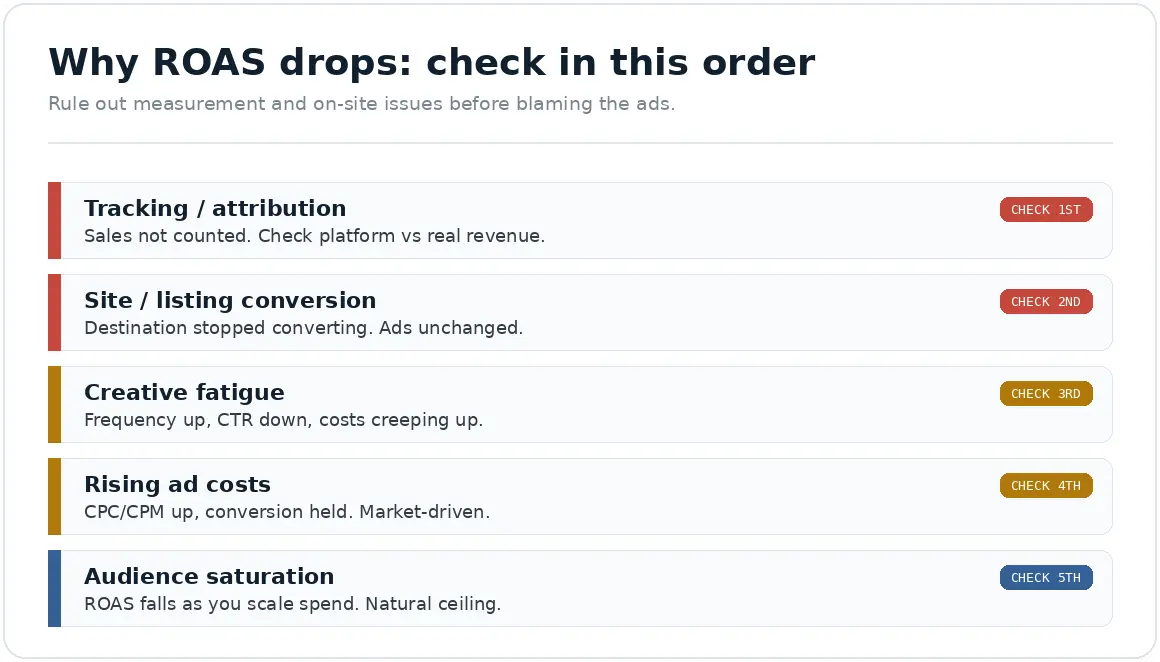
Rule out measurement and on-site issues before blaming the ads.
We diagnose the real cause before touching a campaign.
We check tracking first (is the drop even real?), then site conversion, then creative, costs, and saturation, so you never rebuild campaigns that were never the problem.
It’s part of our analytics and tracking work, feeding the conversion optimization and paid decisions the diagnosis should drive.
// we would rather show up in your reporting than in your inbox
Frequently asked questions
Why did my ROAS suddenly drop?
Most often a tracking or attribution problem (sales not being counted), or an on-site conversion issue (the destination stopped converting), rather than the ads themselves. Check platform revenue against your actual Shopify revenue first; if they diverge, it’s measurement, not a real drop.
Can broken tracking make ROAS look worse than it is?
Yes, very commonly. ROAS is attributed revenue over spend, so a broken pixel, an attribution-window change, or lost conversions from privacy changes make ROAS fall even when sales are steady. Always confirm the drop is real in your actual revenue before acting.
Is a dropping ROAS always a problem?
No. Rising ad costs and audience saturation cause ROAS to fall for reasons outside your funnel, sometimes while total sales still grow. The response is to improve what you control (conversion, AOV, creative) so each click is worth more, rather than assuming something broke.
How do I fix a falling ROAS?
Diagnose first: confirm tracking, check site conversion, then creative fatigue, costs, and saturation. Fix the actual cause, refresh fatigued creative, fix on-site conversion issues, expand saturated audiences, rather than blindly cutting spend or rebuilding campaigns that weren’t the problem.
Sources
Every statistic is traced to its original publisher and dated. Retention benchmark figures vary widely by source and category and are given here as directional ranges, not precise targets; famous single-source retention stats (like the “5 to 25x cheaper” multiplier) are treated as directional only. Benchmark against your own category and cohort trend.
ROAS = attributed revenue / ad spend (arithmetic). Common ROAS-drop causes (tracking/attribution, creative fatigue, rising ad costs, audience saturation, on-site conversion drop): consistent across 2026 paid-performance sources. https://layerfive.com/blog/ecommerce-attribution-beyond-last-click/
Attribution-window and model changes distort reported ROAS; platforms double-count. See the attribution pillar and its sources.
Rising platform ad costs over time: as compiled in the CAC cluster.