Analytics / Attribution
Marketing Attribution for Ecommerce Which Model to Trust
// the model you choose changes which channel looks like the winner

By Fracto Solutions
September 24, 2026
The short answer
Marketing attribution decides which channels and campaigns get credit for a sale. The model you choose changes the answer: last-click credits only the final click and over-values bottom-funnel channels, while data-driven attribution spreads credit across the journey. No model is perfectly accurate, and platforms double-count, so the goal is a consistent model plus a check against real business results.
~6%
more conversions at same ROAS: DDA vs last-click (Google)
Nov 2023
Google removed 4 rule-based models from GA4
2 for 1
Meta + Google both claim the same conversion
What is marketing attribution?
Marketing attribution is the method for assigning credit for a conversion across the touchpoints a customer interacted with before buying. Because most ecommerce buyers touch several channels before purchasing, attribution decides how that credit gets split, and that decision shapes where you spend.
Almost no one buys on the first click. A typical customer might discover you through a social ad, come back via organic search, get a reminder email, and finally purchase after clicking a brand-search ad. Attribution is how you answer “which of those gets the credit for the sale?”, and the answer directly drives budget. If your model gives all the credit to that final brand-search click, you’ll conclude social and email did nothing and cut them, even though they created the demand the final click merely captured. That’s why attribution isn’t an accounting nicety; it’s one of the most consequential settings in your entire marketing stack.
What are the main attribution models?
The common models are last-click, first-click, linear, time-decay, position-based, and data-driven. They differ in how they split credit across the journey, from all-to-one-touchpoint (last or first click) to spread-across-all (linear, data-driven).
Model
How it assigns credit
Tends to over-credit
Last-click
100% to the final click
Brand search, retargeting, Shopping (bottom funnel)
First-click
100% to the first click
Organic, social, display (top funnel)
Linear
Equal credit to every touchpoint
Treats all touches as equal (rarely true)
Time-decay
More credit to touches nearer the sale
Bottom funnel, less severely than last-click
Position-based
More to first and last, less to middle
First and last touches
Data-driven (DDA)
Credit by actual contribution, via machine learning
Nothing by rule; based on your real data
Model behaviors are consistent across 2026 attribution sources. Note: Google removed first-click, linear, time-decay, and position-based as reporting models in GA4 in November 2023; data-driven is now the default there, with last-click still available.
The important shift: Google deprecated the rule-based models (first-click, linear, time-decay, position-based) in GA4 in November 2023 and moved to data-driven by default. So in practice, the live choice for most ecommerce teams is data-driven versus last-click.
- Attribution models
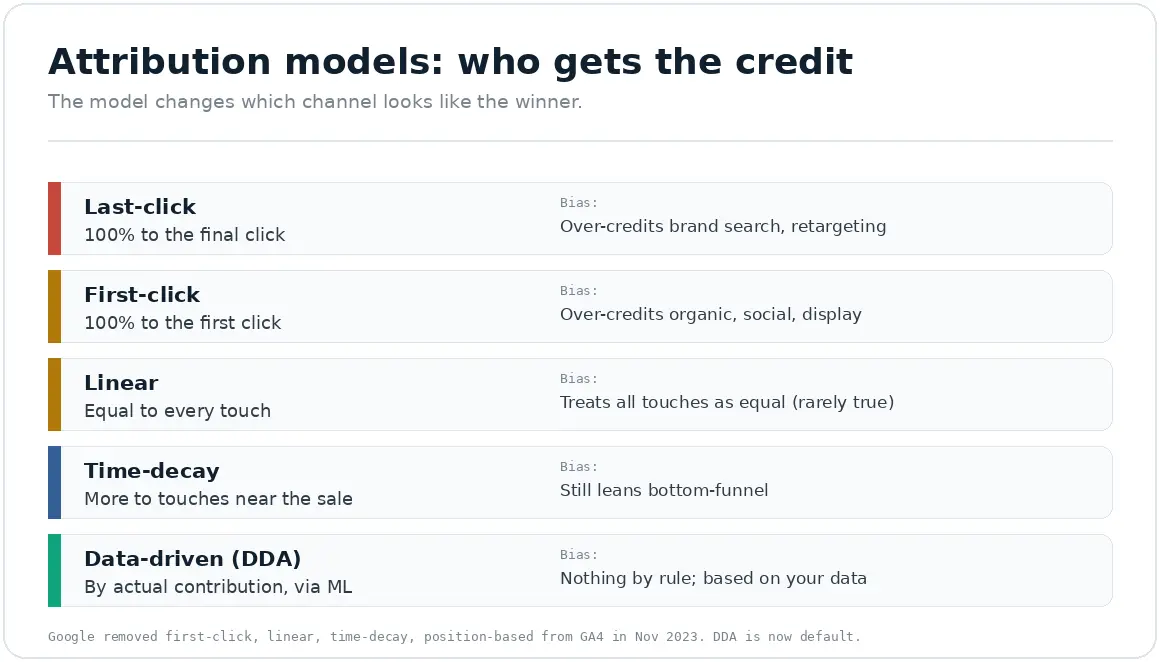
The model changes which channel looks like the winner.
Why is last-click attribution a problem?
Because it gives all the credit to the final click and ignores everything that led to it. That systematically over-values bottom-funnel channels (brand search, retargeting) and under-values the top-funnel channels (social, display, email) that created the demand in the first place.
Last-click is the default many teams unknowingly rely on, and it’s the source of the most expensive attribution mistakes. Its flaw is structural: by crediting only the final touch, it makes demand-capture channels look brilliant and demand-creation channels look worthless. The classic error is cutting Facebook or Instagram because last-click shows them converting little, when in reality social introduced the customer who later converted via a Google search. You then starve the top of the funnel that feeds everything downstream, and a few months later your “efficient” bottom-funnel channels quietly decline because the pipeline of new prospects dried up. Last-click doesn’t just misreport; it actively steers budgets the wrong way.
Is data-driven attribution better?
Generally yes, within a single platform. Data-driven attribution uses machine learning to assign credit based on how touchpoints actually contribute to conversions in your data, rather than a fixed rule. Google’s own research found advertisers using DDA saw roughly 6% more conversions at the same ROAS versus last-click.
Data-driven attribution (DDA) is a real improvement over rule-based models because it’s based on your actual conversion patterns, not an assumption. It compares the journeys of users who converted against those who didn’t to estimate each touchpoint’s influence, which is why it more fairly credits the upper-funnel touches last-click ignores. Google reports that advertisers switching from last-click to DDA saw about a 6% improvement in conversions at the same ROAS, precisely because it stops them over-investing in the bottom funnel and starving the top. DDA is now the default in both Google Ads and GA4. The honest caveat: DDA within Google can’t see Meta’s touchpoints, and vice versa, which leads straight to the biggest attribution problem of all.
Why do my ad platforms report different numbers?
Because each platform claims credit for the same sale under its own model, so they double-count. Meta and Google will both take 100% credit for one order the customer touched on both, which is why your combined platform-reported ROAS is almost always higher than your real business ROAS.
This is the attribution problem that costs the most money and confuses the most teams. Each ad platform is a walled garden: it measures conversions in its own account, with its own model and attribution window, and doesn’t share user-level data with the others. So when a customer sees a Meta ad and later buys after a Google click, both platforms report a conversion, two claimed sales from one real order. Add them up and your platforms “prove” more revenue than you actually made. This is why you can’t trust the sum of platform dashboards for budget decisions, and why the number to anchor on is your real business result: total actual revenue and orders (from Shopify), against total ad spend. The reconciliation discipline behind that is the same one in seven signs your analytics setup is broken.
Which attribution model should I actually use?
Pick one consistent model (data-driven where available), use it across platforms for comparability, and then sanity-check it against your real blended results, total revenue over total spend, rather than trusting any single platform’s number. Consistency plus a business-level check beats chasing a “perfect” model.
There’s no perfectly accurate attribution model, and anyone selling one is overpromising. The practical approach that works: first, choose data-driven attribution where you can (it’s the default and the most defensible), and apply it consistently so campaigns are comparable. Second, tighten attribution windows where they overstate (Meta’s default 7-day click / 1-day view is generous; shortening it on retargeting gives a truer read). Third, and most importantly, judge your marketing against blended, business-level economics, your actual total revenue and orders versus your total spend, not the flattering sum of platform dashboards. For the channels you can’t cleanly track, incrementality tests (turning a channel off and measuring the real drop) reveal true contribution. Attribution informs decisions; your P&L confirms them. This connects directly to real acquisition cost, covered in how CRO lowers CAC.
How does attribution connect to my other metrics?
Attribution underpins your channel ROAS and your CAC, so getting it wrong distorts both. If credit is misassigned, some channels look artificially efficient and others artificially wasteful, which sends your budget, and your reported customer acquisition cost, in the wrong direction.
Attribution isn’t a standalone report; it’s the foundation under your most important marketing numbers. Your per-channel ROAS is only as trustworthy as the attribution behind it (a channel’s ROAS can look terrible under last-click and healthy under DDA, same channel, same sales). Your blended CAC depends on correctly counting which spend produced which customers. So attribution errors ripple outward: a mis-set model can make you cut a profitable channel, misjudge your true CAC, and misallocate your whole budget. That’s why fixing attribution sits alongside fixing tracking as foundational analytics work, everything downstream inherits its accuracy or its errors. When ROAS moves and you don’t know why, attribution is one of the first suspects, covered in why is my ROAS dropping.
We set a consistent model, then anchor every decision to your real blended results.
Rather than trusting any single platform’s self-reported numbers, we standardize on data-driven attribution, tighten windows where they overstate, reconcile against your actual Shopify revenue and total spend, and use incrementality checks where tracking can’t reach. The output is a budget built on what actually drives sales, not double-counted platform credit.
It’s the same measurement-first discipline behind our analytics and tracking work: get the number trustworthy first, because every budget decision inherits its accuracy. On one engagement, acting on what the data actually said helped lift a client’s conversion rate 6% and revenue per visitor 7%, both measured at 95% confidence, work our conversion optimization team led.
// we would rather show up in your reporting than in your inbox
Frequently asked questions
What is marketing attribution in ecommerce?
It’s how you assign credit for a sale across the touchpoints a customer interacted with before buying, social, search, email, ads, and so on. Since most buyers touch several channels, attribution decides how credit is split, which directly shapes where you spend your budget.
Last-click or data-driven attribution, which is better?
Data-driven, generally. Last-click credits only the final click and over-values bottom-funnel channels while starving demand creation. Data-driven spreads credit by actual contribution; Google found it delivered about 6% more conversions at the same ROAS. Data-driven is now the default in Google Ads and GA4.
Why do Meta and Google report more sales than I actually made?
Because each platform claims credit for the same conversion under its own model, so they double-count. A customer who touched both a Meta ad and a Google ad is counted once by each. Add the dashboards up and they overstate real revenue, which is why you anchor on blended business results.
What attribution model should I use?
Pick one consistent model (data-driven where available), apply it across platforms for comparability, and sanity-check it against your real blended results, total revenue over total spend. No model is perfectly accurate, so consistency plus a business-level check beats chasing a perfect model.
Did Google remove attribution models?
Yes. Google removed first-click, linear, time-decay, and position-based as reporting models in GA4 in November 2023, and moved to data-driven attribution by default. Last-click remains available. For most ecommerce teams, the real choice today is data-driven versus last-click.
Sources
Every statistic is traced to its original publisher and dated. Retention benchmark figures vary widely by source and category and are given here as directional ranges, not precise targets; famous single-source retention stats (like the “5 to 25x cheaper” multiplier) are treated as directional only. Benchmark against your own category and cohort trend.
Attribution model behaviors (last-click over-credits bottom funnel; first-click over-credits top funnel; DDA distributes by contribution) and the cross-platform double-counting problem: consistent across 2026 sources. https://www.trackbee.io/blog/why-you-should-switch-from-last-touch-to-data-driven-attribution ; https://leadsuitenow.com/blog/marketing-attribution-models-guide ; https://layerfive.com/blog/ecommerce-attribution-beyond-last-click/
Google removed first-click, linear, time-decay, position-based in GA4 (November 2023); DDA now default, last-click still available. https://www.spaceads.agency/blog/marketing-attribution-models-last-click-vs-data-driven
Google research: DDA vs last-click ~6% more conversions at same ROAS. https://leadsuitenow.com/blog/marketing-attribution-models-guide
Meta default attribution window 7-day click / 1-day view. https://jetfuel.agency/marketing-attribution-for-dtc-brands-in-2026-how-to-know-whats-actually-driving-your-sales/
Fracto client engagement: +6% conversion rate, +7% revenue per visitor, measured at 95% confidence.