CRO / DTC
How CRO Lowers CAC for DTC Brands
// the cheapest customer is the one you already paid for

By Fracto Solutions
August 4, 2026
The short answer
CRO lowers customer acquisition cost by converting more of the traffic you already pay for. Effective CAC is spend divided by customers, so at fixed spend, doubling your conversion rate halves your CAC. No budget change, no new channel. For DTC brands watching paid costs climb, it is usually the highest-leverage lever available.
Every DTC founder is watching the same number climb. The instinct is to fix it on the ad side, by finding a cheaper channel or a better audience. There is a second lever most brands underuse, and it is usually cheaper: convert more of the traffic you are already paying for.
How much does acquisition actually cost right now?
Blended CAC for a typical online store runs about $68 to $84. Paid CAC is a different number, and it is far higher.
This distinction matters more than almost any other figure on this page, because most brands quote one and act on the other. Blended CAC divides all acquisition spend by all new customers, including the ones who arrived organically and cost you nothing. Paid CAC divides paid spend by the customers that paid channels actually produced. In 2026 the gap between them runs roughly 2.4x to 3.1x.
- Blended against paid CAC, 2026

Blended figures from Talk Shop’s 2026 DTC benchmarks. The paid range is derived by applying the same report’s 2.4x to 3.1x blended-to-paid multiple, so treat it as an indicative band rather than a measured figure. If you are benchmarking, make sure you are comparing paid to paid.
Why this matters before anything else
Acquisition costs rose 40% to 60% between 2023 and 2025, the steepest short-term climb the industry has recorded. If you compare your fully loaded paid CAC against someone else’s blended number, the benchmark will flatter you in exactly the wrong direction.
How does CRO reduce customer acquisition cost?
By increasing the share of paid visitors who become customers, so each ad dollar buys more customers without spending more.
Effective CAC on a channel is the money you spend divided by the customers you get. Conversion rate determines how many of the visitors that money bought actually convert. Improve it and the same spend produces more customers, which lowers the cost of each one. Nothing about your budget changes; you simply waste less of the traffic it delivers. That is why CRO is the lever that makes every other channel cheaper at the same time.
What is the actual math connecting conversion rate and CAC?
Simple division. Hold spend constant, improve conversion, and CAC falls in proportion. Doubling conversion halves CAC.
- The math, worked through
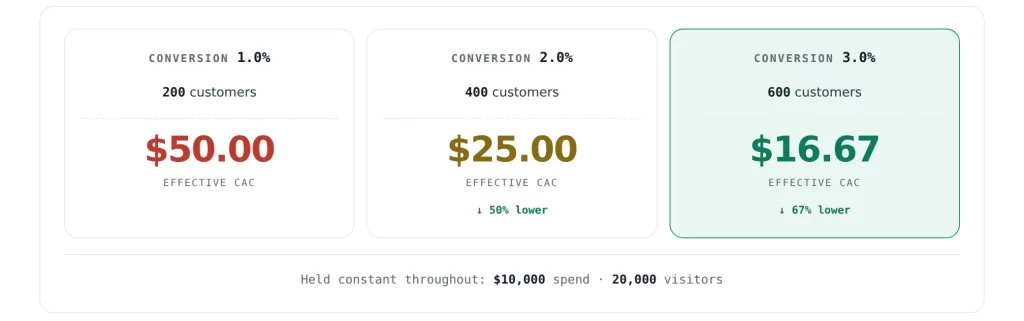
This is arithmetic rather than a projection. Nothing here depends on a benchmark being current: at fixed spend and fixed traffic, CAC moves inversely with conversion rate, always.
You did not find a cheaper channel or a better audience. You stopped losing half the customers your budget had already paid to reach. For a brand with meaningful paid traffic, a conversion improvement is often worth more than an equivalent effort chasing lower ad costs, and unlike the auction, it is fully within your control.
Why is CRO cheaper than lowering ad costs?
Because ad costs are set by the market, while your conversion rate is set by your store. You control one far more than the other.
Platform costs keep rising and every brand bids against the same competition. Your funnel, by contrast, is entirely yours: product page, cart, checkout, mobile experience. Fixing a checkout that loses most of its carts does not require winning an auction against a better-funded competitor, it requires removing friction, which is solvable and repeatable. And a conversion improvement keeps paying out on every future visitor from every channel, indefinitely, while an ad-cost win lasts only until the market moves.
What is a good LTV:CAC ratio for a DTC brand?
Lower than the number you have probably been quoted. For DTC ecommerce, 1.5:1 to 3:1 is the healthy band. The famous 3:1 rule came from SaaS and does not transfer cleanly.
- LTV:CAC health bands, DTC ecommerce
under 1:1
1.5
1.5:1 to 3:1
Above 3:1
Under 1:1
Underwater. Each customer costs more than they are worth.
1:1 to 1.5:1
Thin. Covering acquisition, no room for overhead or error.
1.5:1 to 3:1
Healthy for DTC ecommerce, where margins are lower than SaaS.
Above 3:1
Strong, but sustained 5:1+ usually signals under-investment in growth.
Bands from Foundry CRO’s 2026 benchmarks. DTC subscription businesses sit higher at around 4.1:1, and B2B SaaS at a 3.2:1 median, which is why borrowing a SaaS number for a transactional DTC brand misleads.
The 3:1 rule originated with SaaS investor David Skok at Matrix Partners around 2010, describing mature subscription businesses with contractually defined lifetimes and 75% to 90% gross margins. DTC has neither: revenue is transactional and decays, and gross margin typically runs 45% to 70%. Applying SaaS’s threshold to a DTC brand sets a bar most healthy stores will fail. We break this down in what is a good LTV:CAC ratio for ecommerce.
CRO improves this ratio from the CAC side, which is the faster side to move. Lifetime value takes quarters of retention work to shift. Effective CAC responds to a checkout fix within a single test cycle, and the ratio rises without lifetime value changing at all.
Where do the biggest CAC reductions come from?
From the funnel’s worst leak, which for most DTC stores is mobile checkout, because that is where paid traffic is lost in the largest volume.
- Where the money is, against where it converts
Mobile 63.5%
Desktop 35%
1.4
Mobile
1.2%
converts 37% below desktop
Desktop
1.9%
converts better, sells less
Share of sales by device from IRP Commerce, June 2026, UK and Ireland. Conversion rates from Littledata’s Shopify benchmark, session-based. The device producing most of the revenue is also the one converting worst, which is what makes mobile checkout the highest-value fix on most stores.
Because most paid traffic lands on mobile, a leaky mobile checkout quietly inflates the CAC on your most expensive channel. After that, the usual targets are surprise costs at the final step, forced account creation, slow load, and weak product pages. The order to fix them is not guessed, it is diagnosed, which is what a CRO audit is for.
Should I improve conversion or lower ad spend first?
Improve conversion first, in most cases. It is within your control, it compounds, and it makes any later ad-side work more efficient.
Cutting ad spend without fixing conversion just means fewer customers at the same bad rate. Improving conversion first means that when you scale spend back up, every dollar works harder. A brand that fixes its funnel and then optimises ads beats one that optimises ads into a leaky funnel. Full breakdown in how improving conversion rate reduces CAC.
We treat rising CAC as a conversion problem first.
Rather than starting with your ad accounts, we start with your funnel: where does the traffic you already pay for leak, and which leak costs the most? We fix that first, then measure the effect on effective CAC directly.
On one engagement, rebuilding the buying path lifted a client’s conversion rate by 6% and revenue per visitor by 7%, both A/B tested at 95% confidence. At constant ad spend, that conversion lift is a direct, measurable reduction in effective CAC.
Frequently asked questions
Can CRO really lower my customer acquisition cost?
Yes, directly. Effective CAC is ad spend divided by customers acquired, so improving conversion produces more customers from the same spend and lowers the cost of each. At fixed spend, doubling conversion halves CAC. This is arithmetic, not an estimate.
Is it cheaper to improve conversion or reduce ad spend?
Usually to improve conversion. Ad costs are set by the market and keep rising; your conversion rate is set by your store. A conversion win also compounds on every future visitor from every channel, while an ad-cost win lasts only until the auction moves.
What is a good LTV:CAC ratio for DTC?
For DTC ecommerce, 1.5:1 to 3:1 is the healthy band on 2026 benchmarks, because margins are lower than SaaS. DTC subscription brands sit nearer 4.1:1. The widely quoted 3:1 came from SaaS and sets an unrealistic bar for transactional DTC. Below 1:1 you are underwater; sustained above 5:1 usually means you are under-investing in growth.
What is the difference between blended and paid CAC?
Blended divides all acquisition spend by all new customers, including organic ones that cost nothing. Paid divides paid spend by the customers paid channels produced. In 2026 paid runs roughly 2.4x to 3.1x higher than blended, so quoting one and acting on the other is a common and expensive error.
Where does CRO cut CAC the most?
Usually mobile checkout. Mobile produced 63.5% of ecommerce sales in June 2026 but converts around 37% below desktop, so it is where paid traffic is lost in the greatest volume. Fixing the biggest leak recovers customers you have already paid to acquire.
How much can CRO reduce CAC?
It scales with the conversion improvement. Because CAC moves inversely with conversion at fixed spend, a 50% lift in conversion cuts CAC by about a third, and doubling conversion halves it.
Keep reading
Sources
LTV:CAC, 2026: DTC ecommerce 1.5:1 to 3:1; DTC subscription 4.1:1; B2B SaaS 3.2:1 median; below 1:1 underwater — Foundry CRO. Margin comparison — Eightx.
DTC CAC: blended ~$68 to $84, up 40% to 60% (2023 to 2025); paid runs 2.4x to 3.1x blended — Talk Shop, 2026.
Device conversion: mobile ~1.2% vs desktop ~1.9%, session-to-order, 2,800 Shopify sites studied 2023 — Littledata. Device share of sales: mobile 63.5% — IRP Commerce, June 2026, UK and Ireland.
Fracto engagement: +6% conversion rate, +7% revenue per visitor, A/B tested at 95% confidence.