Paid ads / DTC
Ad Creative Fatigue: How to Know When It's Hurting Your Results
// when your best ad quietly stops working

By Fracto Solutions
September 8, 2026
The short answer
Ad creative fatigue is when your audience has seen an ad so often that it stops working, and your costs quietly climb. The signs: rising frequency, falling click-through rate, increasing cost per click and per acquisition, and dropping engagement. Catch it early and refresh creative before it drains budget.
Ad creative fatigue is when your audience has seen an ad so often that it stops working, and your costs quietly climb. The signs: rising frequency, falling click-through rate, increasing cost per click and per acquisition, and dropping engagement. Catch it early and refresh creative before it drains budget.
Creative fatigue is one of the sneakiest drivers of rising CAC, because it happens gradually and without an obvious cause. One week your ads perform; a few weeks later the same ads cost more and deliver less, and it’s easy to blame the algorithm. This guide covers how to spot fatigue early and what to do about it. It’s the diagnostic companion to how to lower ecommerce CAC.
What is ad creative fatigue?
It’s the decline in an ad’s performance that happens when the same audience sees it too many times. The creative hasn’t changed, but its effectiveness has, and your costs rise as a result.
Audiences habituate. The first time someone sees your ad it’s novel and may stop the scroll; the tenth time, it’s wallpaper. As engagement drops, ad platforms respond by charging more to deliver the ad and showing it less favorably, so a fatigued ad quietly gets more expensive per result. Because the decline is gradual and the ad itself looks fine, fatigue often goes unnoticed until CAC has crept up meaningfully. Recognizing it early is what separates brands that manage it from brands that just watch costs rise.
What are the signs of creative fatigue?
Watch four signals together: rising frequency, falling click-through rate, climbing cost per click and per acquisition, and dropping engagement. When they move together, fatigue is the likely cause.
No single metric proves fatigue, but when frequency is up while CTR is down and costs are rising, that pattern together is the tell.
- Signs of creative fatigue
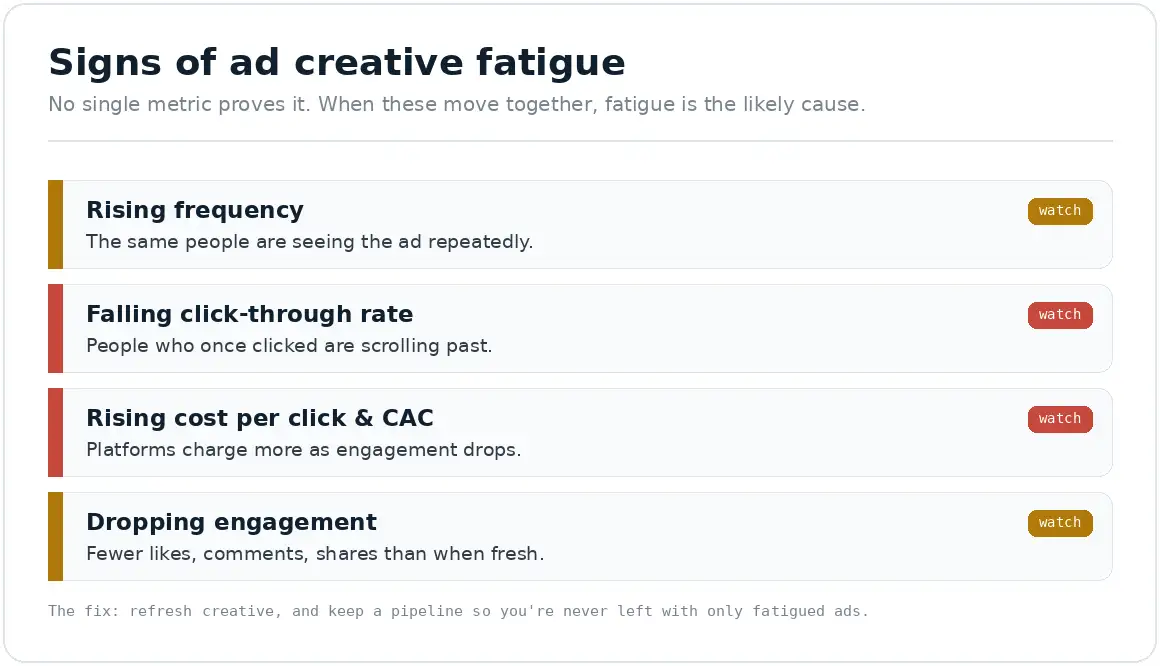
No single metric proves it. When these move together, fatigue is the likely cause.
How high can frequency go before it's a problem?
There’s no universal number, it depends on your audience size, campaign type, and creative. The reliable approach is to watch frequency alongside performance, not chase a fixed threshold.
It’s tempting to want a magic frequency cap, but the honest answer is that it varies too much to state one. A small audience fatigues faster (the same people see the ad sooner); a large one takes longer. A prospecting campaign tolerates different frequency than retargeting. Rather than fixating on a number, watch frequency in context: when it’s climbing and CTR is falling and costs are rising at the same time, that’s your signal regardless of the exact figure. Trust the pattern across metrics over any single benchmark, which is the same discipline that keeps you from acting on a misleading stat.
What fatigue costs you, holding everything else constant
Stage
Impressions
ctr
Clicks
Ad spend
Cost per click
Customers at 2% CVR
Effective CAC
Creative is fresh
500,000
1.2%
6,000
$10,000
$1.67
120
$83.33
CTR down a third
500,000
0.8
4,000
$10,000
$2.50
80
$125.00
CTR halved
500,000
0.6%
3,000
$10,000
$3.33
60
$166.67
This is arithmetic, not a benchmark. Spend, impressions, and conversion rate are all held constant, so the only thing changing is how many people click. The figures are illustrative and rounded; substitute your own to see the effect on your account. Two things are worth noticing. First, the product, the offer, the landing page and the budget are identical in all three rows, yet cost per customer doubles. Second, a brand watching only total spend sees nothing wrong, because spend never moved. That is why fatigue has to be caught on the leading indicators rather than on the monthly total. In practice the real cost rises faster than this table shows, because platforms also tend to charge more to distribute creative that people are not engaging with.
How do I fix creative fatigue?
Refresh the creative. Introduce new variations, angles, formats, or messages so your audience sees something new, and build a pipeline so you’re never caught with only fatigued ads running.
The direct fix is new creative, but “new” doesn’t always mean starting from scratch. Options, roughly in order of effort: change the format (video vs static, new hook), try a different angle or message on the same product, refresh the visuals, or rotate in genuinely new concepts. The strategic fix is a creative pipeline: continuously producing and testing new creative so there’s always fresh material ready before the current set fatigues. Brands that treat creative as an ongoing process, not a one-time asset, keep their CAC lower because they never let fatigue fully set in.
Does creative fatigue affect CAC directly?
Yes. As fatigued creative earns fewer clicks and less engagement, platforms charge more per result, so your cost per acquisition rises even though nothing about your product or offer changed.
This is why fatigue belongs in any serious conversation about CAC. It’s a cost increase that comes entirely from the ad side and creeps in silently. A brand watching only its total spend might not notice that the same budget is buying fewer customers because the creative went stale. Catching fatigue early and refreshing keeps ad efficiency, and therefore CAC, under control. It pairs with the other CAC levers: even perfect creative can’t rescue a funnel that wastes the clicks, which is why conversion work sits alongside creative work in how to lower ecommerce CAC.
Email and lifecycle sits alongside our conversion optimization work, and we treat it the way we treat everything: find where value is leaking (usually missing or thin flows), build the highest-impact ones first, and judge them on revenue per recipient and repeat-purchase rate rather than open rates alone. A beautiful email that doesn’t sell is a vanity metric.
We find where value leaks, fix the highest-impact issue first, and prove the gain in your own numbers.
It’s the same baseline-first, prove-it-in-the-numbers discipline behind our conversion work: fix the biggest leak first, then prove the gain in the client’s own reporting rather than in a platform dashboard.
Frequently asked questions
How do I know if it's creative fatigue or something else?
Look for the pattern: rising frequency plus falling CTR plus rising costs on the same creative, over time. If a fresh creative in the same account performs well while the old one declines, that strongly points to fatigue rather than a market or targeting issue.
How often should I refresh ad creative?
It depends on audience size and spend, larger audiences and lower spend fatigue slower. Rather than a fixed schedule, watch your fatigue signals and refresh when they appear, while maintaining a pipeline so new creative is always ready.
Does a higher frequency always mean fatigue?
Not always, some audiences tolerate higher frequency than others. Frequency matters in context: it’s a concern when it rises alongside falling CTR and rising costs. On its own, a higher number isn’t automatically a problem.
Can creative fatigue be prevented?
Only once your email flows are earning. SMS costs more per message and carries stricter consent rules, so it works best as an accelerant on your highest-intent moments rather than as a parallel channel from day one.
Does lifecycle marketing actually lower acquisition cost?
You can’t stop audiences from habituating, but you can prevent it from hurting you by maintaining a steady pipeline of fresh creative and rotating it in before the current set declines. Prevention is cheaper than recovering a fatigued account.
Keep reading
Sources
Creative fatigue mechanics (habituation, platform response to declining engagement, rising cost per result) reflect established paid-social advertising practice. No proprietary statistics are cited; frequency thresholds deliberately not stated as universal because they vary by audience and campaign.