SMS / Lifecycle
SMS vs Email Marketing for Ecommerce: Which and When
// different tools for different jobs

By Fracto Solutions
October 2, 2026
The short answer
SMS vs email isn’t an either/or choice. SMS is immediate, personal, and near-universally opened, best for time-sensitive, high-intent moments; email is cheaper, richer, and better for detailed or frequent content. The strongest ecommerce programs use both together, SMS for urgency, email for depth, coordinated so they complement rather than fatigue.
~97% vs ~30%
Both
How do SMS and email actually differ?
SMS is immediate, personal, short, and near-universally opened, but limited in format and cost per message, and tightly regulated. Email is cheaper, richer in content, and better for detail and frequency, though it competes for attention in a crowded inbox. They’re suited to different jobs.
The core differences shape when each works:
Dimension
SMS
Reach
Delivery ~97%+ if 10DLC registered (~92% if not). Opens are not measurable
Open rate roughly 20 to 40%, inflated by Apple MPP
Speed
Read within minutes
Read over hours or days
Format
Short text (~160 chars), limited media
Rich: images, long copy, layout
Cost
Higher per message
Very low per message
Regulation
Heavy (TCPA, consent, 10DLC)
Lighter (still needs consent)
Best for
Urgent, high-intent, brief
Detailed, frequent, storytelling
Directional comparison. Email open rates vary and are inflated by Apple Mail Privacy Protection. SMS has no equivalent metric at all, since there is no read receipt, so the SMS column shows delivery rather than opens. The two are not measuring the same thing and should not be read as a like-for-like gap.
Neither is “better”, they’re different tools. SMS buys immediacy and near-certain reads at higher cost and stricter rules; email buys reach, richness, and frequency at very low cost but far lower attention. The skill is matching each to the job it does best.
When should I use SMS over email?
Use SMS for time-sensitive, high-intent, brief messages where immediacy wins: cart recovery, back-in-stock alerts, flash-sale reminders, and shipping updates. Its near-instant read rate is worth the higher cost and stricter rules when timing genuinely matters.
SMS earns its higher cost and compliance burden in moments where speed changes the outcome. The clearest cases: – Abandoned cart: reaching a shopper within minutes, while intent is fresh, recovers more than an email that’s read hours later (covered in abandoned cart SMS). – Back-in-stock: the wanted item is available now and may sell out, immediacy is everything. – Flash sales and time-limited offers: a text creates urgency an email can miss. – Shipping and order updates: transactional texts customers actually want, delivered instantly.
The common thread is urgency plus brevity: the message is short, and being read now (not later) matters. When those two conditions hold, SMS is the right channel. When they don’t, email usually is.
When should I use email over SMS?
Use email for detailed, frequent, or lower-urgency content: newsletters, product education, longer promotions, storytelling, and anything needing images or layout. Email’s low cost and rich format make it the workhorse for the bulk of your lifecycle communication.
Email is the default for most of what you send, because most communication isn’t urgent and benefits from richness. Use email for: – Newsletters and content: education, brand storytelling, longer-form value. – Detailed promotions: multiple products, imagery, layout SMS can’t do. – Regular nurture: email’s low cost supports the frequency that would be intrusive (and expensive) by text. – Anything visual: lookbooks, product showcases, rich post-purchase sequences.
Because email is cheap and information-rich, it carries the depth and volume of your lifecycle program, while SMS handles the sharp, urgent moments. Trying to force detailed content into SMS wastes the channel and annoys subscribers; trying to make email do urgent, must-read-now jobs underperforms. Match the channel to the content.
How do I use SMS and email together?
Coordinate them: use email for depth and routine nurture, SMS for the urgent high-intent moments, and make sure the two channels share context so a customer isn’t hit by both for the same thing. Combined and coordinated, they lift total revenue more than either alone.
The best programs treat SMS and email as one coordinated system, not two silos. Practical coordination: – Divide by job: email carries the regular nurture and detailed content; SMS handles urgent, time-sensitive triggers. – Layer within flows: in a cart-recovery sequence, for example, a fast SMS can lead and email can follow with more detail, or vice versa, without both firing identically at once. – Respect total frequency: count SMS and email together so the customer isn’t overwhelmed; suppress one channel when the other has just handled a message. – Share data: use the same segmentation and engagement signals across both, so targeting is consistent.
Done well, the channels reinforce each other, SMS’s urgency plus email’s depth, and lift total lifecycle revenue beyond what either achieves alone. This coordination is central to a mature lifecycle program.
- SMS vs email
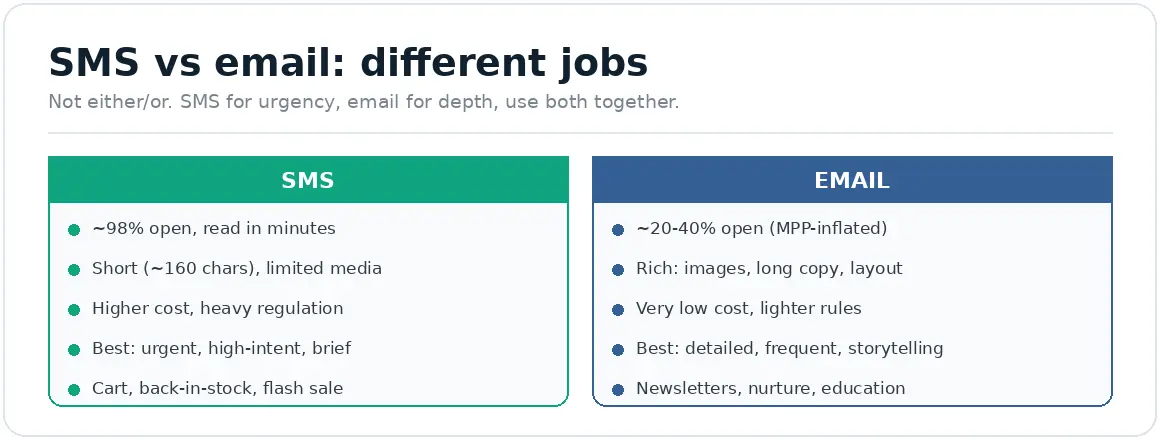
Not either/or. SMS for urgency, email for depth.
Which should I start with?
Most stores should start with email (lower cost, lighter regulation, richer content) and add SMS once the email program is solid, layering SMS onto the highest-intent moments first. Email is the foundation; SMS is the high-impact addition.
For a store building its lifecycle program, the sensible sequence is email first, then SMS. Email is cheaper, less regulated, and does more jobs, so it’s the foundation that carries most of your communication, and it’s where most stores have the biggest untapped opportunity (the flows in email and lifecycle marketing). Once email is working, add SMS to the moments where immediacy pays most: abandoned cart and back-in-stock first, then expand. This order builds the cheaper, broader channel first and layers the powerful-but-costly-and-regulated channel on top where it adds the most. Starting with SMS alone is rarely right; starting with email and adding SMS deliberately is. One more practical reason email comes first: SMS carries real cost and compliance overhead per message, so it rewards a store that already knows its highest-intent moments (from a working email program) and can point SMS precisely at them. Build the cheap, forgiving channel first, learn where urgency lives, then spend the expensive, regulated channel exactly there.
We run SMS and email as one coordinated system, matched to the job each does best.
We use email for depth and routine nurture, SMS for the urgent high-intent moments, and coordinate total frequency so a customer isn’t hit by both for the same thing, which lifts total revenue more than either channel alone.
It’s part of our email and lifecycle work, feeding the conversion optimization that turns the clicks into sales.
// we would rather show up in your reporting than in your inbox
Frequently asked questions
Is SMS or email better for ecommerce?
Neither, they do different jobs. SMS is immediate and near-universally opened, best for urgent, high-intent, brief messages. Email is cheaper and richer, best for detailed and frequent content. The strongest programs use both together: SMS for urgency, email for depth, coordinated so they complement each other.
When should I use SMS instead of email?
For time-sensitive, high-intent, brief messages where being read within minutes matters: abandoned cart recovery, back-in-stock alerts, flash-sale reminders, and shipping updates. SMS’s near-instant read rate justifies its higher cost and stricter rules when timing genuinely changes the outcome.
Should I use both SMS and email?
Yes, ideally. They complement each other: email carries depth and routine nurture, SMS handles urgent moments. Coordinate them so a customer isn’t hit by both for the same thing, and count total frequency across channels. Combined and coordinated, they lift revenue more than either alone.
Which should I set up first, SMS or email?
Usually email, it’s cheaper, less regulated, richer, and does more jobs, so it’s the foundation. Add SMS once email is solid, starting with the highest-intent moments (abandoned cart, back-in-stock). Building email first and layering SMS on deliberately beats starting with SMS alone.
Sources
We removed the “98% SMS open rate” comparison that appeared in an earlier draft. SMS has no tracking pixel and no read receipt, so an open rate cannot be measured at all; the 98% figure is a delivery estimate that vendors relabel as opens, and it dates from the early 2000s. What is measurable is delivery: registered 10DLC traffic lands above 97%, unregistered closer to 92%. Comparing an unmeasurable SMS number against an MPP-inflated email number would have been doubly misleading. Note that RCS, now on roughly 54% of US smartphones including iPhones, does carry real read receipts, so this will become measurable. SMS suited to urgent/brief, email to detailed/frequent; channels complement each other: consistent across 2026 SMS and email sources. https://www.omnisend.com/blog/sms-marketing-best-practices/ ; https://messageiq.io/blogs/sms-marketing-in-ecommerce/
Email open-rate context (inflated by Apple Mail Privacy Protection): see the email benchmarks pillar and its sources.