Email / Lifecycle
Email and Lifecycle Marketing for DTC Brands
// the profit is in the second purchase

By Fracto Solutions
September 5, 2026
The short answer
Email and lifecycle marketing is the system of automated messages that moves a DTC customer from first visit to repeat buyer: welcome, abandoned cart, post-purchase, and winback flows. It’s where much of a brand’s profit lives, because selling again to an existing customer costs far less than acquiring a new one, which is what lifts lifetime value.
Email and lifecycle marketing is the system of automated messages that moves a DTC customer from first visit to repeat buyer: welcome, abandoned cart, post-purchase, and winback flows. It’s where much of a brand’s profit lives, because selling again to an existing customer costs far less than acquiring a new one, which is what lifts lifetime value.
Most DTC brands pour money into acquiring customers, then let them drift away after one order. That’s the expensive mistake lifecycle marketing fixes. The math is simple: acquisition is where you spend, retention is where you profit. This guide covers the email and lifecycle system that turns first-time buyers into repeat revenue, the core automated flows, when they fire, and why this work quietly improves your unit economics. It links out to deeper guides on the highest-value flows.
What is lifecycle marketing?
Lifecycle marketing is sending the right message at each stage of a customer’s relationship with your brand, mostly through automated email and SMS flows, to move them from first visit toward repeat purchase and loyalty.
The word “lifecycle” is the key. Instead of blasting the same promotion to everyone, you map the stages a customer moves through, discovering you, first purchase, post-purchase, becoming a repeat buyer, lapsing, and send messages matched to each. Most of this runs on automated flows (also called automations or journeys) that trigger on behavior: someone joins your list, abandons a cart, or makes a purchase. Campaigns (one-off sends like a sale announcement) sit on top, but the flows are the engine, they run continuously without manual work once built.
Why does email and lifecycle marketing matter for DTC?
Because it’s where the profit is. Acquiring a customer is expensive and getting more so; selling again to someone who already bought is far cheaper, and lifecycle marketing is how you do that at scale.
DTC economics have shifted. Paid acquisition has become materially more expensive since 2023 as ad auctions crowded and targeting signal degraded, so relying on constantly buying new customers is increasingly hard to sustain. The brands that stay profitable are the ones that maximize the value of each customer they’ve already paid to acquire. That’s exactly what lifecycle marketing does: it drives repeat purchases, which lifts lifetime value (LTV), which improves your LTV:CAC ratio without spending a dollar more on ads. We cover that ratio in depth in what is a good LTV:CAC ratio for ecommerce.
What are the core email flows every DTC brand needs?
Four carry most of the value: welcome, abandoned cart, post-purchase, and winback. Each targets a specific, high-intent moment in the customer relationship.
Flow
Triggers when
Job
Welcome
Someone joins your list
Convert a subscriber into a first-time buyer
Abandoned cart / checkout
A shopper leaves without buying
Recover a sale the shopper nearly made
Post-purchase
After an order is placed
Build loyalty and set up the second purchase
Winback
A customer lapses
Re-engage someone who stopped buying
These aren’t the only flows (browse abandonment, back-in-stock, and replenishment also earn their place), but these four are the foundation. Build them first, in roughly this order of value, before adding more. Two of them get their own deep-dives: abandoned cart email flows and the post-purchase sequence.
- The core DTC email flows
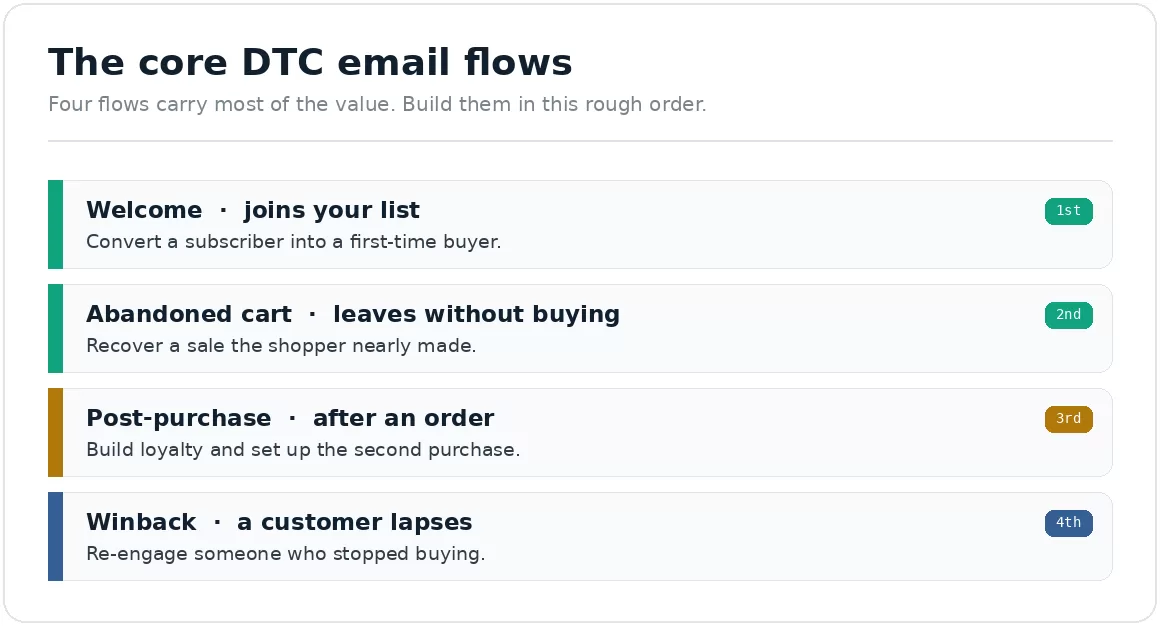
Four flows carry most of the value. Build them in roughly this order.
How well do abandoned cart emails actually work?
Well, because the shopper already showed intent. On Klaviyo’s public benchmark data, abandoned cart flows average around a 50% open rate and roughly $3.65 revenue per recipient, far above standard promotional emails.
These are among the highest-performing emails a store sends, for one reason: the person already added something to their cart, so you’re reminding an interested buyer, not cold-pitching a stranger. Per Klaviyo’s benchmark dataset, abandoned cart flows average about a 50.5% open rate and about $3.65 revenue per recipient, with top performers well above that. A note on honesty: exact figures vary a lot by source and by how “recovery rate” is defined (published averages range widely), so treat any single number as directional and measure your own. The reliable, cross-source finding is that these emails consistently outperform regular campaigns because of that built-in intent. Full detail in the abandoned cart flows guide.
When should each email actually send?
Timing follows intent. The higher the intent and the fresher the moment, the sooner you send. Abandoned cart emails go out within about an hour; post-purchase begins right after the order.
A few timing principles that hold across sources:
Abandoned cart: the first email within about an hour of abandonment captures a large share of recoveries, while the shopper still remembers. Follow-ups over the next few days catch the rest.
Welcome: send immediately, the moment someone subscribes is when their interest is highest.
Post-purchase: begin right after the order (confirmation, then what-to-expect and how-to-use messages) while excitement is high.
Winback: after a customer has gone quiet for longer than their normal purchase cycle, which differs by product.
The pattern is consistent: match the send to the moment of intent, and use sequences rather than single emails, because multi-message flows consistently recover more than one-shot reminders.
Should DTC brands use email, SMS, or both?
Both, used for what each does best. Email carries richer content and costs little; SMS is immediate and high-open, which suits time-sensitive nudges. The strongest programs combine them.
The practical approach is to start with email flows, lower cost, richer format, doing most of the lifecycle heavy lifting, then layer SMS onto the highest-intent moments where immediacy matters, like a cart-abandonment nudge or a back-in-stock alert. SMS is more intrusive and more expensive per message, so it earns its place on urgency, not volume. Over-using SMS drives unsubscribes, so treat it as a scalpel, not a megaphone.
The sequencing matters more than the channel choice. Email carries almost no marginal cost per send, tolerates long messages, and is where the bulk of lifecycle revenue is earned. SMS costs real money per message, has a hard character limit, and sits in the same inbox as a shopper’s family, so the tolerance for a badly timed send is far lower. That asymmetry is the argument for building email first and adding SMS to the two or three moments where immediacy genuinely changes the outcome: a cart about to expire, a back-in-stock alert, a delivery exception.
Consent is the other reason not to treat them as one channel. SMS consent rules are stricter and the penalties for getting them wrong are real, so an SMS list is smaller and harder-won than an email list. Grow it deliberately rather than bolting a phone field onto every form.
How does lifecycle marketing lower CAC?
Indirectly but powerfully: by raising lifetime value. Because your LTV:CAC ratio is lifetime value divided by acquisition cost, increasing repeat purchases lifts the ratio without changing what you spend to acquire.
This is the connection most brands miss. Lifecycle marketing doesn’t lower the cost of acquiring a customer directly, conversion optimization does that (see how CRO lowers CAC). What it does is make each acquired customer worth more, by turning one purchase into several. A higher LTV means you can afford more to acquire customers and still stay profitable, or keep spend flat and widen your margin. Acquisition and retention are the two levers on unit economics; the strongest DTC brands work both. Where to balance spend between them is its own decision, covered in acquisition vs retention spend.
We find where value leaks, fix the highest-impact issue first, and prove the gain in your own numbers.
Email and lifecycle sits alongside our conversion optimization work, and we treat it the way we treat everything: find where value is leaking (usually missing or thin flows), build the highest-impact ones first, and judge them on revenue per recipient and repeat-purchase rate rather than open rates alone. A beautiful email that doesn’t sell is a vanity metric.
It’s the same baseline-first, prove-it-in-the-numbers discipline behind our conversion work: fix the biggest leak first, then prove the gain in the client’s own reporting rather than in a platform dashboard.
Frequently asked questions
Which email flow should I build first?
The abandoned cart flow. It reaches people who already chose a product and stopped one step short, which is why it earns the highest revenue per recipient of any common flow in Klaviyo’s benchmark data. Build it before welcome, browse abandonment, or winback.
How many emails should a lifecycle programme have?
Fewer, better-timed ones beat a long calendar. Most DTC brands are covered by four core flows: welcome, abandoned cart, post-purchase, and winback. Add browse abandonment and back-in-stock once those are earning.
Is email still worth it when open rates are unreliable?
Open rate has been distorted by privacy features, so judge flows on revenue per recipient and placed-order rate instead. Those metrics are unaffected and they answer the question you actually care about.
Should I send SMS as well as email?
Only once your email flows are earning. SMS costs more per message and carries stricter consent rules, so it works best as an accelerant on your highest-intent moments rather than as a parallel channel from day one.
Does lifecycle marketing actually lower acquisition cost?
Indirectly, and meaningfully. It does not reduce what you pay for a click. It raises what each acquired customer is worth, which is the side of the ratio you have more control over when ad costs are rising.
Keep reading
Guide
Best abandoned cart email flows for Shopify stores
Guide
How to build a post-purchase email sequence
Sources
Klaviyo abandoned cart flow benchmarks (public dataset): average open rate ~50.5%, revenue per recipient ~$3.65; top performers reach ~65.3% open and ~$28.89 revenue per recipient. Source: Klaviyo, “The abandoned cart benchmarks report”, analysing 2023 performance data across more than 143,000 abandoned cart flows, published 2024. Exact recovery figures vary by source and definition.
Rising paid acquisition cost is described directionally only. We removed the percentage figure that appeared in an earlier draft because we could not trace it to a primary study.
Baymard Institute, cart abandonment context (~70% average). https://baymard.com/lists/cart-abandonment-rate