SMS / Lifecycle
SMS Marketing for Ecommerce: How to Do It Right (and Legally)
// the most direct channel there is, and the most regulated

By Fracto Solutions
October 1, 2026
The short answer
SMS marketing for ecommerce sends promotional and transactional texts to subscribers who have opted in. It earns near-98 percent open rates because texts get read, but it’s heavily regulated: you need express written consent (TCPA), brand registration (A2P 10DLC), an opt-out in every message, and sending only during permitted hours. Done right and legally, it’s a powerful revenue channel.
~98%
Consent
8-9
Why does SMS work so well for ecommerce?
Because texts get read, almost immediately. SMS open rates sit near 98 percent, far above email, and most messages are read within minutes. For time-sensitive, high-intent moments (a cart abandoned, a product back in stock, a flash sale), that immediacy converts.
SMS’s power comes from its intimacy and immediacy. A text arrives directly on the phone and, unlike email, almost always gets opened, near 98 percent open rates is the consistently cited figure, and usually within minutes. That makes it uniquely suited to time-sensitive messages where speed matters: recovering a cart while the shopper still has intent, alerting a back-in-stock item before it sells out, or driving a limited-time sale. The trade-off for that direct access is that shoppers guard it closely, so SMS must be permission-based, relevant, and used sparingly, or people opt out fast. Used well, it’s a high-revenue channel; used carelessly, it burns the list and risks compliance penalties. The whole discipline is earning and respecting that access.
What are the SMS compliance rules I must follow?
The core rules: get prior express written consent before texting (no pre-checked boxes), register your brand via A2P 10DLC, include an opt-out (like “Reply STOP”) in messages and honor it immediately, and only send during permitted hours (8 AM to 9 PM in the recipient’s time zone under federal rules, with Florida, Oklahoma and Washington stricter at 8 PM). Since 11 April 2025 the FCC requires opt-outs made by any reasonable method, not only a STOP keyword, to be honoured within 10 business days across every channel, so an opt-out arriving by email, phone, website form or a reply on social counts and must be actioned. A store that only processes STOP replies is non-compliant today. Keep consent records.
Compliance is non-negotiable in SMS, TCPA violations can be costly, so this comes before tactics. The essential rules, consistent across sources (and, again, this is practical guidance, not legal advice):
Requirement
What it means
Express written consent
Subscribers must actively opt in; pre-checked boxes don't count. Disclose message type and frequency
A2P 10DLC registration
Register your brand and campaign so carriers recognize your texts as legitimate
Opt-out in messages
Include "Reply STOP to unsubscribe", and honour opt-outs arriving by any reasonable method within 10 business days (FCC, April 2025)
Quiet hours
Send only during permitted hours: 8 AM to 9 PM in the recipient's local time (8 PM in FL, OK, WA) in the recipient's local time
Recordkeeping
Keep proof of consent (source, timestamp); TCPA guidance suggests retaining records for years
International (GDPR/CASL)
Selling abroad adds consent rules; get express consent and honor regional law
Compliance framework consistent across 2026 SMS sources. Rules change and vary by region; confirm current requirements for your markets, and treat this as guidance, not legal advice.
Get consent and registration right first. Everything else in SMS only matters if you’re allowed to send in the first place.
- SMS compliance essentials
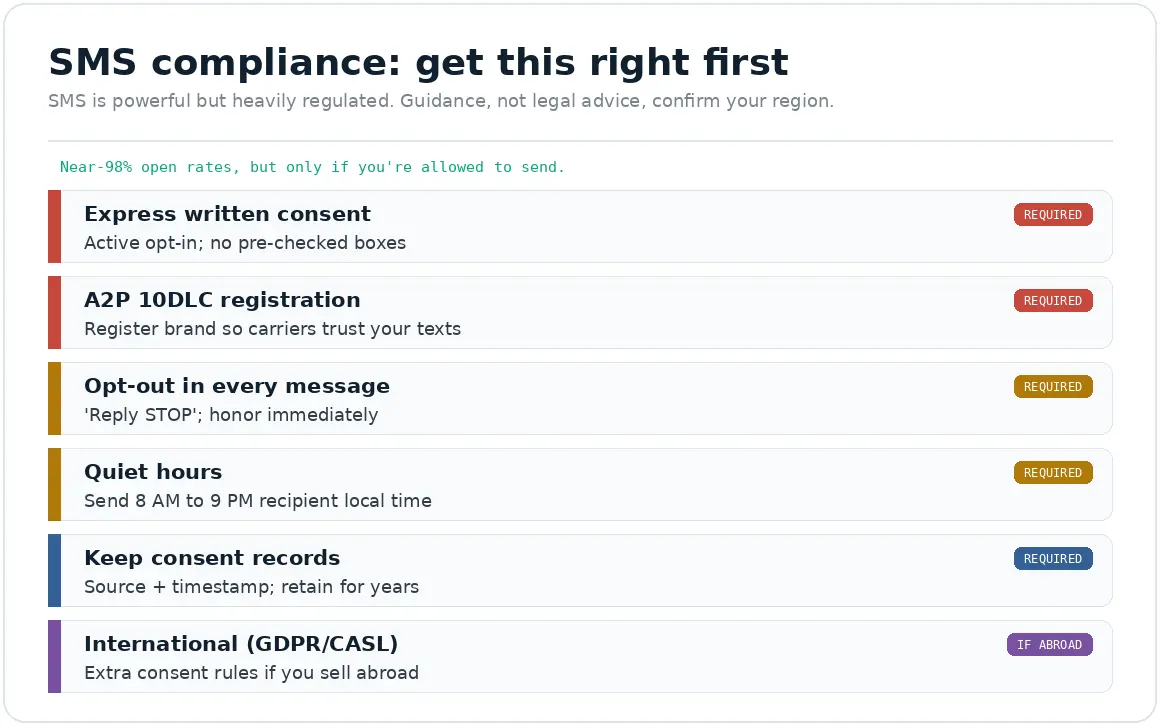
SMS is powerful but heavily regulated. Get consent and registration right first.
How do I grow an SMS list the right way?
With first-party, consented opt-ins: a dedicated (unchecked) SMS checkbox at checkout, website popups offering a clear incentive, and cross-promotion from your email list, always with proper disclosure. Never buy lists or use shared/co-registered consent, both violate the rules.
List growth in SMS is about quality and consent, not size. The compliant, effective methods: – Checkout opt-in: a separate, optional, unchecked SMS checkbox at checkout converts well (often 10 to 25 percent of customers) because they’re already engaged. – Website popups: offer a clear incentive (a discount, early access) with full disclosure language, typically converting a few percent of visitors. – Email-to-SMS: invite your engaged email subscribers to opt into texts for exclusive perks. – Loyalty, QR codes, in-store: additional first-party sources.
Two hard rules: keep SMS consent separate from email consent (a single checkbox for both isn’t valid), and never buy lists or rely on co-registered/shared consent, which the one-to-one consent rule prohibits. A smaller, genuinely opted-in list outperforms and protects you legally; the goal is engaged subscribers who want your texts.
Which SMS flows actually drive revenue?
The same high-intent automated flows that work in email, but with SMS immediacy: welcome, abandoned cart, back-in-stock, post-purchase (shipping updates), and win-back. Cart recovery and back-in-stock are especially strong because SMS reaches the shopper fast, while intent is high.
As with email, automated flows, not blasts, are where SMS revenue concentrates, because they hit the right moment. The highest-value SMS flows: – Welcome: confirm the opt-in and deliver the promised incentive immediately. – Abandoned cart: SMS’s speed makes this a standout; a timely text recovers carts while intent is fresh (covered in abandoned cart SMS). – Back-in-stock: texting the moment a wanted item returns captures urgent intent SMS is perfect for. – Post-purchase / shipping updates: transactional texts customers actually welcome, which also build goodwill for promotional messages. – Win-back: re-engage lapsed customers with a timely, relevant offer.
Omnisend data indicates SMS automations earn far more per send than campaigns (a common finding across channels: triggered beats broadcast). So build the flows first, and use broadcast campaigns sparingly for genuine, timely offers. This mirrors the flows-beat-campaigns pattern from ecommerce email marketing benchmarks.
What does a good SMS message look like?
Short, clear, and compliant: identify your brand, give one clear offer and call to action with a link, and include the opt-out, ideally under about 160 characters. Respect frequency (commonly 4 to 8 messages a month for ecommerce) so people stay subscribed.
Good SMS copy is disciplined because the format is tiny and the access is precious. The reliable formula: brand identifier, a single clear offer, a call to action with a (non-spammy) link, and the opt-out, aiming for roughly 160 characters or fewer so it sends as one message and reads fast. Avoid free URL shorteners (like generic bit.ly links) that carriers associate with spam; use your platform’s tracked links instead. On frequency, most guidance lands around 4 to 8 messages a month for ecommerce, more during major sale periods, while watching your opt-out rate (keep it low, commonly cited under about 2 to 3 percent per send). Over-texting is the fastest way to drive opt-outs and complaints, which hurt both revenue and your carrier standing. Relevance plus restraint keeps the list healthy.
How do I measure SMS performance?
Track click rate, conversion (order) rate, revenue per recipient, opt-out rate, and delivery rate, not just the near-98 percent open rate, which is a channel norm rather than a differentiator. Watch opt-out and delivery closely, because they signal list health and compliance problems early.
Because nearly every SMS is opened, open rate isn’t a useful differentiator; the metrics that matter are further down the funnel. Focus on: click rate (directional benchmarks vary, often cited around 8 to 15 percent for campaigns and higher for flows), conversion/order rate, and revenue per recipient (the bottom line). Just as important are the health metrics: opt-out rate (keep it low; a spike means you’re over-sending or off-target) and delivery rate (aim high; low delivery can signal carrier filtering or a registration/compliance issue). Treat these numbers as directional and, as always, benchmark against your own trend rather than a published average, the same measurement discipline from ecommerce KPIs that actually matter. Rising opt-outs or falling delivery are your early-warning signals to fix something before it costs you.
We treat SMS as a high-value channel that has to be earned and respected: compliant, flow-driven, and measured on revenue.
Because SMS is powerful but tightly regulated, we get the foundation right first, proper consent capture, A2P 10DLC registration, opt-outs, and sensible frequency, then build the high-intent flows (welcome, cart, back-in-stock, post-purchase) where SMS revenue actually concentrates. We measure on clicks, conversion, revenue per recipient, and list health, and run SMS alongside email so they complement rather than fatigue the customer.
It’s the same measurement-first discipline behind our email and lifecycle work and our conversion optimization, because a text that drives a click still needs a page that converts.
// we would rather show up in your reporting than in your inbox
Frequently asked questions
Is SMS marketing effective for ecommerce?
Very, when done right. SMS reaches shoppers within minutes, which makes it powerful for time-sensitive, high-intent moments like cart recovery and back-in-stock alerts. Ignore the 98 percent open rate figure you will see quoted: SMS has no read receipt, so opens cannot be measured. Judge it on delivery, clicks, replies and revenue per message instead. But it must be permission-based and used sparingly, or people opt out fast. Build flows, respect frequency, and measure on revenue.
What are the legal rules for SMS marketing?
The core TCPA rules: get prior express written consent before texting (pre-checked boxes don’t count), register your brand via A2P 10DLC, include an opt-out like “Reply STOP” and honor it immediately, and send only during permitted hours (commonly 8 AM to 9 PM local). Keep consent records. This is guidance, not legal advice, confirm your region’s rules.
How do I grow an SMS list legally?
With first-party, consented opt-ins: a separate unchecked SMS checkbox at checkout, website popups with clear disclosure and an incentive, and inviting engaged email subscribers to opt in. Keep SMS consent separate from email consent, and never buy lists or use shared/co-registered consent, both violate the one-to-one consent rule.
How often should I send marketing texts?
For most ecommerce brands, around 4 to 8 messages a month, more during major sale periods, while watching your opt-out rate (keep it low, commonly under about 2 to 3 percent per send). SMS access is precious; over-texting drives opt-outs, complaints, and carrier filtering, which hurt both revenue and deliverability.
What SMS metrics should I track?
Click rate, conversion (order) rate, revenue per recipient, opt-out rate, and delivery rate, not just open rate, which is near-universal for SMS and so not a differentiator. Watch opt-out and delivery closely: rising opt-outs mean you’re over-sending, and falling delivery can signal a carrier or compliance problem.
Sources
TCPA compliance (prior express written consent, no pre-checked boxes, one-to-one consent), A2P 10DLC registration, opt-out in every message, quiet hours (8 AM to 9 PM local), consent recordkeeping, GDPR/CASL for international: consistent across 2026 SMS sources. https://www.digitalapplied.com/blog/sms-marketing-compliance-tcpa-gdpr-guide-2026 ; https://messageiq.io/blogs/sms-marketing-in-ecommerce/ ; https://launchmystore.io/blog/sms-marketing-ecommerce-revenue-channel
We removed the “~98% SMS open rate” figure that appeared in an earlier draft. SMS carries no tracking pixel or read receipt, so opens cannot be measured; the number is a delivery estimate repeated as a read rate since the early 2000s. Use delivery rate (above 97% for registered 10DLC traffic, around 92% unregistered), click rate, reply rate and revenue per message instead. Flows outperform campaigns per send (Omnisend); frequency ~4 to 8/month, opt-out under ~2 to 3%: https://www.omnisend.com/blog/sms-marketing-best-practices/ ; https://www.clickminded.com/sms-marketing-benchmarks/
Performance figures (click ~8 to 15%, conversion ranges) vary widely by source and are treated as directional. https://www.attnagency.com/blog/sms-marketing-ecommerce