Paid / Retargeting
A Retargeting Strategy That Doesn't Waste Budget
// stop paying to claim sales you'd win anyway

By Fracto Solutions
September 28, 2026
The short answer
A retargeting strategy that doesn’t waste budget segments audiences by intent (cart abandoners get different ads than casual browsers), caps ad frequency so you don’t annoy people, excludes recent buyers, and, above all, measures incrementality, whether retargeting drives sales that wouldn’t have happened anyway, rather than taking credit for buyers who’d return regardless.
Warm
Exclude
Holdout
Why does most retargeting waste money?
Because it re-shows ads to people who were going to buy anyway, then takes credit for their purchase. Retargeting looks highly efficient in platform reports precisely because it targets warm, high-intent people, but much of that “recovered” revenue would have arrived without the ad.
This is retargeting’s dirty secret. By definition, it targets people who already visited your site, so they’re warmer and more likely to convert than cold prospects, which makes retargeting ROAS look fantastic. But high ROAS isn’t the same as high value: if someone abandoned a cart and was going to come back tomorrow to buy, showing them an ad (and paying for it) didn’t create that sale, it just let the ad claim it. So a big share of typical retargeting spend is paid credit-taking, not incremental revenue. The fix isn’t to stop retargeting, it’s to run it so it drives sales that genuinely wouldn’t have happened otherwise, and to measure that honestly.
Common mistake
The fix
One "all visitors" audience
Segment by intent and recency
Same ad shown endlessly
Cap frequency; set time windows
Ads shown to recent buyers
Exclude buyers; move to retention flows
Judging by ROAS alone
Measure incrementality with a holdout test
High retargeting ROAS is flattering by design; the holdout test reveals real, incremental value.
How do I segment retargeting audiences?
Segment by intent and recency. A cart abandoner (high intent) deserves different, more urgent messaging than someone who glanced at one product (low intent). Treating all past visitors as one audience wastes money on low-intent people and under-serves high-intent ones.
Not all past visitors are equal, and lumping them into one “all site visitors” audience is the most common retargeting mistake. Segment by how much intent they showed and how recently: – Cart or checkout abandoners (highest intent), remind them of the specific product, address the friction that stopped them, maybe a gentle nudge. – Product page viewers (medium intent), show the product they looked at and related items. – General browsers or homepage visitors (low intent), lighter touch, or exclude them entirely if they rarely convert. – Recency tiers, someone who visited yesterday is worth more than someone from 60 days ago; weight spend accordingly.
Matching the message and spend to the intent level is what turns retargeting from a blunt instrument into a precise one.
How do I stop annoying people with too many ads?
Cap frequency and set sensible time windows. Showing the same person your ad dozens of times wastes budget and breeds resentment. Limit how often each person sees your ads, and stop retargeting after a reasonable window.
Over-exposure is both a budget leak and a brand problem. Everyone has been followed around the internet by an ad for something they already bought or lost interest in, it’s irritating and it wastes your money on impressions that do nothing. Two controls fix most of this. First, frequency caps: limit how many times a person sees your retargeting ads in a given period, so you stay present without becoming wallpaper. Second, time windows: stop retargeting people after a sensible period (the right window depends on your purchase cycle), because someone who hasn’t returned in months usually isn’t coming back via another impression. Together these keep retargeting efficient and stop it from turning warm prospects cold.
Should I exclude recent buyers?
Almost always, yes. Continuing to show acquisition ads to someone who just bought wastes budget and annoys them. Exclude recent purchasers from prospecting and standard retargeting, and instead move them into post-purchase and retention flows.
This is one of the easiest wins in all of paid advertising, and one of the most commonly missed. If your audiences aren’t set up to exclude recent buyers, you’re paying to show “come buy this” ads to people who already did, pure waste, and a poor experience that can even prompt buyer’s remorse or a return. Exclude recent purchasers from your prospecting and product-retargeting audiences. The better move for those customers isn’t another acquisition ad; it’s a post-purchase and retention sequence that drives the next order, covered in how to improve ecommerce customer retention. Spend the retargeting budget on people who haven’t bought yet.
How do I measure if retargeting actually works?
Measure incrementality, not just ROAS. Run a holdout test: withhold retargeting from a portion of the eligible audience and compare their conversion rate to those who saw the ads. The difference is the real, incremental sales retargeting drove, everything else would have happened anyway.
Because retargeting ROAS is flattering by design, the only honest measure of its value is incrementality: how many extra sales it caused that wouldn’t have happened otherwise. The gold-standard test is a holdout (or “ghost bidding”) experiment, deliberately withhold retargeting ads from a random slice of the eligible audience, then compare that group’s conversion rate to the group that saw the ads. If the ad-exposed group converts meaningfully more, retargeting is adding real value; if the two groups convert similarly, you were mostly paying to claim sales you’d have won anyway. This is more effort than reading a ROAS number, but it’s the difference between knowing retargeting works and assuming it does. It’s the same incrementality thinking behind honest marketing attribution.
- Retargeting without waste
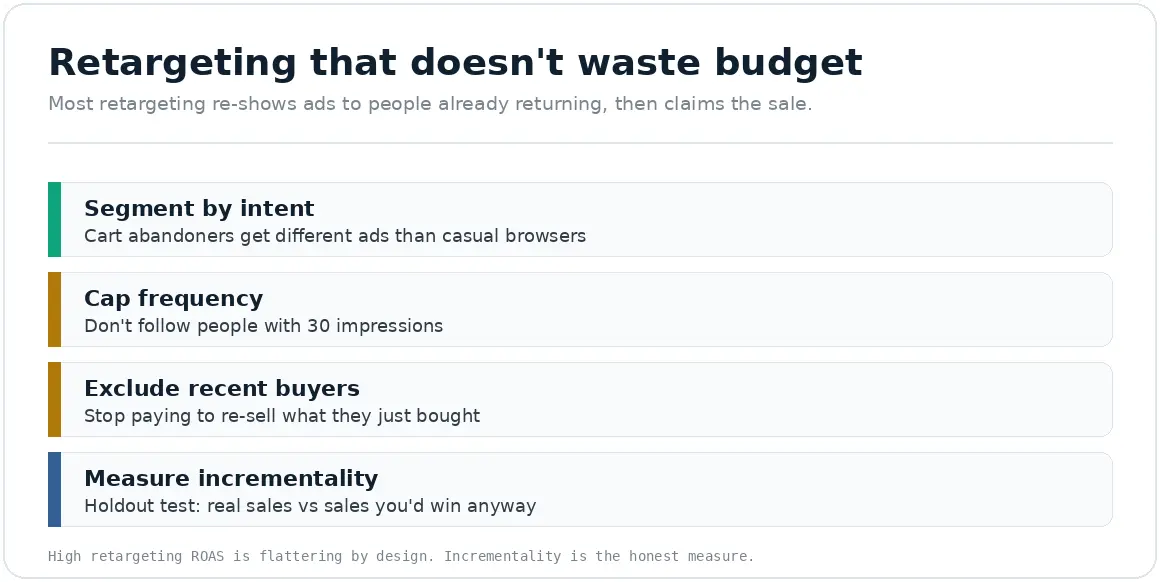
High retargeting ROAS is flattering by design. Incrementality is the honest measure.
We run retargeting for incremental sales, and measure it honestly.
We segment by intent, cap frequency, exclude recent buyers, and run holdout tests to measure the sales retargeting actually caused, rather than the ones it merely claimed credit for.
It’s part of our paid advertising work, and recent buyers move into the retention and conversion optimization flows that drive the next order instead of wasted ad spend.
// we would rather show up in your reporting than in your inbox
Frequently asked questions
Why does retargeting look so profitable but not grow sales?
Because it targets people already likely to buy, so its ROAS looks high, but much of that revenue would have arrived without the ad. Retargeting takes credit for warm buyers returning anyway. To know its real value, measure incrementality (a holdout test), not just reported ROAS.
How do I retarget without wasting money?
Segment audiences by intent (cart abandoners get different ads than casual browsers), cap ad frequency so you don’t over-expose people, set sensible time windows, exclude recent buyers, and measure incrementality. The goal is driving sales that wouldn’t have happened otherwise, not re-showing ads to people already returning.
Should I exclude people who already bought?
Yes, almost always. Showing acquisition ads to recent buyers wastes budget and annoys them. Exclude recent purchasers from prospecting and product retargeting, and move them into post-purchase and retention flows that drive the next order instead of paying to re-sell what they just bought.
How do I know if my retargeting is incremental?
Run a holdout test: withhold retargeting from a random portion of the eligible audience and compare their conversion rate to those who saw the ads. The gap is the incremental sales retargeting actually drove. If both groups convert similarly, retargeting was mostly claiming sales you’d have won anyway.
Sources
Retargeting strategy fundamentals (segment by intent/recency, frequency caps, exclude recent buyers, measure incrementality via holdout tests) reflect established paid-media practice, corroborated across 2026 sources. Grumspot guide: google shopping optimization Retargeting ROAS is flattering because it targets warm audiences; incrementality (holdout testing) is the honest measure: consistent with the attribution principles in the attribution pillar.