Paid / Google Shopping
Performance Max vs Standard Shopping: Which to Run
// automation and reach vs control and transparency

By Fracto Solutions
September 28, 2026
The short answer
Performance Max vs Standard Shopping comes down to automation versus control. PMax lets Google’s AI run bidding, targeting, and placements across all its channels for maximum reach; Standard Shopping gives you manual control and granular reporting. In 2026 the best answer is usually a hybrid: Standard for control, PMax for scale.
Auto
30-50
Both
What's the difference between Performance Max and Standard Shopping?
Performance Max is automated: Google’s AI controls bidding, targeting, and placements across Search, Shopping, YouTube, Display, Gmail, and Discover. Standard Shopping is manual: you control bids, see query-level data, and can add negative keywords. It’s automation and reach versus control and transparency.
The core trade-off is right there in how they run. Performance Max hands Google your feed and creative assets and lets its machine learning decide who to show ads to, where, and at what bid, across essentially all of Google’s inventory. You get broad reach and minimal manual work, but limited visibility and control. Standard Shopping keeps you in the driver’s seat: you set bids, you see which search terms triggered your ads, and you can exclude irrelevant queries with negative keywords. You get transparency and control, but it’s more hands-on and reaches fewer placements. Neither is universally better, they’re built for different priorities.
hjf
Performance Max
Standard Shopping
Control
Google AI decides
You control bids & targeting
Reach
All channels (Search, YouTube, Display, Gmail)
Shopping placements
Reporting
Limited, opaque
Query-level, granular
Needs
~30-50 conversions/mo
Works at low volume
Best for
Scale, discovery
Top / high-margin SKUs, control
Both depend on feed quality. Most 2026 stores run a hybrid: Standard for control, PMax for scale.
When should I use Performance Max?
Use PMax for scale and discovery: when you want maximum reach across Google’s channels, you have strong creative assets and a healthy budget, and, crucially, enough conversion volume for its AI to learn from (commonly cited as around 30 to 50 conversions a month minimum).
Performance Max earns its place when reach and automation are what you need. It’s strong for finding new customers across placements Standard Shopping can’t touch (YouTube, Discover, Gmail), and for scaling without managing everything by hand. But it has prerequisites: it needs good creative assets (headlines, descriptions, images, video) to unlock its full inventory, a budget large enough to feed the algorithm, and, most importantly, enough conversion data to optimize. Sources consistently cite roughly 30 to 50 conversions a month as the minimum for stable Target ROAS optimization, and note PMax turns unpredictable on accounts with only a handful of monthly conversions. Below that volume, PMax is guessing. Above it, it can be powerful.
When should I use Standard Shopping?
Use Standard Shopping when you need control: over bidding, over which search terms you appear for, and over reporting, especially for your top-performing or high-margin products where precision matters more than reach.
Standard Shopping is the right tool when control beats automation. That’s typically true for your most important products: top sellers and high-margin items where you want to bid deliberately, protect margin with a precise Target ROAS, and see exactly which queries convert. It’s also better when you have low conversion volume (PMax can’t learn, but you can manage manually), or when you need clean query-level reporting that PMax doesn’t provide. Very large catalogues (many thousands of SKUs) sometimes lean on Standard for tighter query control too. The theme: where you need to know and decide rather than delegate, Standard Shopping gives you that.
Why is a hybrid approach usually best?
Because it captures the strengths of both: Standard Shopping’s control on the products and queries that matter most, and Performance Max’s scale and reach layered on top. In 2026, running them as a coordinated system typically beats choosing one.
The either/or framing is outdated. The consistent 2026 best practice is a deliberate hybrid: run Standard Shopping on your top-revenue and high-margin SKUs with tight segmentation and manual control, and let Performance Max handle scale, the long tail, and discovery across Google’s wider inventory. Think of PMax as a finishing layer on a structure that already works, not as a replacement for structure. A common, effective split is Standard for brand and high-margin products (where you protect and control) plus PMax for catalogue-wide reach (where you scale). Since late 2024 the two compete on equal terms in the auction, so coordinating them deliberately, rather than letting them cannibalize each other, is the skill. Both, remember, depend entirely on feed quality.
- PMax vs Standard
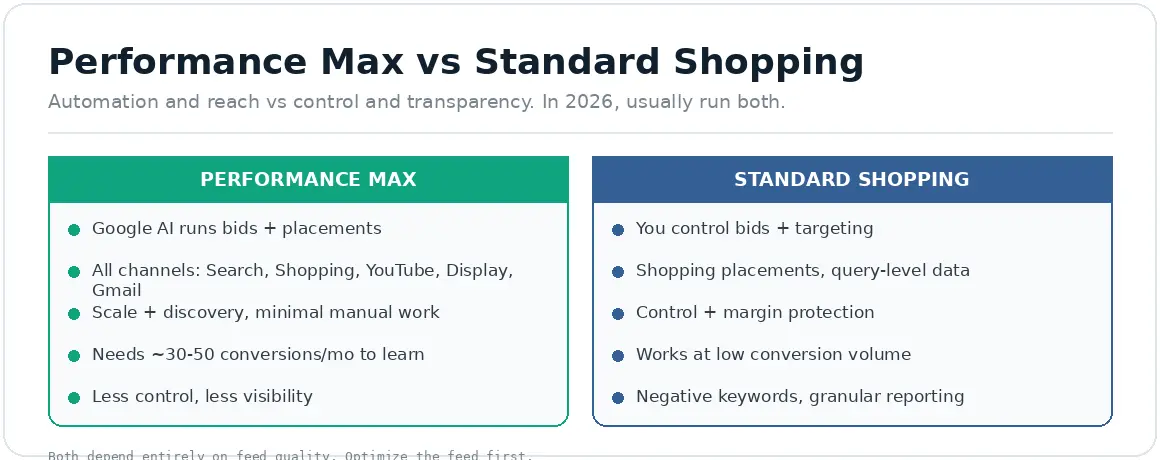
Both depend entirely on feed quality. Optimize the feed first.
Does Performance Max really outperform Standard Shopping?
Sometimes, but the headline numbers are misleading because PMax often absorbs brand-search traffic that would have converted anyway. Strip out brand terms and judge the incremental, genuinely new customers, and the honest comparison is closer than Google’s blended figures suggest.
Google reports that advertisers who shifted from Standard Shopping to Performance Max drove a 25% increase in conversion value on average, at a similar ROAS. Note the exact wording: similar ROAS, not the same budget. At a similar ROAS you may simply be spending more, so the figure is not the free uplift it is often quoted as. That blended number deserves further scrutiny too. A big chunk of PMax’s reported wins can be brand-search conversions, people who were going to buy from you anyway and searched your name, which PMax happily claims credit for. The honest test is to look at the incremental value: exclude your brand terms (or pull branded performance separately) and see what genuinely new demand PMax found through non-brand Search, Shopping, and channels like YouTube and Discover. That remaining number is PMax’s real contribution. Often it’s still positive (those extra placements are real reach), but far smaller than the headline. This is exactly the kind of attribution honesty covered in marketing attribution for ecommerce.
How do I decide for my store?
Match the tool to the product and your data. Enough conversions and a need for scale point to PMax; high-margin or top products and a need for control point to Standard. Most stores end up running both, and either way, fix the feed first.
A practical decision guide: – Low conversion volume (under ~30 to 50/month)? Lean Standard Shopping, PMax can’t learn yet. – Top-selling or high-margin products? Standard, for control and margin protection. – Want scale and discovery, with volume and assets to support it? PMax. – Most established stores? A hybrid: Standard on the products that matter, PMax layered on for reach. – Always, first: optimize the feed, because both campaign types bid on the same product data, and neither fixes a weak feed.
Whichever you run, set your Target ROAS from your break-even (see what is a good ROAS) and judge results on blended profit.
We run Standard and PMax as one coordinated system, on a strong feed.
We put Standard Shopping on the products where control and margin matter, layer PMax on for scale and discovery, and, crucially, fix the feed first, because both bid on the same product data and neither fixes a weak feed.
It’s part of our paid advertising work, with ROAS targets set from your real break-even and results judged on blended profit, the same discipline as our conversion optimization.
// we would rather show up in your reporting than in your inbox
Frequently asked questions
Is Performance Max better than Standard Shopping?
Neither is universally better, they trade automation and reach (PMax) against control and transparency (Standard). PMax needs enough conversion volume to work well; Standard suits high-margin products and low-volume accounts. In 2026, most successful stores run both as a hybrid rather than choosing one.
How many conversions does Performance Max need?
Commonly cited as around 30 to 50 conversions a month minimum for stable Target ROAS optimization, with some accounts needing more to fully settle. Below that, PMax has too little data to optimize and can behave unpredictably. Low-volume accounts are usually better served by manual Standard Shopping.
Should I move my whole catalogue into Performance Max?
Usually not. Moving everything into one PMax campaign gives up product-level control and lets it favor easy, brand-driven conversions. The better approach is a hybrid: Standard Shopping on top and high-margin products for control, PMax for scale and discovery on top of a structure that already works.
Does Performance Max need a good feed?
Yes, completely. PMax uses your Merchant Center feed as its foundation, so a weak feed means it spends against bad data rather than fixing it. Both PMax and Standard depend on feed quality, which is why feed optimization comes before the campaign-type decision.
Sources
PMax vs Standard = automation/reach vs control/transparency; PMax spans Search, Shopping, YouTube, Display, Gmail, Discover; PMax needs ~30 to 50 conversions/month; hybrid (Standard for control + PMax for scale) is the 2026 best practice; both depend on feed quality: consistent across multiple 2026 sources. https://blog.adnabu.com/google-ads/performance-max-vs-standard-shopping/ ; https://growwithvysta.com/blog/performance-max-vs-standard-shopping-the-ecommerce-verdict/ ; https://lionelz.com/en/blog/shopping-campaign-structure-google-ads-2026/
The 25% figure: Google states that advertisers who shifted from Standard Shopping to Performance Max “drove a 25% increase in conversion value, on average, at a similar ROAS” (Google, Retailer best practices for Performance Max). We corrected an earlier draft that rendered this as “at the same budget”; Google says similar ROAS, which is a materially weaker claim, since a similar ROAS on higher spend also produces more conversion value. It is a blended figure and brand traffic absorbed into PMax flatters it, so run a Standard-versus-PMax experiment on your own account before acting on it. https://lionelz.com/en/blog/shopping-campaign-structure-google-ads-2026/