Amazon / Operations
How to Win the Amazon Buy Box
// hold the Buy Box or stay invisible

By Fracto Solutions
September 16, 2026
The short answer
Amazon removed the seller-level eligibility gate in July 2026, so the contest is now what matters: compete on Amazon’s four factors, fulfillment method (FBA has an edge), competitive landed price, strong seller performance metrics, and reliable inventory. The lowest price doesn’t automatically win, Amazon rewards the best overall combination.
80%+
of Amazon sales go through the Buy Box
4
factors: fulfillment, price, metrics, stock
Not
always lowest price, FBA + metrics can win higher
What is the Amazon Buy Box, and why does it matter?
The Buy Box is the featured offer, the Add to Cart and Buy Now section on an Amazon product page. It matters because over 80 percent of Amazon sales go through it, so if you don’t hold it, most shoppers never buy from you even when you’re listed.
When several sellers offer the same product, Amazon displays one of them as the default “featured offer” in the Buy Box, and that seller gets the overwhelming majority of the sales. Everyone else is relegated to a “other sellers” link most shoppers never click, and on mobile, where much of Amazon’s traffic is, non-Buy-Box offers are even more hidden. Across sources, the Buy Box is credited with driving over 80 percent of Amazon sales. So for any product where you compete with other sellers, winning the Buy Box isn’t a nice-to-have, it’s the difference between selling and not.
Who is eligible to win the Buy Box?
Almost everyone, as of 2026. Amazon announced on 8 July 2026 that it is removing the seller-level eligibility gate for the Featured Offer, rolling the change out across all its stores and completing by the end of the year. Most guides still describe the old gate. It is going away.
This is the single biggest change to how the Buy Box works in years, so it is worth being precise about what did and did not change.
What Amazon removed. The old system ran in two stages: an account-level eligibility screen, then an offer-level competition. Sellers who failed the first screen were excluded entirely, regardless of how good their price or delivery was. Amazon has removed that first screen, saying it concluded the step was “no longer delivering additional value to customers”. Existing offers are enrolled automatically and no seller action is required. The EU and UK change took effect on 20 July 2026; the global rollout completes by the end of 2026.
What Amazon did not remove. The competition itself. Being considered does not mean being featured. Competitive total price, delivery speed, stock availability and seller performance still decide who wins, and Amazon can still suppress the Featured Offer entirely, most visibly when it judges a price to be out of line, leaving shoppers a “See all buying options” link instead of an Add to Cart button. Order Defect Rate, late shipment rate and valid tracking rate also still drive account health and enforcement. They have stopped being a hard blocker at the offer layer; they have not stopped mattering.
What this means for you. If you were previously locked out on performance grounds, you are back in the pool. If you were already winning, a barrier that kept some competitors out has come down, so expect more contested ASINs. Either way, the practical move is the same: pull your Buy Box share by ASIN for the last 30 days and see whether it has already shifted, because the rollout has been running since July.
One detail that has not changed: the Featured Offer is assessed per product (per ASIN), not per account, so your share can differ sharply between listings. Note also that Amazon now formally calls it the Featured Offer; “Buy Box” is the sellers’ term and remains in common use.
What factors decide who wins the Buy Box?
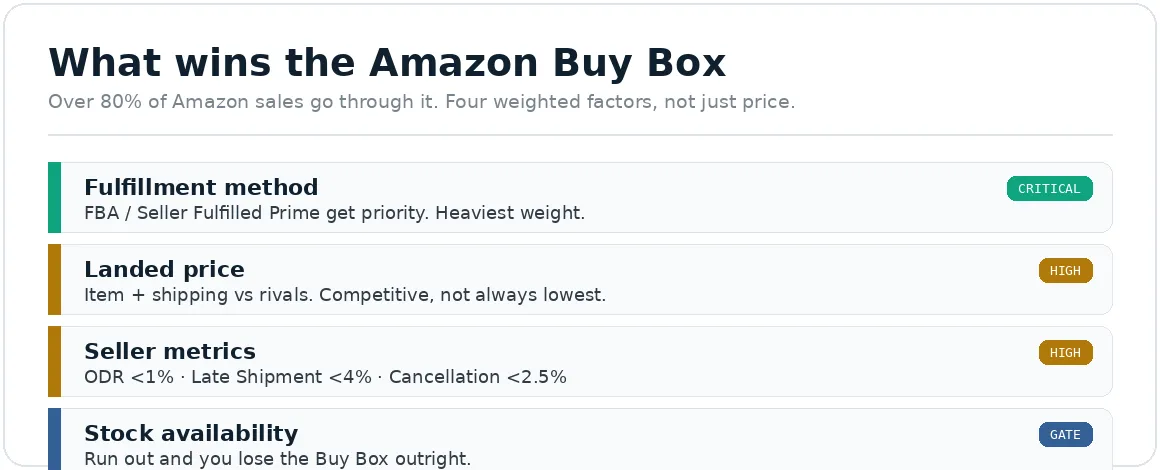
Amazon weighs four main factors: fulfillment method (FBA and Seller Fulfilled Prime have an edge), landed price (item plus shipping), seller performance metrics, and stock availability. It’s a weighted combination, not any single factor.
Amazon’s algorithm picks the Buy Box winner from among competing offers using a weighted mix:
Factor
Why it matters
Fulfillment method
FBA and Seller Fulfilled Prime get priority; fast, reliable delivery is weighted heavily
Landed price
Item price plus shipping; your total cost to the customer, compared to rivals
Seller performance metrics
Order Defect Rate, shipping and cancellation rates, feedback, they gate and rank you
Stock availability
Running out of stock loses the Buy Box outright
*The four Buy Box factors are consistent across 2026 Amazon guides; Amazon does not publish exact weightings.*
The nuance that trips sellers up: these interact. A seller with FBA, great metrics, and near-perfect delivery can win at a slightly higher price than a rival with weak metrics, because Amazon is optimizing the total customer experience, not just the sticker price.
- What wins the Buy Box
Does the lowest price always win the Buy Box?
No, this is the most common myth. Amazon weighs the total customer experience, so a seller with FBA fulfillment, strong metrics, and fast delivery can win the Buy Box at a higher price than a cheaper seller with weaker metrics.
It’s intuitive to assume the cheapest offer wins, but it’s wrong, and believing it leads sellers to destroy their margins in a price race they didn’t need to run. Amazon’s goal is to feature the offer most likely to make the customer happy, which balances price against fulfillment reliability, delivery speed, and seller track record. In practice, FBA sellers can often hold the Buy Box at a modest premium over FBM rivals because Amazon trusts the fulfillment. So the smarter play isn’t always to be cheapest, it’s to be competitively priced while being excellent on the factors you control (fulfillment, metrics, stock). Racing to the bottom on price is often unnecessary and always unprofitable.
How do I actually win and keep the Buy Box?
Use FBA (or match its speed and reliability), price competitively (not necessarily lowest), keep your seller metrics excellent, and never run out of stock. With the eligibility gate gone, these are the whole game. Then monitor continuously, because Buy Box share shifts as prices and metrics change.
A practical playbook: – Use FBA where you can, it’s the single biggest structural advantage for the Buy Box, since Amazon trusts its fulfillment. – Price competitively, aim to be within range of the lowest eligible offer, not necessarily below it. Repricing tools help you stay competitive automatically. – Protect your metrics, keep Order Defect, Late Shipment, and Cancellation rates well under the thresholds, and respond to customers fast. – Never stock out, running out loses the Buy Box immediately and can hurt you even after you restock. – Monitor continuously, Buy Box share is dynamic and recalculated constantly, so watch your win rate per ASIN and react.
Winning the Buy Box and having a listing that converts are two halves of Amazon success, covered together in how to optimize Amazon product listings.
We keep you competitive across the Buy Box factors you actually control.
We get the fundamentals right, FBA or fast reliable fulfillment, healthy metrics, competitive pricing, and never stocking out, then monitor Buy Box share per ASIN and react as prices and metrics shift.
It’s part of the multichannel ecommerce operations we run, alongside the listing optimization and the same measurement-first discipline behind our conversion optimization work.
// we would rather show up in your reporting than in your inbox
Frequently asked questions
What percentage of Amazon sales go through the Buy Box?
Over 80 percent, according to figures cited consistently across Amazon sources. Because most shoppers simply click Add to Cart (the Buy Box) rather than hunting through other sellers, holding it is close to essential for any product where you compete with other sellers.
Does the cheapest seller always win the Buy Box?
No. Amazon weighs the total customer experience, fulfillment method, delivery speed, seller metrics, and stock, alongside price. A seller with FBA and strong metrics can win at a higher price than a cheaper seller with weaker metrics. Racing to the lowest price is often unnecessary.
Do I need FBA to win the Buy Box?
No, but it’s the biggest single advantage, because Amazon trusts its fulfillment and delivery speed. FBM (merchant-fulfilled) sellers can win, especially with excellent metrics and fast shipping, but usually need stronger metrics or sharper pricing to offset FBA’s structural edge.
Why did I lose the Buy Box?
Common causes: a competitor with better metrics or fulfillment, going out of stock, a price that’s no longer competitive, or your seller metrics slipping below Amazon’s thresholds. Buy Box share is recalculated continuously, so check your metrics, stock, and pricing for that ASIN.
Sources
“Over 80% of Amazon sales go through the Buy Box” is one of the most-repeated figures in this field and we have not been able to trace it to a primary Amazon disclosure; aggregators commonly report 80% to 82%. We use it as a directional statement about how decisive the placement is, not as a precise measurement. The four core factors (fulfillment method, landed price, seller metrics, stock availability) and the point that lowest price does not always win are consistent across 2026 Amazon guides. https://www.repricer.com/blog/how-to-win-amazon-buy-box-2026/ ; https://feedvisor.com/university/amazon-buy-box/ ; https://ensobrands.com/amazon-buy-box/
Amazon does not publish exact Featured Offer algorithm weightings, and states that being considered does not guarantee an offer will be featured. Selection is evaluated per ASIN, not per account.