Amazon / Paid
How Much Does Amazon PPC Management Cost?
// the fee is separate from the ad spend

By Fracto Solutions
September 16, 2026
The short answer
Amazon PPC management costs either a flat monthly retainer, commonly around $500 to $5,000 for most brands (more for enterprise), or a percentage of ad spend, typically 10 to 20%. Crucially, that management fee is separate from your ad budget, which you pay Amazon directly. The right model depends on your spend and account complexity.
10-20%
of ad spend, the most consistent pricing model
Separate
management fee is NOT your ad budget
Listing
must convert, or management just spends faster
How much does Amazon PPC management cost?
For most brands, either a flat retainer of roughly $500 to $5,000 per month, or 10 to 20 percent of monthly ad spend. Exact figures vary widely by source and by the size and complexity of your account, so treat these as ranges, not fixed prices.
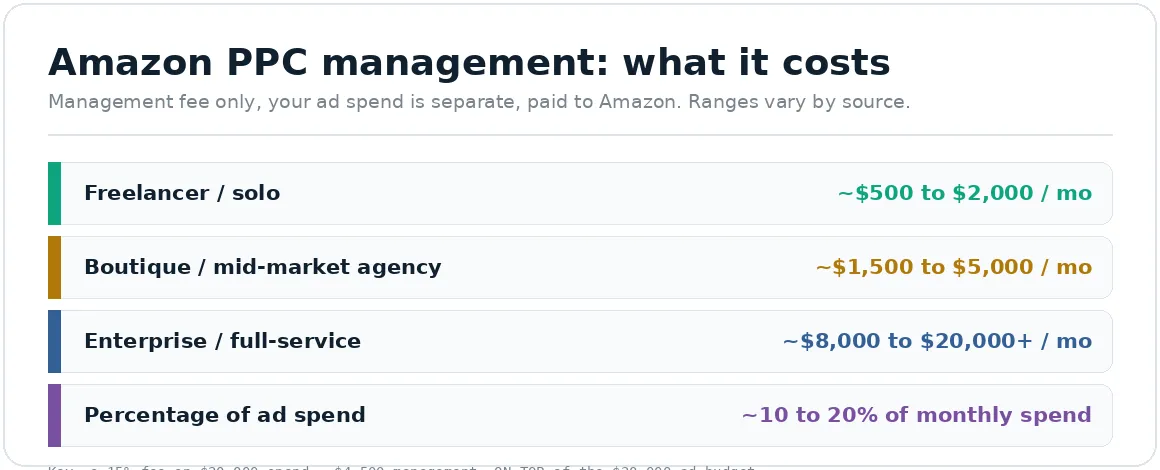
Across 2026 pricing guides the numbers differ (you’ll see freelancer tiers as low as a few hundred dollars and enterprise agencies well into five figures), but the shape is consistent: most growing brands pay somewhere in the low-thousands per month for real management, and the percentage-of-spend model clusters around 10 to 20 percent. Here’s the tiered picture, treat the dollar figures as directional:
Provider tier
Typical monthly fee
Best for
Freelancer / solo consultant
~$500 to $2,000
Small sellers, simple catalogs
Boutique / mid-market agency
~$1,500 to $5,000
Growing brands with steady spend
Enterprise / full-service agency
~$8,000 to $20,000+
Large catalogs, multi-marketplace
Percentage of ad spend
~10 to 20% of monthly spend
Brands with scaling budgets
*Ranges compiled across multiple 2026 Amazon PPC pricing guides; figures vary by source, so use as directional and get specific quotes.*
The wide spread is real, not vagueness on our part, so the useful takeaway is the structure (retainer vs percentage) and the rough magnitude, then get quotes for your specific account.
What's the difference between the management fee and ad spend?
The management fee pays the agency or freelancer to run your campaigns; the ad spend is the money that goes to Amazon for the clicks themselves. They’re completely separate, and confusing them leads to badly wrong budgets.
This is the single most important thing to understand, and where sellers most often get burned. If an agency charges “15 percent of ad spend” and you spend $30,000 a month on Amazon ads, the management fee is $4,500, and that’s on top of the $30,000 you pay Amazon, not included in it. So your total monthly Amazon marketing outlay is ad spend plus management fee. Always clarify which you’re being quoted. A “$3,000 a month” agency fee and a “$3,000 a month ad budget” are entirely different things, and a quote that blurs them is a red flag.
What are the Amazon PPC pricing models?
Three main models: a flat monthly retainer, a percentage of ad spend, and performance-based or hybrid fees. Each aligns incentives differently, and the flat retainer is often preferred because it doesn’t reward the agency simply for spending more.
Flat monthly retainer. A fixed fee regardless of spend. Predictable, easy to budget, and it doesn’t give the agency a reason to inflate your ad spend. Common for brands that want cost certainty.
Percentage of ad spend (10 to 20%). The fee scales with your budget. Simple, but watch the incentive: the agency earns more when you spend more, which isn’t always aligned with your profitability.
Performance-based or hybrid. A base fee plus a bonus tied to results (sales or ACoS targets). Aligns incentives well but can be complex to structure fairly.
For most brands, a flat retainer offers the cleanest incentive alignment, the agency is paid to improve performance, not to grow your spend. Whichever model, judge it on results, not just the fee.
- Amazon PPC pricing
What do you actually get for the fee?
At minimum: campaign setup and structure, keyword research, bid and budget management, negative-keyword work, and reporting. Higher tiers add competitor analysis, listing optimization, dedicated managers, and strategic planning.
The scope should scale with the fee, and it’s worth checking exactly what’s included before signing. Entry-level management typically covers building and structuring campaigns, ongoing bid adjustments, adding negative keywords to cut wasted spend, and regular reporting. Mid-market and full-service tiers add competitor and market analysis, listing and A+ content optimization, a dedicated account manager, and proactive strategy. A common and important nuance: a PPC-only agency manages ads but doesn’t touch your listings, which works only if your listings already convert. If weak listings are your bottleneck, PPC management alone won’t fix it, which is exactly why the listing optimization comes first.
Is Amazon PPC management worth the cost?
It’s worth it when good management recovers more than its fee in reduced wasted spend and increased profitable sales, which is common for accounts with meaningful spend, but only if your listings convert. Managing ads to a listing that doesn’t sell just spends money faster.
The honest answer is “it depends on two things”: your ad spend and your listing quality. On the spend side, professional management usually pays for itself once you’re spending enough that small efficiency gains exceed the fee, cutting wasted spend and improving ACoS on a $30,000 budget easily covers a $4,500 fee. On the listing side, the caveat that runs through this whole cluster applies: even flawless campaign management produces mediocre results if the listing doesn’t convert, because you’re paying for clicks that bounce. So the sequence matters, get the listing converting first, then management amplifies it. For very small budgets, software tools or careful DIY may make more sense than an agency until spend grows.
We price Amazon ad management transparently, and only after the listing converts.
We’re clear about the two costs (management fee vs ad spend), match the model to your account, and, crucially, make sure the listing converts before scaling spend, because managing ads to a page that doesn’t sell just burns budget faster.
It’s part of our paid advertising work, and it depends on the listing optimization that our ecommerce operations team handles first. It ties to the same conversion discipline we bring everywhere.
// we would rather show up in your reporting than in your inbox
Frequently asked questions
How much does Amazon PPC management cost per month?
For most brands, roughly $500 to $5,000 a month as a flat retainer, or 10 to 20 percent of ad spend. Figures vary widely by source and account size. Enterprise accounts run higher. Remember the management fee is separate from the ad budget you pay Amazon.
Is the management fee separate from ad spend?
Yes, completely. The management fee pays whoever runs your campaigns; the ad spend goes to Amazon for the clicks. If an agency charges 15 percent of a $30,000 spend, that’s a $4,500 fee on top of the $30,000. Always clarify which figure a quote refers to.
What's the best Amazon PPC pricing model?
For most brands, a flat monthly retainer, because it doesn’t reward the agency for simply increasing your spend, keeping incentives aligned with performance and profitability. Percentage-of-spend is simpler but can misalign incentives. Performance-based models align well but are harder to structure.
Is hiring an Amazon PPC agency worth it?
Usually, once your ad spend is high enough that efficiency gains exceed the fee, and provided your listings actually convert. Managing ads to a poorly converting listing just wastes money faster. Fix the listing first, then good management amplifies a listing that already works.
Sources
Listing quality gates PPC performance (“even perfect campaigns produce mediocre results if the listing doesn’t convert”): consistent across sources. https://amzdudes.com/decoding-amazon-ppc-agency-pricing-is-it-worth-the-investment/