CRO / Product pages
Product Page Trust Signals That Increase Sales
// reduce the risk, win the sale

By Fracto Solutions
September 14, 2026
The short answer
The trust signals that increase sales most are genuine reviews and ratings (shown near the product title), a clear returns policy, secure-payment cues, and real customer photos. Research from Northwestern’s Spiegel Research Center found displaying reviews can lift purchase likelihood substantially. Placement matters as much as the signal itself.
~270%
purchase-likelihood lift from reviews (Spiegel, Northwestern)
4.0-4.7
Placement
matters as much as the signal itself
What are trust signals, and why do they matter?
Trust signals are on-page elements that reassure a shopper it’s safe and worthwhile to buy: reviews, ratings, returns policies, security cues, and real photos. They matter because online shoppers can’t inspect the product or the seller in person, so they look for proof before committing.
In a physical store, trust is built by the environment, you can hold the product, see other shoppers, talk to staff. Online, all of that has to be reconstructed on the page. Trust signals do that job: they answer the shopper’s unspoken questions, “is this product any good?”, “is this store legit?”, “what if it’s wrong?”, before those doubts turn into an abandoned cart. Because they operate at the exact moment of decision, well-placed trust signals are some of the highest-leverage elements on a product page, and their absence is one of the most common reasons pages underperform.
What's the single most powerful trust signal?
Genuine customer reviews and ratings. They’re the strongest trust signal on a product page, because shoppers trust other buyers far more than they trust your marketing copy. The supporting research is unusually solid.
Reviews win because they’re social proof from people with no reason to flatter you. The evidence here is genuinely strong, not aggregator guesswork: the Spiegel Research Center at Northwestern University found that a product with five reviews was around 270 percent more likely to be purchased than one with no reviews, with the effect larger on higher-priced items (around 380 percent) than cheaper ones (around 190 percent), because reviews reduce more perceived risk when there’s more at stake. The practical takeaways: get reviews on your product pages (even seeding new products to a handful helps cross the “zero reviews” threshold), and show a rating summary near the product title, not just buried in a tab lower down, so shoppers see the proof at the point of decision.
Why can a perfect 5-star rating hurt?
Because shoppers are skeptical of perfection. Research consistently finds a rating in roughly the 4.0 to 4.7 band is trusted more than a perfect 5.0, which many shoppers read as fake or cherry-picked. A few critical reviews actually add credibility.
This is the counterintuitive part of social proof. It’s natural to want a flawless 5.0 average, but shoppers have learned that perfect scores are often manipulated, so a perfect rating can trigger suspicion rather than confidence. Ratings in the roughly 4.0 to 4.7 range tend to convert better because they read as authentic. Likewise, a mix that includes some critical reviews is more persuasive than uniformly glowing ones, because it signals the reviews are real and helps shoppers make an informed choice. The lesson: don’t hide or scrub negative reviews (within reason), authenticity converts better than a suspiciously perfect record.
What other trust signals should a product page have?
Beyond reviews: a clear returns policy, secure-payment cues, real customer photos, and honest availability and shipping information. Each removes a specific doubt at the decision point.
The key supporting signals:
A visible returns policy. Uncertainty about returns is a real abandonment driver; a clear, linked “easy returns” message near the buy button reduces the risk of committing.
Secure-payment cues. Recognizable payment logos and security indicators reassure shoppers it’s safe to enter card details, Baymard finds security cues near the checkout action help.
Real customer photos. User-generated images (not just star ratings) show the product as it really is, and often persuade more than professional shots because they’re believable.
Honest availability and shipping. Clear in-stock status and upfront shipping information (surprise costs are a top abandonment trigger) build trust by removing nasty surprises later.
Recognizable brand and contact details. An identifiable store with real contact information reassures shoppers there’s a real business behind the page.
Trust signal
Where to place it
The doubt it removes
Star-rating summary
Near the product title
Is this product any good?
Full reviews + photos
Mid-page, easy to reach
What do real buyers say?
Returns policy
Near the add-to-cart
What if it's wrong for me?
Secure-payment cues
At the payment step
Is it safe to enter my card?
In-stock + shipping info
Near the buy box
Can I get it, and when?
*Match each signal to the moment its doubt occurs; a signal in the wrong place does little.*
- Trust signals ranked
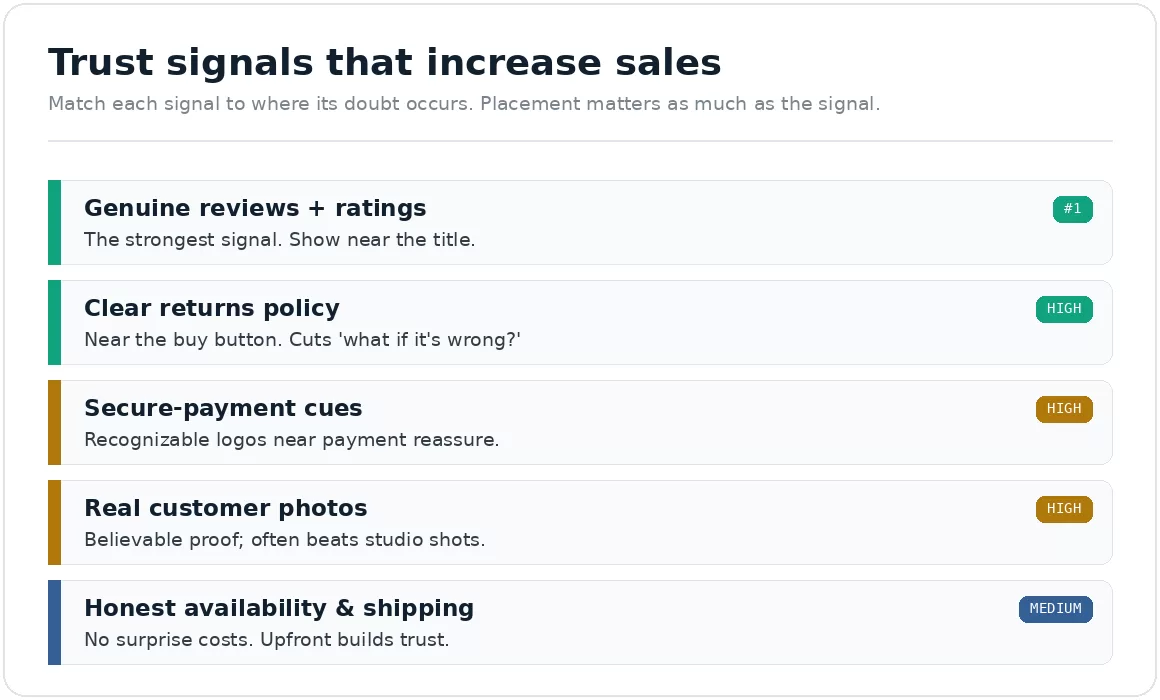
Does placement of trust signals matter?
Yes, as much as the signal itself. The right trust signal in the wrong place does little; the same signal near the decision point can lift conversion. Put the highest-impact signals (ratings, returns) near the buy box.
A trust signal only works if the shopper sees it when the doubt arises. A rating summary buried at the bottom of the page misses the shopper deciding at the top; the same rating shown near the title reaches them at the decision moment. A returns reassurance placed near the add-to-cart answers “what if it’s wrong?” exactly when they’re weighing the purchase. Security cues belong near the payment action. The principle is to match each signal to the moment its doubt occurs, which usually means concentrating the strongest signals in and around the buy box, not scattering them or hiding them in tabs and footers.
How do I add trust signals without faking them?
Use only genuine signals, real reviews, honest ratings, actual policies, and never fabricate. Fake reviews or invented badges erode trust when spotted and can breach platform and advertising rules. Authenticity is the whole point.
Trust signals only work if they’re true, and shoppers (and regulators) are increasingly good at spotting fakes. Don’t invent reviews, buy fake ones, or display trust badges you’re not entitled to, when discovered, these destroy the very trust they were meant to build, and they can violate platform policies and consumer-protection rules. The honest approach is also the effective one: collect real reviews (post-purchase requests work well), display genuine ratings including the imperfect ones, state your real returns and shipping terms clearly, and use actual customer photos. Real trust signals compound over time into a genuinely trustworthy store, which is the durable asset. Collecting reviews ties into your email and lifecycle work.
We place genuine trust signals where the doubt occurs, then test the lift.
We get real reviews onto your pages and show ratings near the title, add a clear returns reassurance near the buy button and secure-payment cues at checkout, and never fake a signal, because authenticity is what actually converts and lasts.
It’s part of our conversion optimization work, and collecting reviews ties into our email and lifecycle service.
// we would rather show up in your reporting than in your inbox
Frequently asked questions
What is the most important trust signal on a product page?
Genuine customer reviews and ratings. Shoppers trust other buyers more than marketing copy, and the research is strong, Northwestern’s Spiegel Research Center found displaying reviews can lift purchase likelihood dramatically. Show a rating summary near the product title, not buried in a tab.
Is a perfect 5-star rating good?
Not necessarily. Research finds shoppers trust a 4.0 to 4.7 average more than a perfect 5.0, which reads as fake or cherry-picked. A few critical reviews add credibility by showing the reviews are real. Don’t scrub negative reviews; authenticity converts better than perfection.
Where should trust signals go on a product page?
Near the decision point. Put ratings near the title, a returns reassurance near the add-to-cart, and security cues near the payment step. The same signal placed where its doubt occurs converts far better than one buried in a tab or footer.
Do trust badges actually work?
Genuine ones can help, security and recognizable payment cues reassure shoppers near checkout. But only use badges you’re entitled to; fake or meaningless badges erode trust when spotted and can breach rules. Real reviews and a clear returns policy generally outperform generic badges.
Sources
Baymard Institute: security cues near the checkout action and clear returns information support conversion; unexpected costs are a top abandonment trigger. https://baymard.com/lists/cart-abandonment-rate
Fake reviews and deceptive trust badges breach platform and consumer-protection rules; authenticity is required. (Established platform and advertising-standards guidance.)