Retention / DTC
How to Improve Ecommerce Customer Retention
// the cheapest customer is the one who already bought

By Fracto Solutions
September 12, 2026
The short answer
To improve ecommerce customer retention, focus on the experience after the first purchase: reliable delivery, a strong post-purchase sequence, timely replenishment prompts, and genuine reasons to come back. Retention is where profit concentrates, because selling again to an existing customer costs far less than acquiring a new one. Track repeat purchase rate, and benchmark it against your own category.
25-30%
a strong repeat purchase rate for most stores
+7%
revenue per visitor lift on one Fracto engagement
$0
new acquisition cost on every repeat order
What is customer retention, and why does it matter so much?
Customer retention is keeping the customers you’ve already acquired, getting them to buy again rather than churning after one order. It matters because retained customers are far cheaper to sell to than new ones, so they’re where margin concentrates.
The economics drive everything here. Acquiring a customer costs money, ad spend, discounts, the whole funnel, and that cost is rising. A customer you’ve already acquired has no new acquisition cost, so every repeat order is dramatically more profitable than the first. This is why retention improves your unit economics directly: it raises lifetime value (LTV) without raising acquisition cost, which lifts your LTV:CAC ratio, the number that determines whether paid growth is sustainable (covered in what is a good LTV:CAC ratio). A store that retains well can afford to acquire aggressively; one that doesn’t is stuck on an expensive treadmill.
Isn't it true that retaining a customer is 5x cheaper than acquiring one?
You’ll see that claim everywhere, usually as “5 to 25 times cheaper.” It’s directionally true, retaining is cheaper than acquiring, but treat the exact multiplier with caution, because it traces to older studies and varies enormously by business.
This is one of the most-quoted stats in marketing, and also one of the most loosely sourced. The honest position: the *direction* is well established and intuitive (you don’t pay acquisition costs twice), but the precise “5x” or “25x” figure comes from aging research and differs hugely by industry, price point, and how you count. So we won’t hang a strategy on a specific multiplier. What matters is the principle, repeat customers are more profitable, and your own numbers: measure what it actually costs you to acquire versus to retain, rather than trusting a blog’s multiplier. The same caution applies to other famous retention stats (“a 5% retention lift raises profit 25 to 95%”, “repeat customers spend 67% more”), directionally reasonable, precisely unreliable.
What is a good repeat purchase rate?
For most ecommerce stores, a repeat purchase rate of roughly 25 to 30 percent is considered strong, with 15 to 30 percent being the typical range. But it varies enormously by category, so your own category benchmark matters far more than the average.
Repeat purchase rate (the share of customers who buy more than once) is the clearest retention metric. Here’s the honest benchmark picture, treat these as directional ranges compiled across 2026 sources, not precise figures:
Category
Typical repeat purchase rate
Supplements & wellness
30 to 45%
Food & beverage
28 to 40%
Beauty & personal care
25 to 35%
Apparel & fashion
20 to 30%
Home & furniture
15 to 25%
Electronics
10 to 20%
Source: ranges compiled from multiple 2026 retention benchmark analyses (Shopify, Klaviyo, Yotpo cohort data and others). Figures vary by source; benchmark against your own category and cohort trend.
The pattern is consistent: consumables and replenishment categories retain far better than durables, simply because people need to rebuy them. That’s why a supplements store at 20% may be underperforming while a furniture store at 20% is doing well. Full detail in what is a good repeat purchase rate for ecommerce.
What actually drives retention?
The post-purchase experience, mostly: reliable fulfillment, useful communication, easy reordering, and genuine reasons to return. Retention is earned in what happens after checkout, not before it.
The biggest levers, in rough order:
A great core experience. Reliable delivery, a product that meets expectations, and painless support. No loyalty tactic overcomes a bad first experience.
A strong post-purchase email sequence. Onboarding, how-to-use, and well-timed reorder prompts keep you present. This is the engine of retention, covered in email and lifecycle marketing, and it’s a core part of our email and lifecycle service.
Replenishment and subscription options. For consumables, making reorder effortless (or automatic) is the single strongest retention lever.
Relevant, timely communication. Reaching customers when they’re due to rebuy, not blasting everyone weekly.
Genuine loyalty incentives. Rewards that matter, used sparingly, can help, but they’re a multiplier on a good experience, not a substitute for one.
A useful test for any retention tactic is whether it would still make sense if you removed the incentive. A post-purchase sequence that’s genuinely helpful, a reorder reminder that arrives right when a customer is running low, a product that simply works, these earn repeat orders on their own merits. Discounts and points layered on top can accelerate that, but layered on top of a poor experience they just subsidize customers who were leaving anyway. Fix the experience first; treat incentives as the amplifier, never the foundation.
- What drives retention
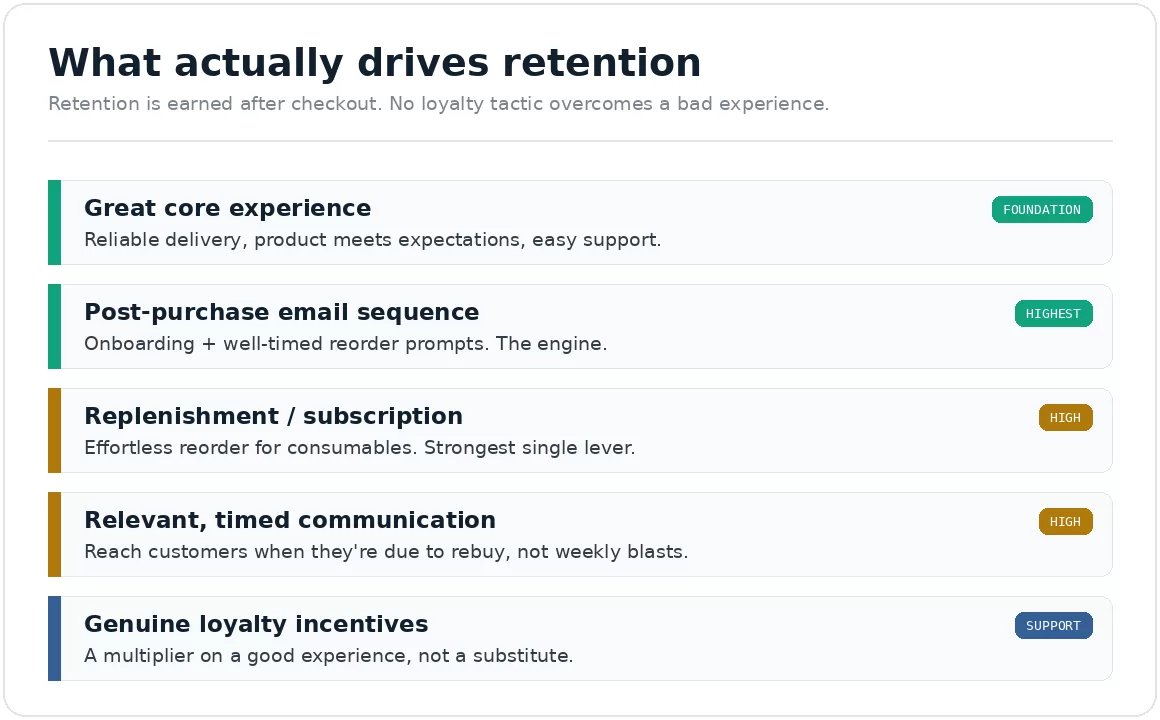
Retention is earned after checkout. No loyalty tactic overcomes a bad experience.
How does retention connect to profit and CAC?
Directly. Higher retention raises lifetime value, which improves your LTV:CAC ratio without changing acquisition cost, and a healthier ratio lets you either spend more to grow or keep more margin.
This is the strategic payoff. Retention doesn’t lower what you pay to acquire a customer (conversion optimization does that, see how CRO lowers CAC). Instead it makes each acquired customer worth more, by turning one purchase into several. Because LTV:CAC is lifetime value over acquisition cost, lifting LTV lifts the ratio directly. A healthy ratio (commonly cited around 3:1 on a revenue basis, though that benchmark itself came from SaaS and should be read with care) is what makes paid acquisition sustainable. So retention and acquisition aren’t rivals, retention is what makes acquisition affordable. Where to put the next marketing dollar between them is its own decision, covered in acquisition vs retention spend.
Should I invest in retention or acquisition first?
Both matter, but the balance shifts with your stage. Early on you need enough customers for retention to matter; once you have a base, retention usually becomes the higher-return investment because it compounds.
There’s no universal answer, and anyone who says “retention always wins” is ignoring a real constraint: you can’t retain customers you haven’t acquired. A brand with a few hundred customers can’t retention-market its way to scale, it needs acquisition to build the base first. But as that base grows, retention’s advantage compounds, because each retained customer costs little and lifts lifetime value across every future order. So the honest sequencing for most stores is: acquire enough to have something to retain, build the retention machinery (post-purchase sequence, reordering, communication) alongside it so it’s ready, then weight increasingly toward retention as the base matures and acquisition costs climb. The full trade-off, and how to read your own numbers to decide, is in acquisition vs retention spend.
How do I measure retention properly?
Track repeat purchase rate and cohort retention over time, on consistent cohorts, and compare to your own trend rather than a cross-industry average. The trend is the signal; a single number out of context misleads.
A few measurement principles that keep you honest:
Repeat purchase rate (share of customers who’ve bought more than once) is the headline metric, simple and revealing.
Cohort retention (what share of a given month’s new customers return within a set window) shows whether retention is improving over time, which a lifetime average hides.
Benchmark against yourself. A cross-industry “30%” is nearly meaningless given the category spread; your month-over-month cohort trend is what matters.
Watch the treadmill signal: revenue can rise while repeat rate falls, which means you’re buying growth rather than building it. That’s the warning sign to catch early.
We treat retention as the other half of growth, measured on your own cohorts.
Rather than bolting on a generic loyalty app, we start with the experience: is fulfillment reliable, is the post-purchase sequence doing its job, is reordering effortless for products that should repeat? Then we measure cohort retention and repeat purchase rate over time and improve the weakest link.
It’s the same baseline-first discipline behind our conversion optimization work, where retention is measured on consistent cohorts rather than on whichever window flatters the number. Retention and conversion together lift revenue per visitor and lifetime value.
Frequently asked questions
What is a good customer retention rate for ecommerce?
Roughly 25 to 35 percent over 12 months is typical, but it varies dramatically by category, consumables like supplements and food reach 35 to 50 percent, while durables like electronics sit closer to 15 to 25 percent. Benchmark against your own category and cohort trend, not a cross-industry average.
Is it really cheaper to retain a customer than acquire one?
Directionally yes, you don’t pay acquisition costs again for an existing customer. But be cautious with the famous “5 to 25 times cheaper” figure; it’s loosely sourced and varies widely. Measure your own acquisition versus retention costs rather than trusting a generic multiplier.
What's the single best way to improve retention?
For most stores, a strong post-purchase experience: reliable delivery, a good onboarding and reorder email sequence, and effortless reordering (or subscription) for consumables. No loyalty program overcomes a poor core experience, so fix that first.
What's the difference between repeat purchase rate and retention rate?
Repeat purchase rate is the share of all customers who’ve bought more than once (lifetime). Retention rate is the share of a specific cohort who return within a set window. Both matter; cohort retention better shows whether you’re improving over time.
How does retention affect my profit?
It raises lifetime value without raising acquisition cost, which improves your LTV:CAC ratio and unit economics. Because repeat orders carry no new acquisition cost, they’re far more profitable than first orders, so a rising repeat rate compounds directly into margin.
Keep reading
Sources
Every statistic is traced to its original publisher and dated. The GA4-vs-Shopify gap is corroborated across multiple independent 2025 to 2026 analyses; the Shopify checkout changes are from Shopify’s own documentation and migration guides. Figures that could not be traced to a primary source were left out.
Shopify Web Pixels API is the sanctioned method for checkout event tracking; runs sandboxed, subscribes to standard events (checkout_completed, payment_info_submitted, etc.); no DOM or dataLayer access. https://weltpixel.com/blogs/news/shopify-checkout-extensibility-and-conversion-tracking-what-broke-what-did-not ; Shopify Customer Events documentation.
checkout.liquid and additional scripts sunset for Thank you/Order status pages in 2025 (August 26, 2026 for non-Plus); Shopify Scripts sunset June 30, 2026; GTM containers incompatible with the new sandbox; official Google & YouTube and Facebook & Instagram apps are the supported paths; custom pixels for other tracking. https://revize.app/blog/shopify-checkout-extensibility-migration-guide ; https://monkeyman.agency/insights/shopify-checkout-extensibility-conversion-tracking/