Paid ads / DTC
Acquisition vs Retention Spend: Finding the Right Balance
// where does the next dollar go?

By Fracto Solutions
September 8, 2026
The short answer
Acquisition brings new customers; retention gets more from the ones you have. Neither wins outright, the right balance depends on your stage and unit economics. Early on, acquisition usually leads; as you mature, retention compounds. Your LTV:CAC ratio and payback period tell you where the next dollar should go.
Acquisition brings new customers; retention gets more from the ones you have. Neither wins outright, the right balance depends on your stage and unit economics. Early on, acquisition usually leads; as you mature, retention compounds. Your LTV:CAC ratio and payback period tell you where the next dollar should go.
“Should I spend on getting new customers or keeping the ones I have?” is one of the most consequential questions in DTC, and the honest answer is “it depends, and here’s on what.” This guide covers the real trade-off, when each side wins, and how to read your own numbers to decide. It builds on how to lower ecommerce CAC.
What's the difference between acquisition and retention spend?
Acquisition spend brings in new customers (mostly paid ads); retention spend gets existing customers to buy again (mostly email, lifecycle, loyalty). One grows the customer base; the other grows the value of it.
They’re different jobs with different economics. Acquisition is how you expand, but it’s expensive and getting more so, you’re paying market rates to win attention. Retention is cheaper per dollar of revenue, because you’re marketing to people who already know and trust you, but it can only grow the base you already have. The mistake is treating it as either/or. The real question isn’t which to do, it’s how to balance them given where your business is.
Why isn't retention always the answer?
Because you can’t retain customers you haven’t acquired. Retention compounds an existing base, so if that base is small, acquisition has to come first, no matter how efficient retention is.
The “retention is cheaper” truth gets overstated. It’s real, keeping a customer costs less than winning a new one, but retention has a ceiling set by how many customers you have. A young brand with a few hundred customers can’t retention-market its way to scale; it needs to acquire first. Retention becomes more powerful as your base grows, because there’s more value to compound. So the answer shifts with your stage: acquisition-led early, increasingly retention-weighted as you mature. Anyone who tells you retention is always the priority is ignoring the base-size ceiling.
When should I lean toward acquisition?
When you’re early, when your base is small, or when you have a genuine growth opportunity and healthy unit economics to fund it. Acquisition leads when there’s room and reason to grow the base.
Lean acquisition when: you’re a newer brand still building a customer base; your LTV:CAC ratio is healthy enough to acquire profitably (comfortably above 2:1, ideally in the 3:1 to 5:1 range on a revenue basis); or you’ve found a channel or moment worth pressing. The check is always your economics, if you can acquire a customer for meaningfully less than they’re worth over their lifetime, and you have base to build, acquisition is a good use of the next dollar. What “healthy” looks like is covered in what is a good LTV:CAC ratio.
- Acquisition vs retention
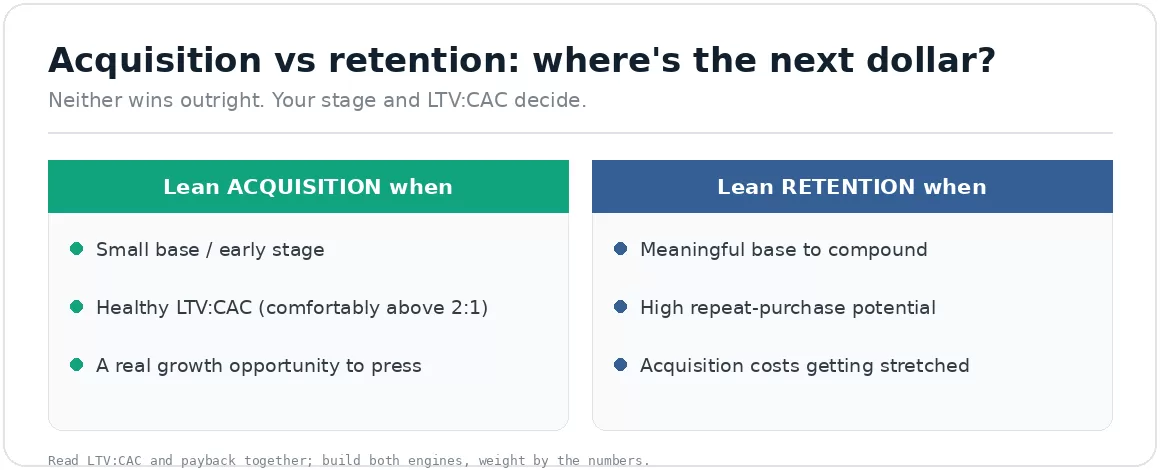
Neither wins outright. Your stage and LTV:CAC decide where the next dollar goes.
When should I lean toward retention?
When you have a meaningful base, when repeat-purchase potential is high, or when acquisition economics are getting stretched. Retention leads when there’s value to compound and rising CAC to offset.
Lean retention when: you’ve built a base worth nurturing; your product has natural repeat purchase (consumables, refills); or your acquisition costs are climbing to the point where squeezing more from existing customers is the better return. As brands mature and CAC rises, retention’s compounding advantage grows, each retained customer costs little and lifts lifetime value, which improves the whole LTV:CAC equation. The retention engine (email and lifecycle flows) is covered in email and lifecycle marketing for DTC brands.
How do I use my numbers to decide?
Let your LTV:CAC ratio and CAC payback period point the way. A strong ratio with room to grow favors acquisition; a stretched ratio or long payback favors shoring up retention and efficiency first.
What a conversion rate change does to effective CAC
Scenario
Ad spend
Visitors
Conversion rate
Customers
Effective CAC
Starting point
$10,000
20,000
1.5%
300
$33.33
Conversion up 20%
$10,000
20,000
1.8%
360
$27.78
Conversion up 50%
$10,000
20,000
2.25%
450
$22.22
This is arithmetic, not a benchmark: effective CAC is acquisition spend divided by customers acquired. Spend and traffic are held constant, so nothing changes in the ad account. The figures are illustrative and rounded to the nearest cent; substitute your own to see the effect on your numbers.
Two numbers do most of the work. Your LTV:CAC ratio tells you whether acquisition is profitable: comfortably above 2:1 (ideally 3:1 to 5:1 on revenue) means you can acquire profitably and may lean in; below that means fix efficiency or retention before spending more to acquire. Your CAC payback period tells you about cash flow: a fast payback (under a few months) supports aggressive acquisition; a slow one means new customers tie up cash, favoring retention and conversion work first. Read them together, and revisit as they move. The point is to make the call from your data, not a generic rule.
Is it really either/or?
No. The strongest brands do both, and the two reinforce each other. The framing is about where the next marginal dollar goes, not choosing one forever.
Acquisition and retention aren’t rivals, they’re partners. Acquisition builds the base; retention maximizes it; and a bigger, better-retained base makes future acquisition more affordable (because higher LTV supports higher CAC). Over time you’re always doing both. “Balance” just means allocating the next increment of budget where it earns the most right now, and that shifts as your brand grows and your numbers change. And underpinning both is conversion: whatever you spend to acquire or retain works harder when your site actually converts, which is why lowering CAC starts with the funnel.
We find where value leaks, fix the highest-impact issue first, and prove the gain in your own numbers.
That is the same baseline-first method behind our conversion optimization work: confirm the data is trustworthy, fix the biggest leak, then prove the gain in your own reporting.
Frequently asked questions
Is it cheaper to retain a customer than acquire one?
Generally yes, marketing to people who already know you costs less per dollar of revenue than winning new customers. But retention can only grow the base you already have, so it’s not a substitute for acquisition, especially early on.
What ratio should I use to decide between them?
Your LTV:CAC ratio and CAC payback period. A healthy ratio (comfortably above 2:1, ideally 3:1 to 5:1 on revenue) with a fast payback supports leaning into acquisition; a stretched ratio or slow payback favors retention and efficiency first.
Should a new brand focus on retention?
Not primarily, a new brand has too small a base for retention to move the needle. Acquisition usually has to lead early, with retention flows built alongside so they’re ready to compound as the base grows.
Can I do both at once?
Yes, and mature brands always do. The real decision is where the next marginal dollar goes, which shifts with your stage and your numbers. Build both engines; weight them by what your LTV:CAC and payback tell you.
Keep reading
Sources
LTV:CAC bands (roughly 3:1 to 5:1 on a revenue basis, below 2:1 underwater) are a widely used planning heuristic rather than a measured benchmark, and we present them as such. We removed the “healthy payback under six months” guidance that appeared in an earlier draft: it originates in SaaS practice, and reported DTC payback periods run considerably longer, so applying it to an ecommerce store would fail most healthy businesses. Compare your payback to your own trend and cash position instead.
Retention-vs-acquisition cost relationship (retaining costs less per revenue dollar than acquiring) reflects established DTC economics; base-size ceiling is structural.