CRO / Revenue
Do Free Shipping Thresholds Actually Work?
// set it above your AOV, then check the margin

By Fracto Solutions
September 11, 2026
The short answer
Free shipping thresholds do work for raising average order value when set correctly, above your current AOV, so shoppers add an item to qualify. But they can lose money if set too high (shoppers abandon) or too low (you give away shipping). The right threshold is a margin calculation, not a guess, and worth testing.
15-30%
above AOV: the threshold sweet spot
40%
abandon checkout over unexpected costs (Baymard)
Net
revenue, not AOV, is the real scoreboard
Do free shipping thresholds really increase AOV?
Yes, generally, because they give shoppers a concrete reason to add one more item. Free shipping is one of the biggest drivers of where people shop, and a threshold channels that motivation into a larger order. But the size of the effect varies widely by store, so treat quoted uplift figures with caution.
The mechanism is well established even where the exact numbers aren’t. Shoppers strongly prefer free shipping, and unexpected extra costs are the number-one reason they abandon checkout, cited by 40% of abandoners in Baymard’s research, once you set aside the larger group who were only browsing and never intended to buy on that visit. A threshold turns that preference into AOV growth: a shopper with $70 in the cart and free shipping at $85 often adds a $20 item rather than pay for delivery. One honest caveat: you’ll see uplift claims ranging from “12%” to “30%” across sources, and they disagree because they come from different stores and mostly vendor blogs. The direction is reliable; the precise number is not. Measure your own.
Where should I set my free shipping threshold?
Above your current AOV, commonly 15 to 30 percent above, so the gap feels like “add one item”, not “place a second order.” Anchor it to your real AOV, never a random round number.
The consistent rule of thumb across sources is to set the threshold a modest step above what customers already spend. Here’s the logic in a table:
Threshold relative to AOV
What happens
Below your AOV
Most orders already qualify, so you give away shipping for no added spend
15 to 30% above AOV
The sweet spot: a small, achievable gap nudges one more item
Far above AOV (roughly 2x)
Feels unreachable; shoppers abandon or just pay shipping
Rule of thumb compiled from multiple 2026 analyses; the exact sweet spot varies, so test two or three thresholds.
For example, if your AOV is $65, a threshold around $75 to $85 is a believable stretch. A $130 threshold feels like starting over and tends to backfire. And because AOV differs by category, a fashion store (higher AOV) and a food store (lower AOV) should land on very different numbers.
- The threshold sweet spot
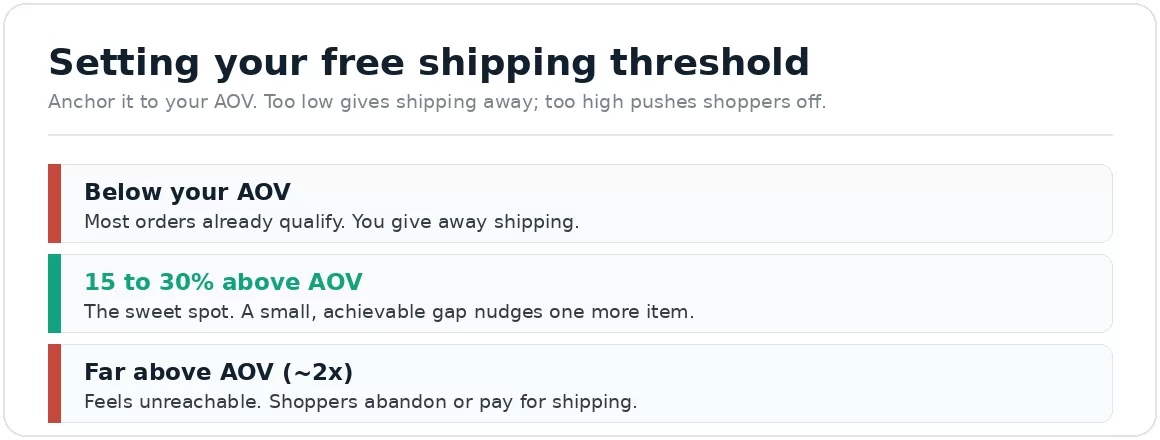
Anchor the threshold to your AOV. Too low gives shipping away; too high pushes shoppers off.
What's the margin trap to avoid?
A threshold can raise AOV while losing money, if the shipping you absorb costs more than the extra revenue you gain. Always run the net-benefit math, don’t judge by the AOV number alone.
This is the step most stores skip. Raising AOV feels like a win, but if you’re now paying shipping on far more orders, the added shipping cost can exceed the added revenue. The check is simple arithmetic: compare the extra margin from bigger orders against the extra shipping you’re now absorbing. If a threshold lifts your average order by $12 at, say, 55% margin (about $6.60 gained) but makes you absorb $8 of shipping you previously charged, that order just got less profitable, not more. The threshold has to clear that bar. This is why the metric to watch is net revenue or contribution margin, not AOV.
How do I choose the exact number for my store?
Start with the rule of thumb (15 to 30% above AOV), then test two or three thresholds and pick the one that maximizes net revenue, not the highest AOV. Most stores find their sweet spot within a few tests.
A practical process: – Calculate your current AOV (revenue divided by orders, net of refunds). – Set a starting threshold about 15 to 30% above it. – Add a progress cue (“you’re $X away from free shipping”), which consistently outperforms a static message because of the goal-gradient effect. – Test two or three levels with AOV, conversion rate, and net margin all measured, because a higher threshold might raise AOV but drop conversion. – Pick the winner by net revenue, not by whichever produced the biggest AOV.
Treat it as an A/B test with net revenue as the primary metric, since AOV alone can mislead.
Does a progress bar make a difference?
Yes, consistently. Showing shoppers how close they are to the threshold (“$12 away from free shipping”) motivates more than a static rule, because people push harder as they near a visible goal. It’s a cheap addition with a reliable effect.
The goal-gradient effect is one of the more dependable findings here: a dynamic, personalized cue that updates as the cart grows outperforms a passive “free shipping over $85” banner. It makes the gap feel small and achievable and keeps the goal in front of the shopper as they browse. Most Shopify themes and cart apps support a progress bar, and it’s one of the lowest-effort, highest-consistency parts of a threshold strategy. Pair it with relevant product suggestions (“add one of these to qualify”) and you give the shopper both the motivation and the answer. The suggested items should sit in the price gap between the cart total and the threshold, so a shopper $12 short is shown something around $12 to $20, not a $2 sticker or a $200 upgrade. Matching the suggestion to the gap is what turns the progress bar from a nag into a helpful nudge.
We set the threshold on your margin math, not a round number, then test it.
We calculate the threshold from your real AOV and shipping cost, add a progress cue, and test two or three levels with AOV, conversion, and net margin measured together, so the threshold makes money rather than just raising a vanity number.
It’s part of our conversion optimization work, judged on net revenue in your own analytics.
Frequently asked questions
Do free shipping thresholds actually increase revenue?
They increase AOV reliably when set correctly, but revenue only rises if the added order value beats the extra shipping you absorb. Run the net-benefit math and measure net revenue, not just AOV. Set well, thresholds are one of the most effective AOV levers.
What's the ideal free shipping threshold?
There’s no universal number, it should sit 15 to 30 percent above your current AOV so the gap is achievable. If your AOV is $65, try $75 to $85. Test two or three levels and pick the one that maximizes net revenue.
Can a free shipping threshold hurt my store?
Yes, if set wrong. Too high and shoppers abandon or pay for shipping; too low and you give away shipping on orders that already qualified. And even a “working” threshold loses money if absorbed shipping exceeds the extra margin. Always check the net math.
Does a progress bar help?
Yes. A dynamic cue showing how close the shopper is (“$12 away”) consistently outperforms a static message because of the goal-gradient effect. It’s a low-effort, reliable addition to any threshold strategy.
Keep reading
Sources
Free shipping is a leading driver of shopping choice. Unexpected extra costs are the number-one checkout abandonment reason at 40%, once respondents who were only browsing are excluded; browsing is the largest group overall. Baymard revises this page periodically and a later revision reports 39%, so re-check and record the date you verified it. Baymard Institute. https://baymard.com/lists/cart-abandonment-rate Free-shipping-threshold rule of thumb (set 15 to 30% above current AOV) and progress-bar (goal-gradient) effect: consistent across multiple 2026 analyses. https://www.acceleroi.com/blog/increase average order value ; https://ecomhint.com/blog/average-order-value by-industry AOV uplift percentages vary widely by source and are treated as directional here, not cited as precise figures.