CRO / Revenue
Upselling vs Cross-Selling: What Works in Ecommerce?
// deepen the purchase, or widen it

By Fracto Solutions
September 11, 2026
The short answer
Upselling offers a better or larger version of what a shopper is buying; cross-selling offers complementary products that go with it. Both raise average order value, but they work in different moments: upsells at the point of choosing, cross-sells at the cart and after purchase. Relevance matters more than which one you pick.
2
moves: upsell (better version) vs cross-sell (add-ons)
Relevance
matters more than which tactic you pick
3
placements: product page, cart, post-purchase
What's the difference between upselling and cross-selling?
Upselling moves a shopper to a better, larger, or premium version of what they’re already considering. Cross-selling adds complementary products alongside it. One deepens the purchase; the other widens it.
A clear example: a shopper is buying a camera. Upselling offers the higher-spec model or a bigger memory package, the same purchase, upgraded. Cross-selling offers a case, an extra battery, or a memory card, different items that complete the purchase. Both increase what the shopper spends, but they answer different questions. Upselling answers “would you want a better one?” Cross-selling answers “what else do you need to go with this?” Knowing which question fits the moment is what makes them work.
What to compare
Upsell
Cross-sell
What it offers
A better or larger version
Complementary add-ons
Typical order lift
Larger per order
Smaller per order
How easy the yes is
Harder (bigger ask)
Easier (small add-on)
Best placement
Product page, post-purchase
Cart, product page, post-purchase
*Both raise AOV when the suggestion is genuinely relevant; the label matters less than the match.*
Which one raises AOV more?
It depends on your products, so there’s no universal winner, and be wary of anyone quoting a precise “X% more” figure, because those numbers vary widely by store and rarely trace to a real study. In general, upselling can produce larger per-order jumps (a premium version costs more), while cross-selling wins more often (adding a small accessory is an easier yes).
Rather than chase a headline percentage, think about the size and likelihood of the lift. Upsells tend to be higher-value but lower-acceptance: convincing someone to buy the premium model is a bigger ask, but when it lands, the order jumps a lot. Cross-sells are lower-value but higher-acceptance: adding a $15 accessory to a $120 order is an easy yes, and those small wins add up across many orders. For most stores the answer isn’t either/or, it’s both, matched to where they fit in the journey. The honest measure of which works for you is your own AOV and net revenue, tested, not a number from a blog.
Where should upsells go?
At the point of choosing, on the product page, and sometimes as a post-purchase offer. Upselling works best while the shopper is still deciding what to buy, or right after they’ve committed, when a small upgrade feels easy.
Two strong placements. First, the product page: show the better version alongside the standard one so the comparison is right there while they decide, “for $20 more, get the larger size.” Second, post-purchase: after checkout but before the confirmation, offer an upgrade or add-on. Post-purchase upsells are especially low-risk because they don’t interrupt or complicate the original purchase, if the shopper says no, you’ve lost nothing, and if they say yes, the order grows. What doesn’t work is an aggressive upsell that interrupts checkout and creates doubt about the original choice.
- Upsell vs cross-sell
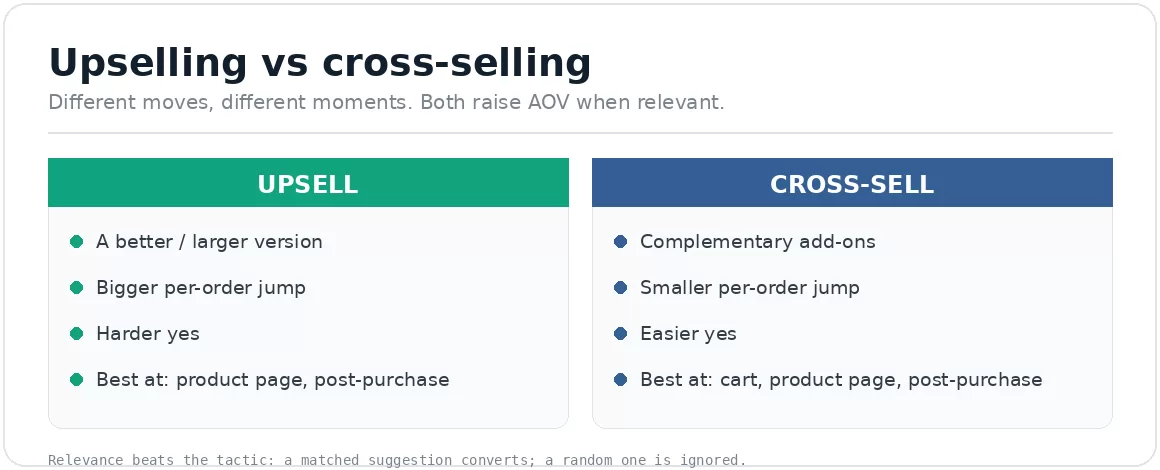
Different moves for different moments. Relevance beats the tactic label.
Where should cross-sells go?
At the cart and on the product page, where “what goes with this?” is a natural question. Cross-sells work best once the shopper has chosen the main item and is open to completing the set.
The cart is prime cross-sell real estate: the shopper has decided what they want, and relevant additions (“customers often add these”) feel helpful rather than pushy. The product page works too, showing complementary items below the main product. And post-purchase cross-sells (a follow-up email suggesting the matching item) capture shoppers after the fact. The key across all placements is that the suggestion completes what they’re already buying. A cross-sell for something unrelated to the cart is just noise.
Why does relevance matter more than the tactic?
Because an irrelevant suggestion is ignored no matter how it’s labeled, while a relevant one converts whether it’s an upsell or a cross-sell. Relevance, not the tactic name, is what actually drives the extra sale.
This is the thing most stores get wrong. They install an upsell or cross-sell app, switch on generic “you may also like” recommendations, and see little because the suggestions aren’t genuinely matched to what the shopper wants. A camera buyer shown random kitchenware ignores it; the same buyer shown the right lens or case often adds it. Relevance comes from understanding what your customers actually buy together (your own order data) and from thoughtful merchandising, not from the widget itself. Get relevance right and both tactics work; get it wrong and neither does. That’s a data and merchandising problem, which is where real AOV gains come from.
Should I use apps or build it manually?
Apps are fine to start, but their default “related products” logic is often too generic to convert well. The lift comes from curating relevant suggestions, however they’re delivered, so refine the app’s recommendations with your own product knowledge.
Shopify has many upsell and cross-sell apps, and they make implementation easy. The trap is trusting their automatic recommendations, which often surface loosely-related or bestselling items rather than genuinely complementary ones. Use the app for the mechanism (showing offers at the right moment) but curate the actual suggestions: define which products pair with which, based on what your shoppers really buy together. A well-curated manual pairing usually beats an algorithm’s guess for a small catalog. For larger catalogs, a good recommendation engine helps, but still needs oversight. A simple starting point: pull your own order data and list the items most often bought together, then wire those exact pairings as your cross-sells rather than trusting a generic “related products” default. It is low effort and grounded in what your shoppers actually do.
We curate relevant offers from your real order data, then test them.
We look at what your customers actually buy together and wire those exact pairings as upsells and cross-sells, rather than trusting a generic app default. Then we test placement and offers with AOV and net revenue measured together.
It’s part of our conversion optimization work, and it uses your own analytics to find the pairings that genuinely convert.
Frequently asked questions
What is the main difference between upselling and cross-selling?
Upselling offers a better or larger version of the item the shopper is buying; cross-selling offers complementary products that go with it. Upselling deepens the purchase, cross-selling widens it. Both raise average order value in different ways.
Which is better for increasing AOV, upselling or cross-selling?
Neither universally, it depends on your products. Upsells tend to produce bigger per-order jumps but are a harder yes; cross-sells are smaller but accepted more often. Most stores use both. Ignore precise “X% better” claims and measure your own results.
Where should I place upsells and cross-sells?
Upsells work at the point of choosing (product page) and post-purchase. Cross-sells work at the cart and product page, where “what goes with this?” is natural. Post-purchase offers for both are low-risk because they don’t disrupt the original order.
Do upsell and cross-sell apps work?
The mechanism works; the default recommendations often don’t. Generic “you may also like” suggestions rarely convert. Use the app to show offers at the right moment, but curate the actual product pairings using your own data on what customers buy together.
Keep reading
Sources
Upsell/cross-sell definitions and placement (product page, cart, post-purchase) reflect established ecommerce merchandising practice. Specific uplift percentages vary widely by source and are treated as directional, not cited as precise figures.
Relevance and curation as the primary driver of recommendation performance is consistent across 2026 AOV analyses. See the linked AOV pillar and its sources.