White-label / Agencies
Best Abandoned Cart Email Flows for Shopify Stores
// remind, reassure, then nudge

By Fracto Solutions
September 5, 2026
The short answer
The best abandoned cart email flow is a three-email sequence: a fast reminder within about an hour, a helpful nudge the next day, and a final message a few days later. Lead with the cart contents and a clear link back to checkout. Hold any discount until the last email, if at all.
The best abandoned cart email flow is a three-email sequence: a fast reminder within about an hour, a helpful nudge the next day, and a final message a few days later. Lead with the cart contents and a clear link back to checkout. Hold any discount until the last email, if at all.
Abandoned cart emails are among the highest-return messages a Shopify store can send, because the shopper already showed intent by adding to cart. But most stores run a single generic reminder and leave money on the table. This guide covers the flow that actually works: how many emails, when, what they say, and the discount question. It’s the email-flow deep-dive under the email and lifecycle pillar, and it pairs with the broader abandoned cart recovery guide.
Why do abandoned cart emails work so well?
Because the shopper already demonstrated purchase intent. You’re not persuading a stranger, you’re reminding someone who was moments from buying, which is why these emails outperform standard campaigns.
Abandoned cart flow benchmarks
Metric
Average
Top 10%
Open rate
50.5%
65.3%
Click rate
6.25%
--
Placed order rate
3.33%
--
Revenue per recipient
$3.65
$28.89
Source: Klaviyo, “The abandoned cart benchmarks report”, analysing 2023 performance data across more than 143,000 abandoned cart flows, published 2024. This is the highest revenue per recipient of any common flow in that dataset. The gap between the average and the top decile is the point worth noting: the same flow type earns roughly eight times more for the brands that build it properly.
On Klaviyo’s benchmark data, abandoned cart flows average around a 50% open rate and roughly $3.65 revenue per recipient, well above regular promotional emails. The reason is intent: adding to cart is a strong signal, and a well-timed reminder often just needs to remove whatever small friction (a distraction, a question, a hesitation) stopped the purchase. One honest caveat: published conversion and recovery figures vary widely by source and definition, so use benchmarks as direction and measure your own flow’s revenue per recipient over time.
How many emails should an abandoned cart flow have?
Three is the reliable standard. Multi-email sequences consistently recover more than a single reminder, and three balances thoroughness against annoyance.
The evidence across sources is consistent on this point even where exact numbers differ: three-email sequences meaningfully outperform single-email reminders. One email catches the genuinely distracted; the follow-ups catch people who needed another touch or a little more reason. Going far beyond three brings diminishing returns and rising unsubscribes, so three is the sweet spot for most stores. Think of each email as having a distinct job rather than just repeating the reminder.
What should the three-email sequence say, and when?
Each email has a different job. The first reminds, the second helps, the third creates gentle urgency, spaced over roughly three days.
Email 1, the reminder (within ~1 hour). Short and simple: “you left something behind,” the cart contents with product image, and a clear button back to checkout. Sending within the hour matters, it captures a large share of total recoveries while the shopper still remembers. No discount here.
Email 2, the helpful nudge (~1 day later). Address why people hesitate: add trust signals (reviews, guarantees, return policy), answer common questions, and reinforce the value. Still no discount, you’re removing doubt, not buying the sale.
Email 3, the final message (~3 days later). Gentle urgency (“your cart is about to expire”) and, if you choose to use one, a modest incentive. This is the place for a discount, if at all, so you’re not training shoppers to abandon carts for a coupon.
Keep the tone helpful, not pushy, “still interested?” beats “DON’T MISS OUT.” You’re recovering a sale, not pressuring a stranger.
- The 3-email cart sequence
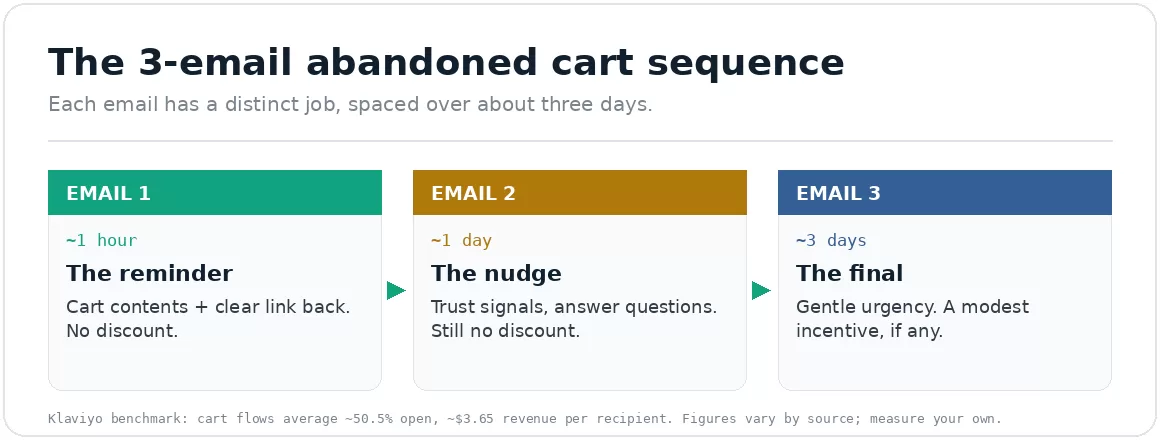
Each email has a distinct job. Klaviyo benchmarks shown; figures vary by source, so measure your own.
Should abandoned cart emails include a discount?
Cautiously, and late if at all. Leading with a discount trains shoppers to abandon carts on purpose to trigger the coupon, which erodes margin over time.
This is the most common mistake. If every abandoned cart gets an immediate discount, shoppers learn the pattern and abandon deliberately. Better to reserve any incentive for the final email, and even then consider whether free shipping or a small perk works instead of a straight discount. Many carts recover with no discount at all, just a timely reminder and reassurance, because the issue was friction or distraction, not price. Test whether a discount actually lifts net revenue for your store before making it standard; sometimes it just gives margin away on sales you’d have won anyway.
What makes an abandoned cart email convert?
The essentials: show the cart contents, make the return-to-checkout link obvious, load fast on mobile, and reconnect the shopper with the specific product they wanted.
A few specifics that consistently help. Include the product name and image, “you left the Blue Wool Sweater in your cart” reconnects better than “you left something behind.” Make the CTA a single, obvious button straight back to the checkout, not the homepage. Keep it clean and fast on mobile, where most of these emails are opened. And make sure the underlying checkout is actually worth returning to, if your checkout has the friction that caused the abandonment in the first place, the email just sends people back to the same wall. That’s why cart-email work pairs with fixing checkout itself, covered in the checkout optimization framework.
How do I measure if my flow is working?
Track revenue per recipient and recovered revenue over time, not just open rates. Opens tell you the subject line worked; revenue tells you the flow worked.
Set your own baseline and watch it, comparing to benchmarks only as a rough guide since they vary so much. The metric that matters is revenue per recipient (and total recovered revenue), because it captures whether the flow actually brings sales back, not just whether people opened it. If opens are high but revenue is low, the problem is the email content or the checkout it leads to, not the subject line. Re-check periodically and improve the weakest email in the sequence.
We find where value leaks, fix the highest-impact issue first, and prove the gain in your own numbers.
That is the same baseline-first method behind our conversion optimization work: confirm the data is trustworthy, fix the biggest leak, then prove the gain in your own reporting.
Frequently asked questions
How long should I wait to send the first abandoned cart email?
About an hour after abandonment. That first email captures a large share of total recoveries while the shopper still remembers their cart. Waiting too long lets intent fade.
Is one abandoned cart email enough?
Usually not. Multi-email sequences consistently recover more than a single reminder. A three-email flow is the reliable standard, each email doing a distinct job: remind, reassure, then gently create urgency.
Should the first email have a discount?
No. Leading with a discount trains shoppers to abandon carts deliberately. Reserve any incentive for the final email, if you use one at all, many carts recover with just a timely reminder and reassurance.
What's the difference between abandoned cart and abandoned checkout emails?
Cart abandonment is leaving after adding to cart; checkout abandonment is leaving after starting checkout. Checkout abandoners showed higher intent (they began buying), so those flows can be even more valuable. The principles are the same.
Sources
Klaviyo abandoned cart flow benchmarks (public dataset): average open rate ~50.5%, revenue per recipient ~$3.65; three-email sequences outperform single emails; first email within ~1 hour captures a large share of recoveries. Source: Klaviyo, “The abandoned cart benchmarks report”, analysing 2023 performance data across more than 143,000 abandoned cart flows, published 2024; average placed-order rate 3.33%, top 10% reaching ~65.3% open and ~$28.89 revenue per recipient. Exact conversion and recovery figures vary by source and definition.
Baymard Institute, cart abandonment context. https://baymard.com/lists/cart-abandonment-rate