Conversion / Shopify
Shopify Abandoned Cart Recovery: How to Win Back Lost Sales
// win back what the checkout still loses

By Fracto Solutions
July 29, 2026
The short answer
Recover abandoned carts on Shopify with an automated flow that triggers soon after someone leaves: a reminder within about an hour, a follow-up that answers common hesitations, and an optional final nudge. Every message links straight back to the filled cart. Recovery wins back a share of lost sales, not all of them.
Recovery is your second line of defence, not your first. The bigger win is always fixing the checkout so fewer people leave in the first place. But even a well-built store loses carts, so a recovery flow is worth setting up once and letting run.
This is the recovery half of how to reduce cart and checkout abandonment on Shopify. That guide covers prevention; this one covers winning back what you still lose.
How does Shopify abandoned cart recovery actually work?
An automated sequence of messages triggered when a shopper adds items, reaches the cart or checkout, then leaves without buying.
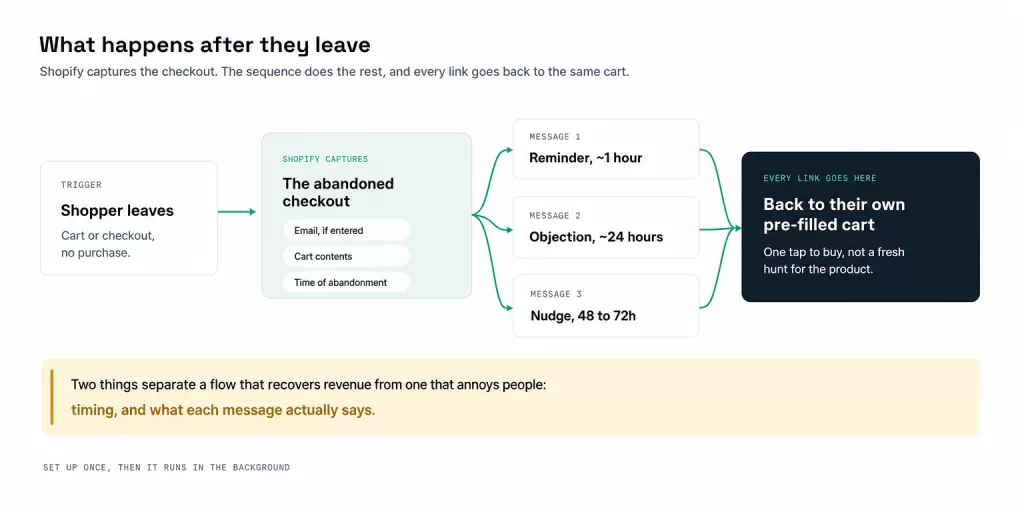
Shopify captures the abandoned checkout, including the shopper’s email if they entered it, and either Shopify’s built-in recovery or a connected tool sends timed follow-ups. Each message carries a link back to the shopper’s own pre-filled cart, so returning to buy takes one tap rather than a fresh hunt for the product.
Two things separate a flow that recovers revenue from one that annoys people: timing, and what each message actually says. Get those right and the sequence quietly earns money in the background.
What should an abandoned cart email sequence include?
Three messages is the reliable default: a reminder, an objection-handler, and a final nudge.
01. The reminder (within about an hour). Short and helpful, not salesy. Remind them what they left, show the item, link straight back to the cart. Many recoveries happen here, on people who simply got distracted.
02. The objection-handler (around 24 hours later). Address why people hesitate: shipping cost and timing, returns, sizing, or trust. Answer the doubt rather than repeating the reminder.
03. The final nudge (around 48 to 72 hours). A last prompt, and the only place to consider a modest incentive if margins allow. Leading with a discount trains shoppers to abandon on purpose, so hold it back.
- The three-message sequence
Message 1
Reminder
within~1hour
Message 2
Objection-handler
~24hours
Message 3
Final nudge
~48 to 72 hours
The reliable default. A prompt reminder catches the distracted, an objection-handler answers the hesitant, and a final nudge closes the rest. Hold any incentive until the last message so you don’t train shoppers to abandon on purpose.
Should I use email, SMS, or both?
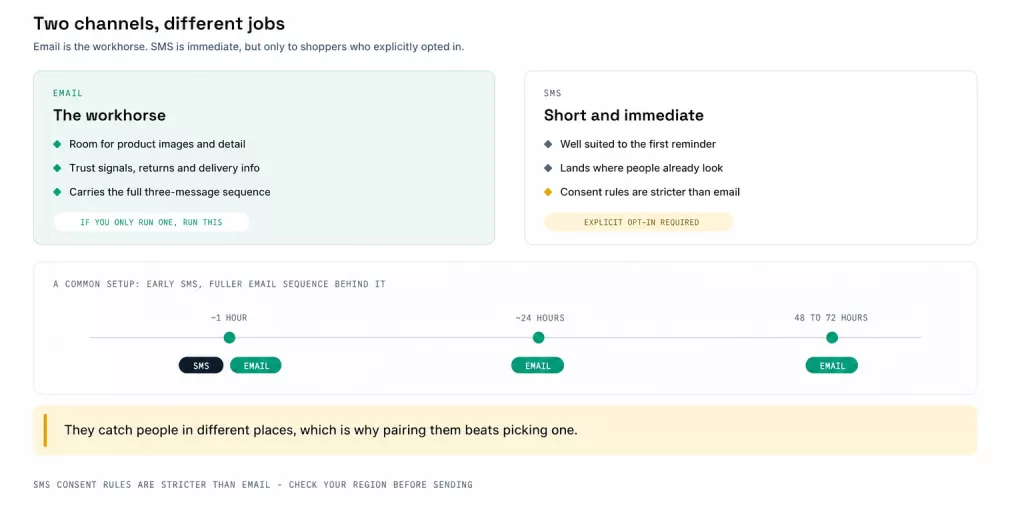
Both, if you have SMS consent, because they catch people in different places.
Email is the workhorse: room for product images, trust signals, and links. SMS is short and immediate, well suited to the first reminder, but only to shoppers who have explicitly opted in, since SMS consent rules are stricter than email. A common setup pairs an early SMS reminder with the fuller email sequence behind it. If you only run one channel, run email.
How soon should the first message go out?
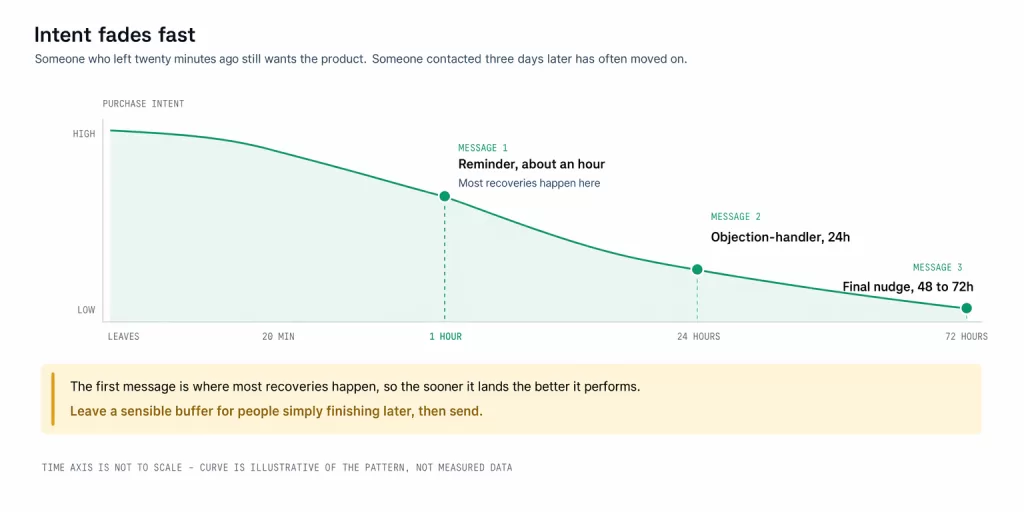
Within roughly an hour of abandonment, because intent fades fast.
Someone who abandoned twenty minutes ago still remembers the product and why they wanted it. Someone contacted three days later has often moved on or bought elsewhere. The first message is where most recoveries happen, so the sooner it lands, while still leaving a sensible buffer for people simply finishing later, the better it performs. Later messages can space out over the following days.
Does Shopify recover carts automatically, or do I need an app?
Shopify has built-in recovery for a basic single email. For anything more, a dedicated tool gives you the segmentation and multi-step flows that recover meaningfully more.
- Shopify Admin — Abandoned checkouts
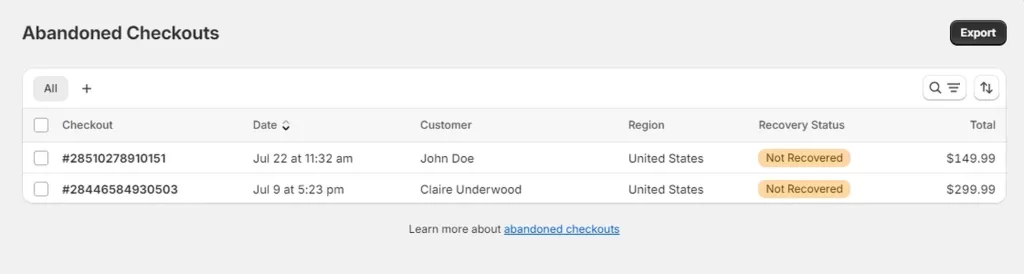
Shopify logs every abandoned checkout with its recovery status. Confirm the built-in recovery is switched on, then decide whether a dedicated flow is worth the extra reach.
Confirm the built-in recovery is actually enabled first, since many stores never turn it on. Beyond that, an email and SMS platform lets you run the full three-message sequence, add SMS, segment by cart value or customer type, and test what works. The built-in feature is a floor, not a ceiling.
Is recovery better than fixing my checkout?
Fixing the checkout comes first. Recovery wins back a portion of the carts you lose; a better checkout stops you losing them at all, which helps every future shopper.
Think of it as order of operations. If your checkout leaks badly because of surprise costs, forced account creation, or a long form, recovery emails are bailing water out of a boat with a hole in it. Fix the hole first. In one recent engagement we rebuilt a client’s buying path, product page, quick-view add-to-cart, and a persistent sticky add-to-cart, so more shoppers reached checkout in fewer clicks; checkout starts rose 5% and add-to-cart 3%, A/B tested at 95% confidence. Recovery then works on the smaller number who still slip through.
The two work together: fix the checkout to lose fewer carts, then recover a share of what remains.
We find the leak, fix it, and prove the gain in your own numbers.
Recovery flows are worth running, but they work on the carts a leaky checkout hands them. We map the funnel, fix the friction losing the most revenue, then let a tuned recovery sequence mop up the rest.
Frequently asked questions
What is a good abandoned cart recovery rate?
It varies widely by store, offer, and how good the sequence is, so track your own rate inside Shopify rather than chasing a benchmark. Against a roughly 70% abandonment rate, even a modest recovery rate adds up over a year.
When should the first recovery email be sent?
Within about an hour of abandonment, while the shopper still remembers the product and their intent. Most recoveries come from this first message.
How many recovery emails should I send?
Usually three: a reminder, an objection-handler, and a final nudge. Beyond that you tend to annoy more shoppers than you recover.
Should I offer a discount to recover a cart?
Only in the final message, and only if margins allow. Leading with a discount teaches shoppers to abandon deliberately to trigger one.
Do recovery emails replace fixing my checkout?
No. They recover a share of lost carts, but fixing the checkout prevents the loss for every future shopper, which protects far more revenue.
Keep reading
Sources
Baymard Institute, Cart Abandonment Rate Statistics: ~70% average across 50 studies — baymard.com
Fracto client engagement: rebuilt buying path, +5% checkout starts and +3% add-to-cart, A/B tested at 95% confidence.