CRO / Ecommerce
CRO Agency vs. In-House Team: Which Is Right for Your Store?
// the traffic threshold that decides this, not the budget line

By Fracto Solutions
September 1, 2026
The short answer
In-house works once you have enough traffic to reach statistically significant tests within weeks, and once the role has real organizational priority behind it. Below that, an agency’s cross-client pattern recognition, and its built-in accountability, substitutes for what a single hire often can’t get inside a company where CRO isn’t clearly anyone’s job.
This is usually framed as a budget question, but the more useful lens is traffic volume and organizational ownership. Here is the honest comparison, with the numbers most stores never actually run.
The two options cost more alike than the sticker prices suggest
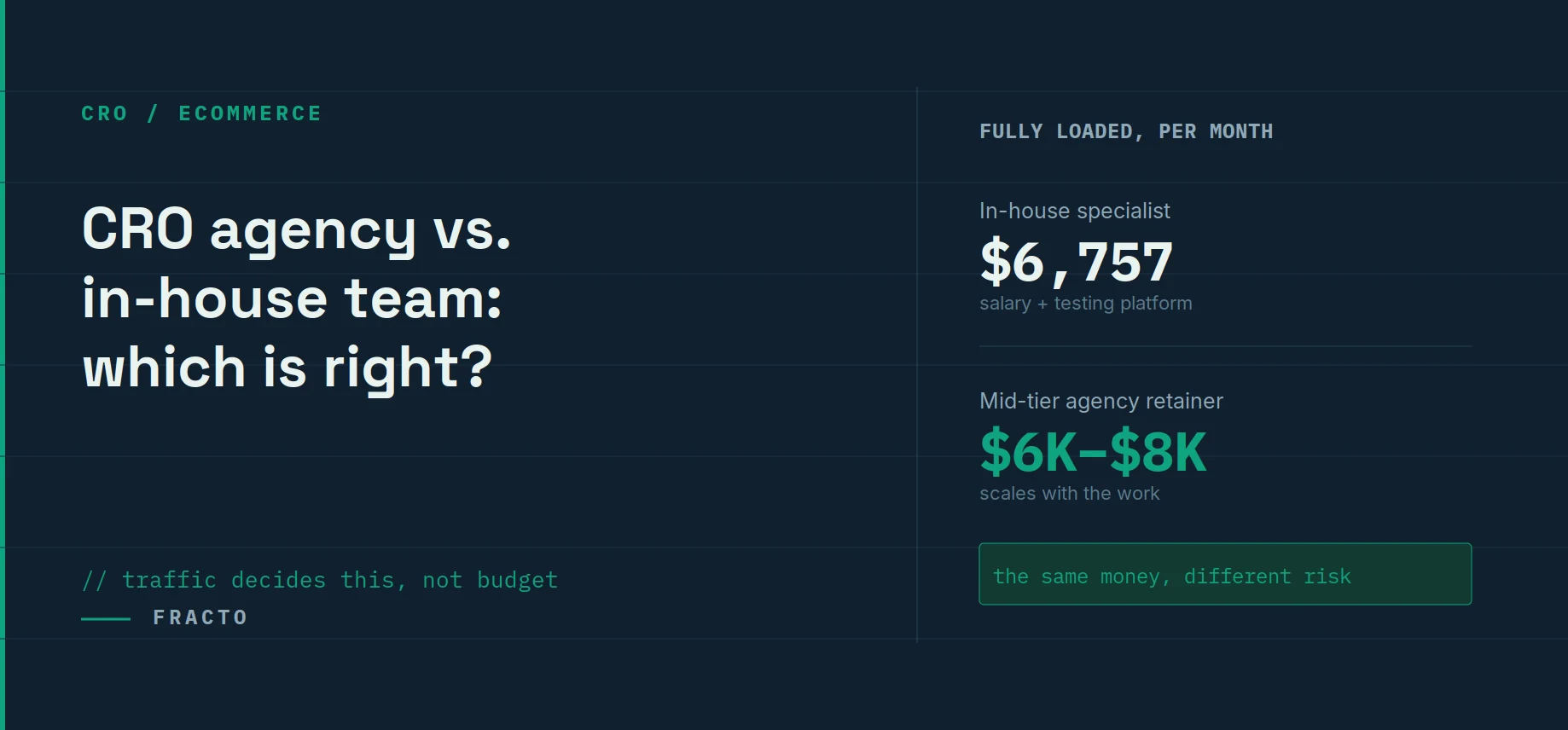
Once tooling is included, a fully loaded in-house specialist lands at roughly $6,757 a month, which sits inside the $6,000 to $8,000 mid-tier agency range. The decision is therefore not really about price.
Because the headline numbers look so different, an annual salary against a monthly retainer, most stores never run the comparison on the same basis. When you do, the interesting differences are cost behavior and accountability, not cost.
The ownership problem hiring alone doesn't solve
Hiring one person into an organization that has never assigned CRO to anyone doesn’t automatically fix it, and this is where in-house plans most often fail quietly.
- How CRO is actually staffed across companies today
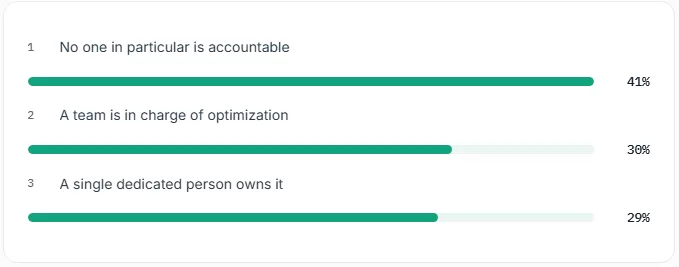
CXL, State of Conversion Optimization Report, 2016 (722 respondents); its 2018 follow-up found ownership had improved, with over 60% assigning CRO to a person or team. A single in-house hire dropped into an organization with no established owner risks becoming a title without the cross-team priority to actually ship changes.
Why some in-house hires underdeliver despite a real budget
Not a skill problem, usually an organizational one. If engineering, design, and marketing haven’t cleared priority for the role’s requests, a specialist with a $73,000 salary can end up in the same stalled position as a company with no owner at all, just with a bigger price tag attached.
What each option actually costs on salary alone
A CRO specialist averages roughly $73,000 a year; a manager, roughly $121,000. An agency retainer ranges far more widely, from $2,000 to $25,000+ a month.
- 2026 salary and retainer ranges
Option
Typical cost
Cost behavior
CRO specialist (in-house)
$73,098/yr avg.
Fixed
CRO manager (in-house)
$121,359/yr avg.
Fixed
Agency retainer
$2,000 to $25,000+/mo
Scales with scope
In-house salary averages: Salary.com, Aug 2026, US national data. Agency range: 2026 CRO pricing guide.
The tooling cost most in-house budgets miss
Salary is the visible cost. Tooling, ramp-up time, and the cost of an unfilled seat while you hire sit below the waterline.
- The hidden cost of an in-house hire
- Salary
$73,098/yr
- Testing platform
$7,980 to $40,000+/yr
- Hiring and ramp-up time
weeks unfilled or unproductive
- Cross-team priority cost
design, dev time competing for it
The number quoted in a hiring plan is almost always the salary line above the waterline. The full cost of the role sits below it.
An in-house hire needs an actual A/B testing platform to do the job, and that line item alone varies by an order of magnitude depending on the vendor and traffic volume.
- Testing platform cost by vendor
VWO, mid-market
Growth plan, ~100K MTU
$665 to $798/mo billed annually
Pro tier: $1,336/mo
~$8K to $16K
per year
Optimizely, enterprise-grade
Essential tier, entry deployments
$25,000 to $40,000/yr reported
Mid-market: $65K to $120K/yr
$25K+
per year, minimum
VWO does not publish these figures on its public pricing page; they appear only in the in-app checkout after registration, and the numbers here come from multiple independent 2026 pricing analyses that agree.
Optimizely publishes no list price at all, so its figures are reported buyer estimates from a single 2026 pricing analysis, and they sit at the low end of what is reported.
Other 2026 analyses put the entry point nearer $36,000/yr, and Vendr’s marketplace data gives a median of about $81,447/yr across 126 purchases, with a low of roughly $26,000. Treat both vendors as negotiating ranges, not quotes.
Note also that VWO’s free Starter tier is being discontinued, and Wingify announced an AB Tasty merger in January 2026, so this tier structure may move.
The real, worked cost comparison
Add salary and a mid-market testing platform together, and an in-house hire’s true annual cost lands much closer to a premium agency retainer than the salary figure alone suggests.
- Total annual cost, salary plus tooling
Component
Annual cost
CRO specialist salary
$73,098
VWO Growth testing platform
$7,980
Total in-house, specialist + tooling
~$81,078/yr (~$6,757/mo)
The two options land closer than the headline numbers suggest. $6,757 a month for a fully-loaded in-house specialist sits almost exactly inside the $6,000 to $8,000 mid-tier agency retainer range.
The real difference isn’t the number, it’s the cost behavior and the accountability structure.
The in-house cost is fixed and its success still depends on internal ownership actually being cleared, while the retainer scales with the work and contractually assigns follow-through.
Illustrative combination of the salary and tooling figures cited above; actual totals vary by hire location, benefits load, and platform tier chosen.
The decision rule
Traffic volume and organizational readiness, not sticker price, should decide this, since the totals above are often closer than expected.
- Which to choose
if
High, sustained traffic, fast test cycles, and cross-team priority already cleared
enough volume to hit significance in weeks
In-house pays for itself
Fixed cost is justified when testing volume is high enough to keep a hire fully utilized and the organization actually clears priority for their work.
if
Lower or inconsistent traffic, or CRO has never had a clear internal owner
below significance threshold, or CRO has no established owner
Agency is the better fit
Cross-client pattern recognition and contractual accountability substitute for both the sample size and the organizational priority a single store often lacks.
if
Not sure yet which category you’re in
testing the waters
Start with an agency audit
Lower commitment than a full-time hire, and tells you your actual traffic and testing capacity before deciding. Our diagnostic walkthrough shows the shape of that first pass.
The hybrid model most stores land on
Start with an agency for the audit and roadmap, implement the highest-impact fixes, then consider an in-house hire once volume and organizational readiness both justify it.
This avoids paying for a full-time role, plus tooling, before there’s enough testing volume to keep it productively busy, and de-risks the decision by proving out the value of CRO work, and building the internal habit of prioritizing it, before committing to fixed headcount and a testing platform contract.
We work as the flexible option while you find your testing rhythm.
Start with an audit and roadmap from our conversion optimization service, scale the engagement as traffic and testing demand grow, no fixed headcount or platform contract required upfront, and a named team accountable for follow-through from day one.
On one engagement, this approach lifted conversion 6% and revenue per visitor 7%, both A/B tested at 95% confidence.
Frequently asked questions
What traffic level justifies an in-house CRO hire?
There’s no universal number, but broadly, once you can reach statistically significant test results within a few weeks rather than a few months, an in-house hire’s fixed cost becomes easier to justify.
Does the in-house cost comparison include tooling?
It should. A mid-market testing platform runs roughly $665 to $798 a month at around 100K monthly tracked users, rising to about $1,336 a month on a Pro tier, on top of salary. Enterprise platforms start far higher. That changes the real total cost of an in-house hire significantly.
Can I switch from agency to in-house later?
Yes, many stores start with an agency and transition to an in-house hire once testing volume and revenue justify a dedicated role.
Is a mid-tier agency retainer actually cheaper than an in-house hire?
Often close, once tooling is included on the in-house side. A specialist’s salary plus a mid-tier testing platform can land within a similar range to a mid-tier agency retainer. The difference is that the in-house cost is fixed regardless of testing volume, while the retainer scales with the work being done.
Why does an in-house hire sometimes fail to deliver even with a real budget?
Often an ownership problem, not a skill problem. CXL’s 2016 research found 41% of companies had no one specifically accountable for CRO; by its 2018 report, over 60% had given it to a person or team.
Hiring one person into an organization that hasn’t cleared space, priority, or cross-team cooperation for the role can recreate the same stalling pattern with a bigger price tag.
Sources
CRO ownership structure (41% no one accountable, 30% team, 29% single person) — CXL, 2016 State of Conversion Optimization Report, 722 respondents. Its 2018 report found ownership had improved, with over 60% assigning CRO to a person or team.
CRO specialist average salary, $73,098/yr — Salary.com, Aug 2026. CRO manager average, $121,359/yr — Salary.com, Aug 2026. Both are US national averages and are revised monthly.
CRO agency pricing range, $2,000 to $25,000+/month — Conversion Rate Optimization Pricing Guide, 2026. Single-source industry guide; agency pricing is not systematically surveyed, so treat this as an observed range rather than a benchmark.
VWO Growth plan pricing, $665 to $798/mo at 100K MTU — in-app checkout pricing, not published on VWO’s public pricing page; corroborated across multiple independent 2026 pricing analyses that agree.
Optimizely Essential tier pricing floor, $25,000 to $40,000/yr — single 2026 Optimizely enterprise pricing analysis (custom-quoted; figures are reported estimates, not list prices).
This is the lowest floor in circulation: other 2026 analyses report an entry point nearer $36,000/yr, and Vendr marketplace data shows a median of about $81,447/yr across 126 logged purchases.