CRO / Ecommerce
How to Choose the Best CRO Agency for Your Ecommerce Store
// what separates a good fit from a bad one, beyond the client logos

By Fracto Solutions
September 1, 2026
The short answer
Ask for a real sample audit, check how they prioritize fixes by impact versus effort, and confirm they measure revenue per visitor, not just raw conversion rate. Expect pricing anywhere from $2,000 to $25,000+ a month depending on scope, with most mid-tier engagements landing around $6,000 to $8,000.
Choosing a CRO agency is a decision-stage search: you’ve likely already accepted you need help and are now trying to avoid picking the wrong one. The market spans a genuinely wide price range for genuinely different scopes of work, so knowing what you’re actually paying for matters more than the number on the invoice.
What are you actually buying when you hire a CRO agency?
Less a set of tests than a process someone is contractually obliged to finish. That distinction is what separates a retainer that works from one that produces a slide deck.
Most stores arrive at this decision after an internal effort stalled, and the stall is rarely a bad test result. It is that no one had the time, mandate, or cross-team standing to see the loop through. An agency sells the loop, and, more usefully, sells accountability for it.
- Why the loop stalls internally
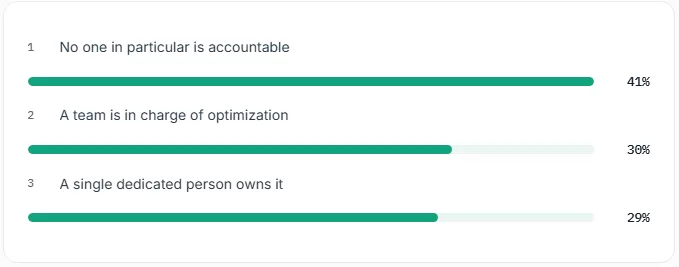
CXL, State of Conversion Optimization Report, 2016 (722 respondents); its 2018 follow-up found ownership had improved, with over 60% assigning CRO to a person or team. A retainer contract inherently assigns accountability that many internal efforts never had, which is itself part of what you’re paying for.
What this means for your evaluation
If CRO has never been anyone’s job at your company, the agency conversation isn’t just “can they run tests,” it’s “will they actually own the follow-through.” Ask directly who on their side is accountable for your account week to week, not just who ran the initial audit.
What a good agency does differently
Any agency can show client logos. What separates a real diagnostic process from a template is visible before you sign anything.
Sample audit. Ask for an actual example, or a lightweight version on your own store during the sales conversation. How they diagnose problems tells you more than any case study, and our own walkthrough of how to diagnose Shopify conversion issues shows what that process should actually cover.
Prioritization method. Fixes ranked by impact versus effort, with a clear, specific reason one comes before another, not a flat list presented as equally urgent.
Success metric. Revenue per visitor and average order value tracked alongside conversion rate, since raw conversion rate alone is easy to move in the wrong direction, for example by cutting cheap traffic that never converted anyway.
Engagement scope. A clear line on what’s actually included: audit only, implementation, ongoing testing, or some combination.
Named accountability. A specific person or team responsible for your account, not a rotating pool, so the ownership gap that stalled your internal effort doesn’t just move to a new vendor.
What CRO actually costs in 2026
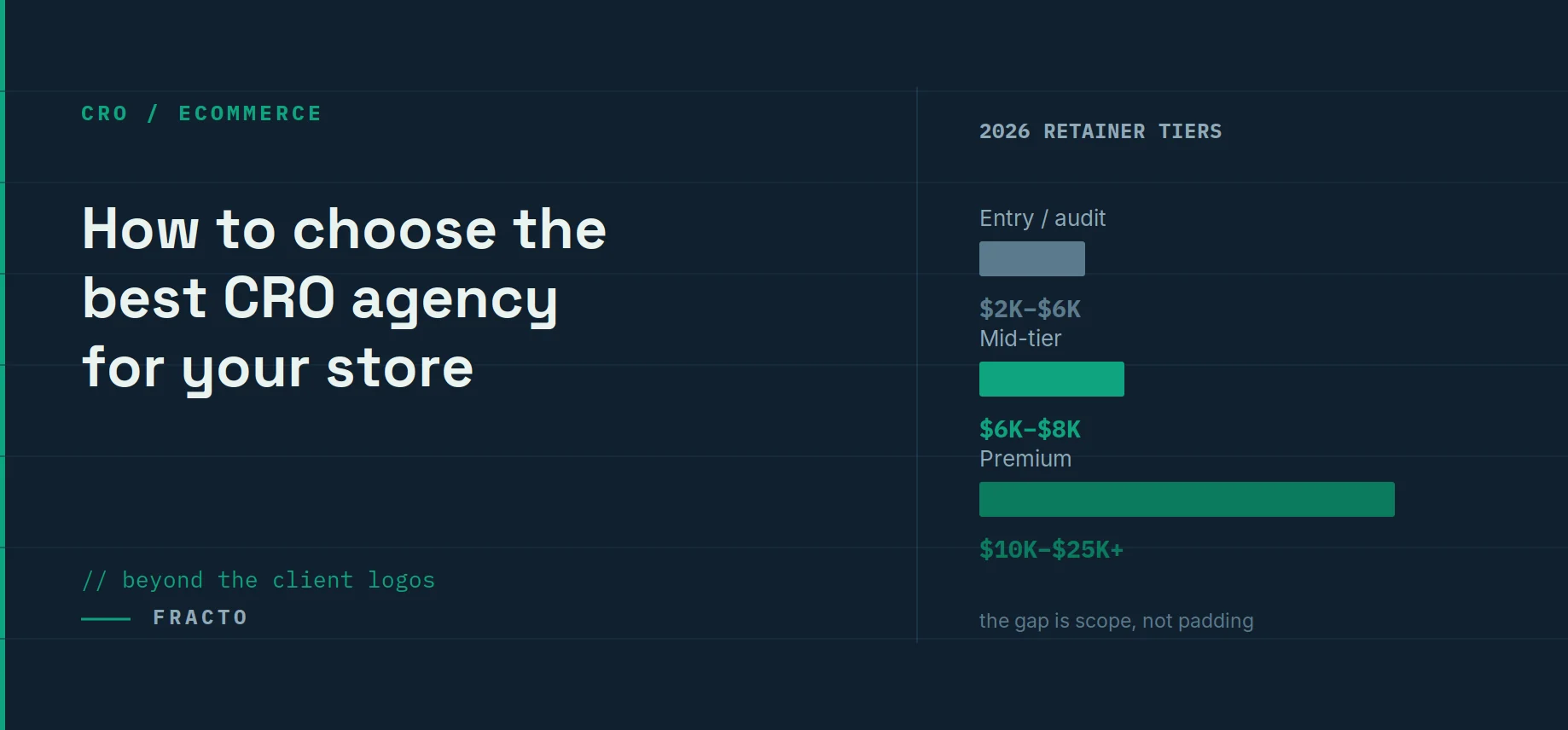
Retainers commonly range from $2,000 to $25,000+ a month. The gap between tiers is scope, not padding, entry tiers are typically audit-only, while premium tiers include continuous testing.
- 2026 CRO pricing tiers
Tier
Typical monthly range
What's usually included
Entry / audit-only
$2,000 to $6,000
One-time diagnostic and fix list, no ongoing testing
Mid-tier retainer
$6,000 to $8,000
Audit plus ongoing testing at moderate cadence
Premium / high-traffic
$10,000 to $25,000+
Continuous testing, dedicated strategist, monthly reporting
The overall $2,000 to $25,000+ span and the $6,000 to $8,000 mid-tier come directly from a 2026 CRO pricing guide. The entry and premium bands, and what each tier includes, are our interpretation of how that span breaks down in practice, not figures stated by the guide. Agency pricing is not systematically surveyed, so treat all three as observed ranges rather than benchmarks.
Entry-tier versus premium: what actually changes
The price difference tracks testing cadence and dedicated attention, not the quality of the initial diagnosis.
- Same diagnostic quality, different depth of ongoing work
Entry / audit-only
One diagnostic pass
Fix list handed off
No ongoing testing
You implement, or hire separately for that
Mid-tier / premium retainer
Same initial diagnostic
Continuous testing cycle
Implementation support included
Monthly reporting and re-prioritization
Neither tier should skip the diagnostic step. The difference is what happens after the first fix list is delivered, and whether anyone stays accountable for it.
Red flags worth watching for
A default recommendation to redesign the whole site, vague success metrics, and reluctance to share a sample audit are the three most common warning signs.
A full redesign resets your existing data and testing history, and it’s slower and more expensive than targeted fixes. A good CRO partner should be able to justify why one is genuinely necessary for your specific store rather than defaulting to it as the answer to every problem. Similarly, if an agency can’t clearly explain what they’ll measure success against beyond “conversion rate will go up,” or who specifically owns your account, that’s a sign the same ownership gap that stalled your internal effort will simply move to a new vendor.
The evaluation checklist before you sign
Five signals split cleanly into what a real diagnostic process looks like, and what a template pitch looks like.
- Green flags vs. red flags
- Green flags
- Shows a real sample audit, or runs a light one on your store live
- Names a specific person or small team accountable for your account
- Tracks revenue per visitor and AOV, not just conversion rate
- Ranks fixes by impact versus effort, with a stated reason for the order
- Clear on what's included: audit, implementation, ongoing testing
- Green flags
- Recommends a redesign before auditing anything
- Can't say who specifically will own your account week to week
- Only success metric offered is "conversion rate will go up"
- Presents every recommendation as equally urgent
- Vague on scope until after the contract is signed
Ask these five questions directly in the sales conversation. A confident, specific answer on the left column outweighs any case study on a landing page.
We show you the audit before you commit to anything.
You see exactly how our conversion optimization service diagnoses your store’s leaks and prioritizes fixes before deciding whether to move forward, no redesign pitch, no vague success metrics, and a named team accountable for follow-through.
On one engagement, that diagnostic-first approach lifted conversion 6% and revenue per visitor 7%, both A/B tested at 95% confidence.
Frequently asked questions
What should a good CRO audit include?
A funnel breakdown, specific diagnosed friction points rather than generic advice, and a prioritized fix list ranked by expected impact versus effort to implement.
How much should a CRO agency cost in 2026?
Typical retainers range from $2,000 to $25,000 or more per month, with mid-tier specialists commonly landing between $6,000 and $8,000 per month. Entry-tier engagements are often audit-only, without ongoing testing.
How long until I see results from a CRO agency?
Depends on traffic volume and the size of the fix. High-impact, low-effort fixes like checkout simplification often show measurable results within a few weeks of shipping, while smaller tests can take months to reach significance on lower-traffic stores.
Should I be worried if an agency recommends a full redesign?
Not automatically, but ask why. A redesign resets your existing data and testing history and is slower and more expensive than targeted fixes. A good agency can justify why one is genuinely necessary rather than defaulting to it.
Why do so many internal CRO efforts stall before an agency is even considered?
In CXL’s 2016 State of Conversion Optimization Report, 41% of companies had not assigned CRO to anyone specific. Its 2018 follow-up found this improved, with over 60% giving it to a person or team. A test with no clear owner rarely gets followed through, which is often the actual reason a business starts looking for outside help.
Keep reading
Guide
CRO agency vs. in-house team: which is right for you?
Sources
CRO agency pricing ranges, $2,000 to $25,000+/month — Conversion Rate Optimization Pricing Guide, 2026. Single-source industry guide; agency pricing is not systematically surveyed, so treat this as an observed range rather than a benchmark.
30% of marketing budget CRO allocation guideline — Crazy Egg CRO budgeting guidance, cited in the above 2026 pricing guide.
CRO ownership structure (41% no one accountable, 30% team, 29% single person) — CXL, 2016 State of Conversion Optimization Report, 722 respondents. Its 2018 report found ownership had improved, with over 60% assigning CRO to a person or team.