CRO / Mobile
Why Is My Mobile Conversion Rate So Low?
// some gap is normal; a big one is fixable

By Fracto Solutions
September 14, 2026
The short answer
Your mobile conversion rate is probably low because of friction, not weak intent: a hard-to-complete checkout, slow load times, and cramped tap targets on a small screen. Some gap versus desktop is normal (mobile converts lower everywhere), but a large gap points to fixable problems, most often in mobile checkout.
Friction
Checkout
By device
segment your data, or the gap stays hidden
Is a low mobile conversion rate normal?
Partly. Mobile converts lower than desktop everywhere, so some gap is expected and not a problem. But a large gap, or a mobile rate far below your category norm, signals fixable friction rather than just the nature of mobile.
Set expectations first. Across 2026 data, mobile carries most ecommerce traffic (roughly 70 to 78 percent) yet converts meaningfully lower than desktop, commonly around half to two-thirds of the desktop rate, though sources vary on the exact figure. So if your mobile rate is somewhat below desktop, that’s the normal pattern, not a crisis. What warrants investigation is a gap wider than that, a mobile rate that’s a small fraction of desktop, or a sudden drop, because those point to specific friction you can fix. The way to tell is to compare your device gap to the typical range and, more importantly, to your own history.
What actually causes low mobile conversion?
Friction that’s worse on a small screen: a difficult checkout, slow load, hard typing, and cramped tap targets. The shopper wants to buy; the mobile experience makes it harder than it should be.
The main causes, roughly in order of impact:
Difficult checkout. The biggest one. Forms that fit on one desktop screen get split across several on mobile, and each screen is another chance to abandon. Mobile checkout abandonment runs well above desktop for this reason.
Slow load times. Mobile connections are often slower, and shoppers abandon slow pages quickly. Speed hits mobile harder than desktop.
Hard typing and long forms. Entering details on a phone is error-prone, so every unnecessary field costs more conversions than it would on desktop.
Cramped tap targets. Buttons too small or too close together cause misfires and frustration.
A hidden or hard-to-reach add-to-cart. If the primary action isn’t obviously visible and thumb-reachable, shoppers stall.
Notice these are all experience problems, not intent problems. Mobile shoppers aren’t less serious; they’re fighting a harder interface. That distinction matters because it changes what you do about it: you don’t need to attract different shoppers, you need to remove the obstacles in front of the ones you already have. Almost every cause on this list is something you control directly, which is why low mobile conversion is usually one of the most fixable problems a store has.
Cause
Why it hits mobile harder
First check
Difficult checkout
Forms split across small screens
Mobile checkout completion vs desktop
Slow load
Mobile networks and devices are slower
Mobile Core Web Vitals
Hard typing / long forms
Thumb-typing is error-prone
Number of required fields
Cramped tap targets
Small, close buttons misfire
Button size and spacing on a real phone
* Diagnose device-first: segment analytics by device, then watch real mobile sessions.*
- Why mobile runs low
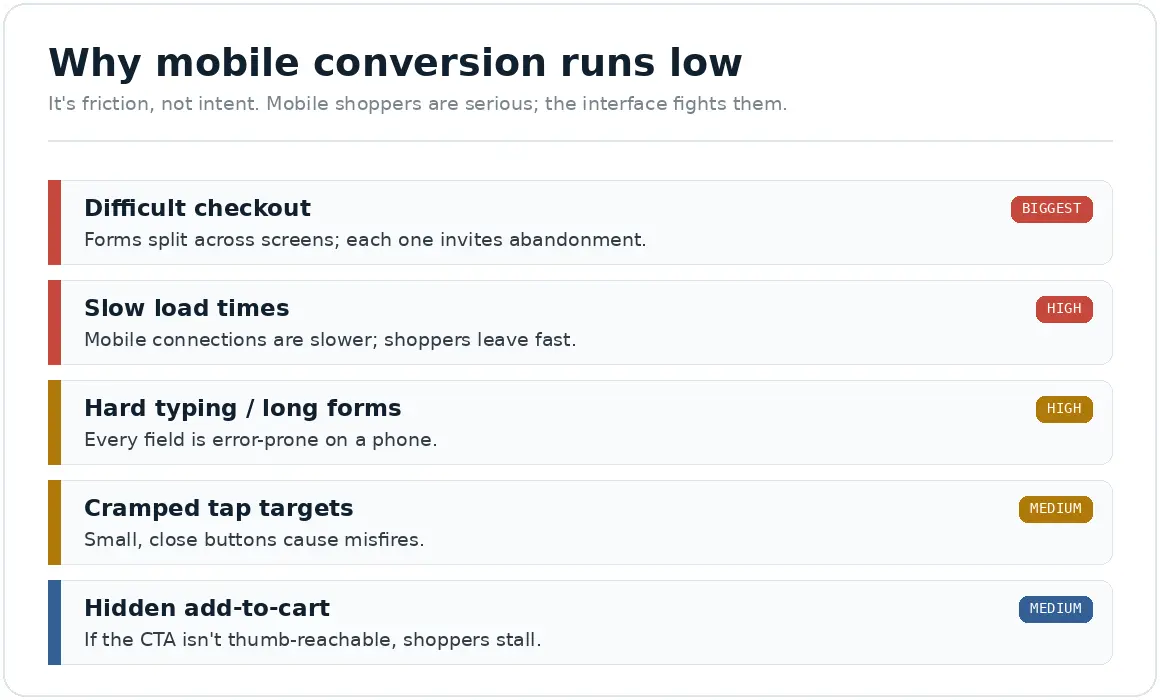
It is friction, not intent. Almost every cause is within your control.
Could my mobile site speed be the problem?
Very possibly. Speed affects mobile conversion more than desktop because mobile connections and devices are often slower, and shoppers abandon slow mobile pages fast. It’s one of the first things to check.
Speed is a frequent and under-diagnosed cause of low mobile conversion. A page that feels fine on your office desktop can be sluggish on a phone over a mobile network, and shoppers won’t wait. Check your mobile performance specifically (not a blended or desktop score) against Google’s Core Web Vitals: Largest Contentful Paint under 2.5 seconds, Interaction to Next Paint under 200 milliseconds, Cumulative Layout Shift under 0.1. These are measured on real users, who are mostly on mobile, so they effectively are your mobile benchmark. If you’re well outside them, speed is likely dragging your mobile conversion down. The full connection is in how Shopify speed impacts conversion rate.
How do I diagnose my own mobile problem?
Split your data by device, then watch real mobile sessions. Analytics shows where mobile shoppers drop; session recordings show why. Together they point you at the specific friction.
Diagnosis is two steps, and neither requires guessing:
Segment everything by device. Look at conversion rate, funnel drop-off, and checkout completion for mobile separately from desktop. A blended number hides the mobile story entirely. This alone often reveals that the “conversion problem” is specifically a mobile-checkout problem.
Watch real mobile session recordings. Free tools like Microsoft Clarity let you watch actual mobile sessions. You’ll see the friction directly, a shopper mis-tapping a cramped button, struggling with a form field, or abandoning at a slow-loading step, in a way no dashboard conveys.
The steepest mobile drop-off, confirmed by what you see in recordings, is your priority fix. This is the same diagnostic method as how to diagnose Shopify conversion issues, applied device-first.
What should I fix first to raise mobile conversion?
Mobile checkout, in most cases. It’s where the largest share of mobile shoppers abandon, so fixing it recovers the most. Then speed, then tap-friendly design.
Let your own diagnosis lead, but for most stores the ranking is consistent: start with checkout (enable wallet and express payments so shoppers skip typing, offer guest checkout, cut fields), because that’s where committed mobile buyers are lost in the largest numbers. Then address speed (it compounds with everything else), then tap-friendly design (visible sticky add-to-cart, larger buttons, legible text). The full fix playbook is in the mobile conversion pillar, and the checkout specifics in mobile checkout best practices.
We diagnose the mobile funnel device-first, then fix the biggest leak.
We split your data by device, watch real mobile session recordings to see the friction directly, and fix the steepest mobile drop, usually checkout or speed, rather than guessing.
It’s part of our conversion optimization work, measured in your own analytics so the mobile story isn’t hidden inside a blended number.
Frequently asked questions
Is it normal for mobile to convert lower than desktop?
Yes. Mobile converts lower than desktop across essentially all of ecommerce, so some gap is expected. What’s not normal is a very wide gap or a sudden drop, those point to fixable friction, usually in mobile checkout or speed, rather than the nature of mobile.
How much lower should mobile conversion be?
Commonly around half to two-thirds of the desktop rate, though sources vary widely on the exact figure. Rather than a fixed target, compare your device gap to your own history and category. A gap much wider than typical is worth investigating.
Does site speed really affect mobile conversion that much?
Yes, often more than on desktop, because mobile connections are slower and shoppers abandon slow pages quickly. Check your mobile Core Web Vitals specifically. If you’re well outside Google’s thresholds, speed is a likely cause of low mobile conversion.
How do I find out exactly why my mobile converts poorly?
Keep reading
Sources
Mobile cart/checkout abandonment exceeds desktop; Baymard overall 70.22%. https://baymard.com/lists/cart-abandonment-rate
Google Core Web Vitals thresholds (LCP <2.5s, INP <200ms, CLS <0.1). https://web.dev/articles/vitals