CRO / Product pages
How to Write Product Descriptions That Convert
// sell the outcome, not the spec sheet

By Fracto Solutions
September 14, 2026
The short answer
Product descriptions that convert lead with benefits, not features, answer the questions that cause hesitation (sizing, materials, compatibility), and match their length to the purchase: short and scannable for simple items, thorough for considered ones. Write unique copy for your customer rather than copying the manufacturer, which also protects your SEO
Benefits
Unique
copy beats manufacturer text for conversion and SEO
Fit
What makes a product description convert?
Copy that sells benefits, removes doubt, and is easy to scan. The description’s job isn’t to describe the product, it’s to make the shopper confident this is right for them, by answering their real questions and showing what they’ll get out of it.
A converting description does three jobs at once. It translates features into benefits (not “100% merino wool” but “stays warm without the itch, and regulates temperature so you’re comfortable all day”). It removes doubt by answering the questions that cause hesitation before the shopper has to go looking. And it’s formatted to be read the way people actually read online, scanning, not studying. The common failure is treating the description as a technical data dump; the fix is treating it as a conversation with a specific shopper about why this product solves their problem.
Should I focus on features or benefits?
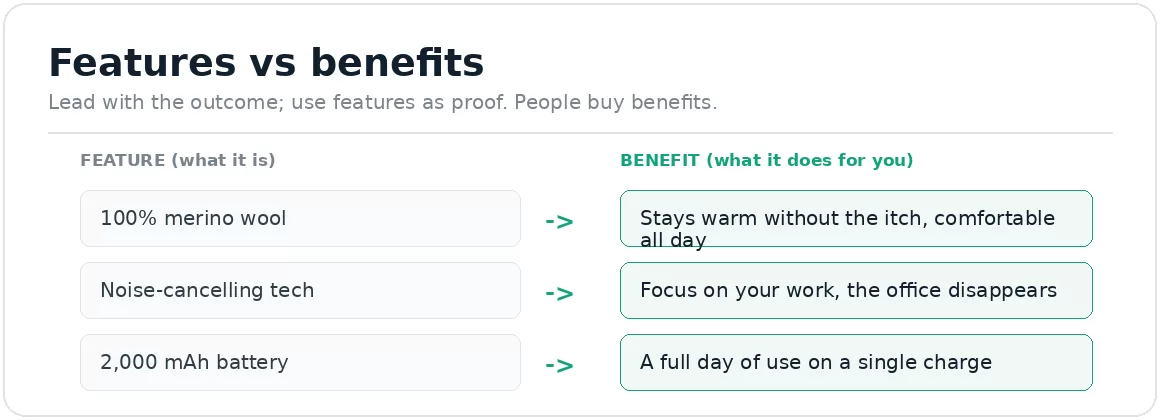
Benefits first, then features to back them up. Features are facts about the product; benefits are what those facts do for the shopper. People buy outcomes, so lead with the outcome and use features as proof.
This is the oldest rule in copywriting and still the most broken. A feature is “noise-cancelling technology”; the benefit is “focus on your work without the office disappearing into headphone hiss.” Shoppers care about the second. That doesn’t mean drop the features, they matter as evidence, and some shoppers (especially for technical products) want the specs, but lead with what the product does for the person, and let the features support that claim. A useful test: for each feature, ask “so what?” until you reach something the shopper actually cares about. That answer is the benefit to lead with.
Feature (what it is)
Benefit (what it does for the shopper)
100% merino wool
Stays warm without the itch, comfortable all day
Noise-cancelling technology
Focus on your work without the office hum
2,000 mAh battery
A full day of use on a single charge
Machine washable
No special care, just toss it in with the laundry
*Lead with the benefit; keep the feature as proof. Run each feature through “so what?” until you reach what the shopper cares about.*
- Features vs benefits
How long should a product description be?
Match the length to the purchase. Simple, low-cost, impulse items convert best with short, scannable copy; considered or expensive products justify longer, thorough descriptions that answer every question.
There’s no universal ideal length, and anyone quoting an exact word count is guessing. What matters is fit-to-purchase. For an inexpensive impulse buy, a few sharp benefit-led bullets is plenty, more copy just gets in the way of a quick decision. For a considered or high-priced purchase (where the shopper is weighing a bigger risk), thorough copy earns its place, because it answers the many questions that would otherwise cause hesitation or a support ticket. The principle: give shoppers exactly as much information as the decision requires, no more, no less. When unsure, structure for both, scannable bullets up top for the quick reader, fuller detail below for the thorough one.
What questions should a description answer?
Whatever your shoppers actually ask before buying, sizing, materials, compatibility, care, what’s included, and how it compares. Answering these in the description removes friction and reduces returns and support load.
The best source for description content isn’t your imagination, it’s your customers’ real questions. Mine your support tickets, product-page Q&A, and reviews for the doubts that come up repeatedly, then answer them proactively in the copy. Common ones across categories: How does the sizing run? What’s it made of? Will it work with what I already own? How do I care for it? What’s in the box? Answering these does double duty: it removes the hesitation that kills conversion, and it cuts the returns and support tickets that come from mismatched expectations. A description that preempts the shopper’s questions is doing real conversion work
Does copying the manufacturer's description hurt?
Yes, on two fronts. It’s generic, so it doesn’t convert as well as copy written for your customer, and it’s duplicate content, which hurts your SEO because search engines have seen it on every other store selling the same item.
Using the manufacturer’s supplied copy is tempting and common, and a mistake. First, conversion: manufacturer copy is written to be neutral and universal, not to sell to your specific audience with your voice and your customer’s questions in mind. Second, SEO: if a hundred stores use the identical manufacturer description, search engines see duplicate content and none of those pages stands out, so you lose organic visibility. Writing unique descriptions solves both, better conversion and better rankings, which is why it’s worth the effort even across a large catalog (prioritize your best-sellers first). This ties into broader ecommerce SEO as much as conversion.
How do I write descriptions at scale?
Prioritize and systematize. Write unique copy for your best-sellers first (where it pays off most), use a repeatable structure so writing is faster, and improve the rest over time rather than trying to perfect everything at once.
A large catalog makes “write unique copy for everything” feel impossible, so don’t try to do it all at once. Start where it matters most: your best-selling and highest-margin products, where better copy returns the most. Use a consistent template (benefit-led opening, scannable bullets, an answers-the-questions section, then specs) so each description is faster to write and consistent in quality. Then work down the catalog over time. For the long tail of low-traffic products, lighter-touch unique copy still beats identical manufacturer text. The goal is progress across the catalog, not perfection on day one.
We write descriptions from your shoppers' real questions, then measure the lift.
We mine your support tickets, reviews, and product Q&A for the doubts that actually cause hesitation, write unique benefit-led copy that answers them, and prioritize your best-sellers first where it pays off most.
It’s part of our conversion optimization work, and because unique copy also helps rankings, it connects to our SEO work too
// we would rather show up in your reporting than in your inbox
Frequently asked questions
What's the most important thing in a product description?
Leading with benefits rather than features, saying what the product does for the shopper, not just what it is. People buy outcomes. Back the benefits with features as proof, and answer the questions that cause hesitation. That combination is what turns a description into a selling tool
How long should a product description be?
It depends on the purchase: short, scannable copy for simple impulse items; thorough copy for considered or expensive ones where shoppers have more questions. There’s no magic word count. Give exactly as much information as the decision requires, structured so quick and thorough readers are both served.
Is it bad to use the manufacturer's description?
Yes. It’s generic, so it converts worse than copy written for your customer, and it’s duplicate content shared across every store selling the item, which hurts your SEO. Writing unique descriptions improves both conversion and rankings, start with your best-sellers.
How do I know what to include in a description?
Answer your shoppers’ real questions. Mine support tickets, product Q&A, and reviews for the doubts that come up repeatedly (sizing, materials, compatibility, care), and address them in the copy. This removes friction and reduces returns from mismatched expectations.
Keep reading
Pillar
Product page optimization: the complete guide
Guide
Product page trust signals that increase sales
Pillar
Ecommerce SEO: how to rank and convert
Sources
Duplicate content (identical manufacturer descriptions across stores) weakens SEO: consistent with Google’s guidance on helpful, original content. https://developers.google.com/search/docs/fundamentals/creating-helpful-content