Web Development / Platform
Is Headless Shopify Worth It?
// powerful, expensive, and usually unnecessary

By Fracto Solutions
September 29, 2026
The short answer
Headless Shopify (a custom front end on Shopify’s backend) is worth it only for large, well-resourced brands where a custom experience will materially lift conversion or performance, enough to justify a $40,000 to $200,000+ build plus ongoing engineering. For most stores, a well-optimized standard Shopify theme converts just as well for far less.
$40k-$200k+
Materially
Most
What is headless Shopify?
Headless Shopify means separating the front end (what shoppers see) from Shopify’s back end (products, cart, checkout, orders). You build a completely custom storefront, usually in a framework like Next.js or React, that connects to Shopify’s commerce engine via API.
Normally, Shopify’s front end and back end are one system: your theme and Shopify’s commerce engine are tightly coupled. “Going headless” decouples them, you keep Shopify running the commerce (catalog, cart, checkout, orders) but replace the standard themed storefront with a fully custom front end built in modern web frameworks, talking to Shopify through its APIs. The appeal is total design and performance freedom: you’re no longer bound by what Shopify’s theme system allows. The cost is that you’re now building and maintaining a custom application, which is a fundamentally bigger undertaking than running a theme.
What does headless Shopify cost?
A lot: commonly $40,000 to $200,000+ for the initial build, plus significant ongoing engineering (a custom front end needs continuous development and maintenance). Year-one totals often run well into six figures once you include the build, tooling, and engineering.
Headless is the most expensive way to run a Shopify store, and the ongoing cost is the part people underestimate. Directional 2026 figures: the initial build commonly runs $40,000 to $200,000+ depending on complexity, and, crucially, a headless storefront isn’t “set and forget”, it needs ongoing engineering (developers to maintain and evolve the custom front end), which can add tens of thousands a year. Add supporting tools (a separate CMS, hosting for the front end) and year-one totals frequently exceed $100,000. Compare that to a well-built standard Shopify theme (a few thousand to $25,000 one-time, minimal ongoing dev) and the gap is enormous. That gap is the whole decision: headless has to earn back a very large premium.
Approach
One-time build
Ongoing dev
Best for
Standard theme (optimized)
~$2,500 to $25,000
Minimal
Almost all stores
Headless / composable
~$40,000 to $200,000+
Significant, continuous
High-volume, genuine custom need
Headless has to earn back a very large premium, plus a permanent engineering bill.
When is headless Shopify worth it?
When you’re a large, well-resourced brand and a custom front end will deliver a materially better experience, faster performance or a unique interface, that lifts conversion or supports a scale a theme can’t, enough to justify the cost. It’s worth it when the experience is a genuine competitive advantage, not a vanity project.
Headless is genuinely the right call for a specific profile of brand: – High volume, where even a small conversion or performance gain translates to large revenue, enough to pay back the build. – A genuine need for custom experience a theme can’t deliver, a unique interactive storefront, a specific performance target, complex content-and-commerce integration. – The engineering resources (in-house or agency) to build and, importantly, maintain it long-term. – A clear, quantified payoff, you can show the custom experience will lift conversion or performance enough to justify the premium.
The honest framing from the industry: don’t go headless unless the experience drives a materially higher conversion rate, because the cost (build plus ongoing engineering) will otherwise crush your margins. For the brands that fit this profile, headless is a real advantage. For everyone else, it’s expensive overkill.
- Headless: worth it or not
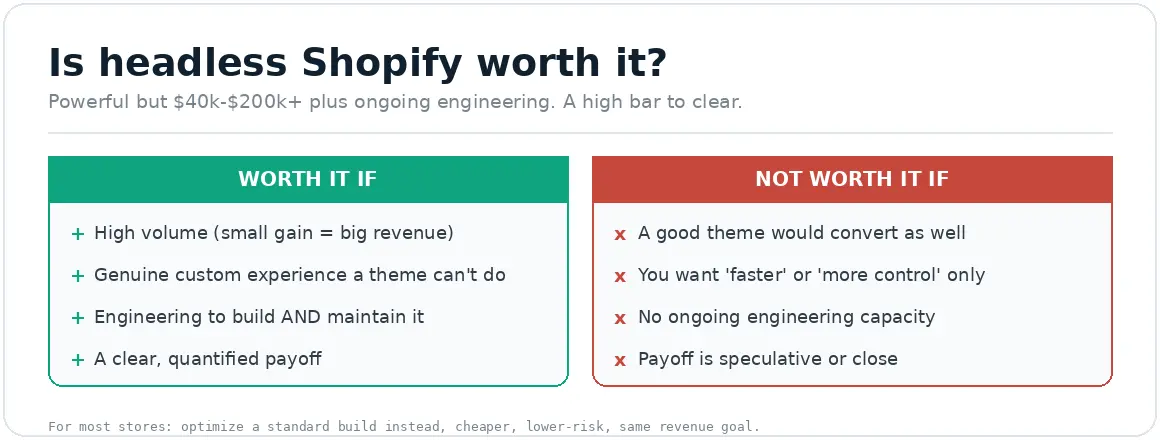
Powerful but $40k-$200k+ plus ongoing engineering. A high bar to clear.
When is headless NOT worth it?
For the vast majority of stores: if a well-optimized standard Shopify theme would convert just as well, headless is a costly mistake. Most performance and design goals are achievable on a standard build at a fraction of the price, without ongoing engineering overhead.
Here’s the uncomfortable truth for most stores considering headless: you probably don’t need it. The common reasons people want headless, “faster site,” “more design control,” “better performance”, are usually achievable on a standard, well-optimized Shopify theme without the enormous cost. A properly built and speed-optimized theme can hit Google’s Core Web Vitals and convert excellently. The design flexibility most brands actually need fits within the theme system. And a standard build has no ongoing engineering bill. So unless you’re in the specific high-volume, genuine-custom-need profile above, headless spends six figures to solve problems a much cheaper approach would solve, and adds a permanent maintenance cost. The money is almost always better spent on conversion optimization of a standard build, which reliably lifts revenue (see Shopify CRO: the complete guide).
How do I decide if headless is right for me?
Quantify it. Estimate the conversion or performance gain a custom front end would realistically deliver, translate that to revenue, and compare against the full cost (build plus ongoing engineering). Only go headless if the payoff clearly and comfortably exceeds the cost, and if you can maintain it.
Treat it as an investment decision, not a technology preference: – Define the concrete benefit. What specifically will headless do that a well-optimized theme can’t, and how much conversion or performance will that realistically add? – Translate to revenue. At your volume, what is that gain worth per year? – Cost it fully. Build plus ongoing engineering plus tooling, over several years, not just year one. – Compare honestly. Does the payoff comfortably exceed the cost? If it’s close or speculative, it’s a no. – Check you can maintain it. Headless without ongoing engineering capacity becomes a liability.
For most stores this analysis ends with “optimize the standard build instead,” which is the cheaper, lower-risk path to the same revenue goal. For the few it fits, headless is worth it, and worth doing properly. We help make that call honestly in our web development work.
We help you make the headless call honestly, and usually point you to a cheaper path.
We quantify the realistic conversion or performance gain against the full cost (build plus ongoing engineering), and only recommend headless for the high-volume, genuine-custom-need brands it actually fits. For most stores, we steer the budget into optimizing a standard build instead.
It’s part of our web development work, and the alternative we usually recommend, optimizing a standard build, is our conversion optimization work, which reliably lifts revenue for far less.
// we would rather show up in your reporting than in your inbox
Frequently asked questions
Is headless Shopify worth it?
Only for large, well-resourced brands where a custom front end will materially lift conversion or performance, enough to justify a $40,000 to $200,000+ build plus ongoing engineering. For most stores, a well-optimized standard Shopify theme converts just as well for a fraction of the cost, so headless isn’t worth it.
What does headless Shopify cost?
Commonly $40,000 to $200,000+ for the initial build, plus significant ongoing engineering to maintain the custom front end, often pushing year-one totals well past $100,000. The ongoing cost is the part most people underestimate; a headless storefront needs continuous development, unlike a standard theme.
Does headless Shopify improve conversion?
It can, through a faster, more custom experience, but only if that experience is meaningfully better than a well-optimized standard theme, which is a high bar. Most conversion and performance goals are achievable on a standard build. Headless only lifts conversion enough to justify its cost for a narrow set of high-volume brands.
What's the alternative to headless?
A well-built, speed-optimized standard Shopify theme, which can meet Core Web Vitals, offer strong design, and convert excellently at a fraction of the cost and with no ongoing engineering bill. For most stores, investing that saved money into conversion optimization delivers a better, more reliable return than going headless.
Sources
The ecommerce revenue equation (revenue = traffic x conversion rate x AOV x purchase frequency) and the “four levers” framework: consistent across 2026 growth frameworks.
Shopify;
Pattern
Revenue per visitor / RPU (conversion rate x AOV) as a truer north star than conversion rate alone:
Drip Agency;
Build Grow Scale
We removed the “$87 median ecommerce CAC” figure that appeared in an earlier draft. Shopify does publish it, but attributes it to a third-party agency analysis rather than to its own data, and the benchmark table on that same Shopify page gives $64 for organic and $68 for paid. Other figures in circulation for the same metric run from roughly $42 to $318 depending on what counts as acquisition spend. A number that unstable is not a benchmark, so we describe the direction only. Rising CAC and the shift toward retention as stores mature:
Shopify; and as compiled in the LTV:CAC and CAC clusters.