Web Development / Platform
When Should You Replatform Your Ecommerce Store?
// most problems follow you to the new platform

By Fracto Solutions
September 29, 2026
The short answer
Replatform your ecommerce store only when the platform itself is genuinely holding back your growth, through hard limits, unfixable performance, or missing capabilities you truly need, not because of problems a fix or optimization could solve. Replatforming is expensive ($15,000 to $200,000+) and risky, so it should be a last resort, not a first move.
Last
$15k-$200k+
Follows
What does replatforming actually involve?
Replatforming means migrating your entire store, products, customers, orders, content, and design, to a different ecommerce platform. It’s a major project touching data migration, redesign, integrations, SEO preservation, and testing, not a simple switch.
People underestimate replatforming because “moving platforms” sounds mechanical. In reality it’s a full rebuild plus a data migration: you’re moving your product catalog, customer accounts, order history, and content, rebuilding the design and functionality on the new platform, reconnecting every integration (payments, shipping, email, ERP), and, critically, preserving your SEO so you don’t lose rankings in the move. Each of those is a project in itself, and getting any one wrong (broken redirects, lost data, a slower site) can cost real revenue. That scope is why replatforming is expensive and risky, and why it should only be undertaken when the payoff clearly justifies it.
When is replatforming genuinely justified?
When the platform is a hard constraint on your growth: you’ve hit limits it can’t exceed, its performance can’t be fixed, it lacks capabilities you genuinely need, or its total cost has become untenable at your scale. If the platform itself is the ceiling, replatforming is warranted.
There are real, legitimate triggers for replatforming, and they share one trait: the platform, not your execution, is the limiting factor. The genuine signs: – Hard technical limits you’ve hit and can’t work around (catalog size, API limits, checkout customization the platform forbids). – Performance you can’t fix on the current platform despite proper optimization. – Missing capabilities you truly need, for example B2B, complex subscriptions, or international features the platform can’t support even with apps. – Cost that no longer makes sense at your scale (fees or required workarounds costing more than a better-fit platform would). – A platform being deprecated or losing support.
When one or more of these genuinely applies, and you’ve confirmed it’s the platform and not something fixable, replatforming can be the right, if painful, move.
- Replatform or not
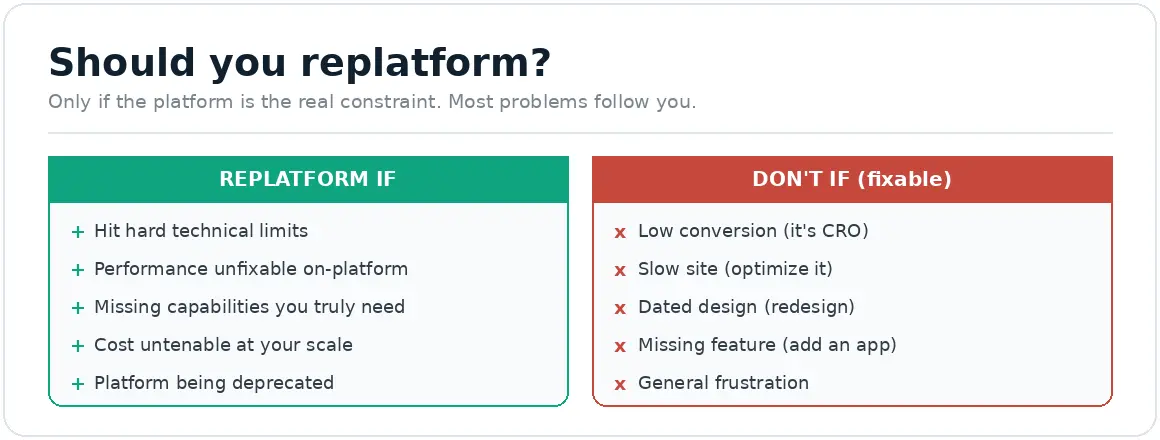
Only if the platform is the real constraint. Most problems follow you.
When should you NOT replatform?
When your problems are fixable on the current platform, poor conversion, slow speed from bad optimization, a dated design, or missing features an app could add. Replatforming to escape these usually just carries the same problems to a new platform at great expense.
This is where most replatforming mistakes happen: blaming the platform for problems it didn’t cause. Red flags that you should NOT replatform: – Low conversion. That’s almost always a CRO problem (product pages, checkout, trust), not a platform problem, and it moves with you. Fix it where you are (see how to diagnose conversion issues). – Slow site. Usually fixable through optimization, apps, images, hosting, on your current platform. – Dated design. A redesign or new theme is far cheaper than a replatform. – A missing feature. Often an app or custom development adds it without migrating everything. – General frustration. “The grass is greener” rarely survives contact with a new platform’s own quirks.
The test: would this problem follow you to the new platform? If yes, replatforming doesn’t fix it, it just relocates it and adds a huge bill.
How much does replatforming cost?
It ranges enormously by scale: roughly $1,500 to $5,000 for a small DIY/app-based migration, $15,000 to $75,000 for a mid-market agency-assisted replatform, and $80,000 to $200,000+ for an enterprise move. Add the hidden costs of downtime risk, SEO recovery, and team time.
Migration cost swings wider than almost any other ecommerce line item, and the direct build cost is only part of it. Directional 2026 ranges:
Replatform type
Typical cost
Small (DIY, migration app)
~$1,500 to $5,000
Mid-market (agency-assisted)
~$15,000 to $75,000
Enterprise (e.g. to Shopify Plus)
~$80,000 to $200,000+
Directional ranges compiled from 2026 migration-cost sources; figures vary widely by catalog size and complexity.
Beyond those direct costs, budget for the indirect ones that catch people out: the risk of downtime or lost sales during cutover, the SEO dip and recovery if redirects and structure aren’t handled perfectly, staff time and disruption, and the learning curve on the new platform. Those hidden costs are real and often exceed the build. It’s why the decision deserves the honest scrutiny in the sections above.
How do I make the decision properly?
Diagnose the real problem first. Confirm whether it’s genuinely the platform or something fixable where you are, quantify what replatforming would cost (direct and hidden) against the benefit, and only proceed if the platform is truly the constraint and the payoff clearly justifies the risk.
A disciplined decision process: – Name the specific problem and test whether it would follow you (conversion, speed, and design problems usually would). – Try to fix it where you are first, optimization, apps, a redesign, custom development are all far cheaper than a replatform. – If it’s genuinely a platform limit, quantify the full cost (build plus downtime, SEO, and team time) against the concrete benefit. – Only replatform if the platform is the real ceiling and the benefit clearly outweighs the cost and risk.
Most “we need to replatform” conversations end, correctly, with fixing the real problem on the current platform instead. Replatforming is the right call sometimes, but it should be a considered last resort, which is exactly how we approach it in our web development work.
We diagnose the real problem first, and usually save you from an unnecessary replatform.
We test whether the problem would actually follow you to a new platform (low conversion and slow speed usually would), try to fix it where you are first, and only recommend replatforming when the platform is genuinely the constraint and the payoff clearly justifies the cost and risk.
It’s part of our web development work, and because most ‘we need to replatform’ problems are really conversion problems, it connects to our conversion optimization work.
// we would rather show up in your reporting than in your inbox
Frequently asked questions
When should I replatform my ecommerce store?
Only when the platform itself is genuinely the constraint, hard limits you can’t work around, unfixable performance, missing capabilities you truly need, or untenable cost at scale. If a problem is fixable on your current platform (like low conversion or slow speed), fix it there instead; replatforming won’t solve problems the platform didn’t cause.
How much does it cost to replatform?
Roughly $1,500 to $5,000 for a small DIY/app migration, $15,000 to $75,000 for a mid-market agency-assisted move, and $80,000 to $200,000+ for enterprise. Beyond the build, budget for downtime risk, SEO recovery, and team time, hidden costs that often exceed the direct build cost.
Will replatforming fix my low conversion rate?
Almost never. Low conversion is a CRO problem (product pages, checkout, trust, speed) that moves with you to the new platform. Replatforming to fix conversion usually just relocates the problem at great expense. Diagnose and fix conversion on your current platform first.
What's the biggest risk of replatforming?
Losing revenue and SEO in the move. If data migration, redirects, or site structure aren’t handled perfectly, you can lose rankings and sales, sometimes for months. Combined with downtime risk and the cost, that’s why replatforming should be a considered last resort, not a first response to frustration.
Sources
Conversion, speed, and design problems are usually fixable on the current platform, not platform constraints: consistent with established CRO practice; see the diagnosis and speed clusters.