CRO / AEO
How to Structure Content So AI Engines Cite You
// make it easy to quote

By Fracto Solutions
September 15, 2026
The short answer
To structure content so AI engines cite you, lead every section with a self-contained 40 to 60 word answer, phrase headings as the questions people ask, keep paragraphs short and use lists and tables, add FAQPage and Article schema that mirrors the visible text, and name specific, verifiable facts rather than vague claims.
40-60
word self-contained answer up front
Schema
FAQPage/HowTo/Article, mirroring visible content
Specific
named facts get cited; vague claims don’t
What structure do AI engines actually reward?
Content they can extract as a clean, self-contained answer: a direct answer up front, headings phrased as questions, short scannable paragraphs, lists and tables, and explicit schema. The easier you make extraction, the more likely the citation.
Picture what an answer engine does: it scans pages for the clearest, most quotable answer to a specific question, then lifts it into its response with a citation. Everything that makes that lift easier helps you; everything that makes it harder hurts. A buried answer, a wall of text, a vague heading, all force the engine to work harder and often to pick a clearer competitor instead. So the structural goal is extractability: hand the engine a clean, self-contained answer it can quote without needing the surrounding context. The specific techniques below all serve that one goal.
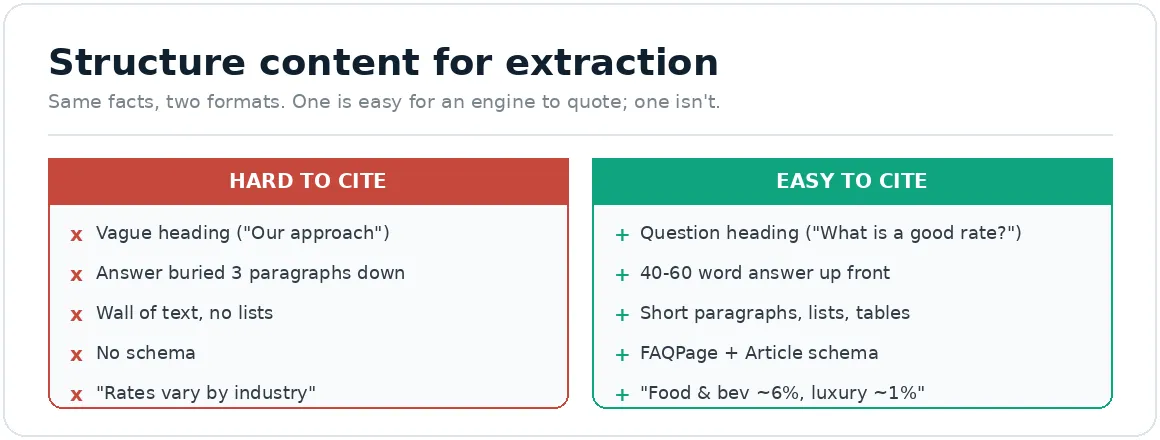
Element
Hard to cite
Easy to cite
Heading
"Our approach"
"What is a good conversion rate?"
Answer
Buried 3 paragraphs down
40 to 60 words, up front
Format
Wall of text
Short paragraphs, lists, tables
Schema
None
FAQPage + Article (mirroring content)
Facts
"Rates vary by industry"
"Food & bev ~6%, luxury ~1% (Shopify)"
*Same facts, two formats. Extractability is what earns the citation.*
How should I write the answer itself?
Lead each major section with a direct, self-contained answer of about 40 to 60 words, then expand beneath it. Write it so it makes sense quoted on its own, with no dependence on the surrounding text. This is the single highest-leverage technique.
The answer-first structure (the “inverted pyramid”) is the most consistently cited AEO technique across every source, because it hands the engine exactly what it wants. Practically: for each question your section addresses, open with a crisp answer a reader (or engine) could lift and understand alone, then follow with context, evidence, and detail. Two tests for a good answer block: it directly answers the implied question in the first sentence, and it stands on its own if copied out of the page. Definitional sections should define the term first; how-to sections should give the steps first. This serves human readers too, they get their answer fast, which is why it’s worth doing regardless of AI.
How should I write headings?
Phrase headings as the exact questions people ask, not as clever labels. “How do I get cited by ChatGPT?” beats “Citation strategies,” because engines match a question-shaped heading directly to a user’s query.
Headings do double duty in AEO: they organize the page for readers and signal to engines what each section answers. Question-shaped headings win because answer engines are matching user questions to content, and a heading that mirrors the question is an unmistakable match. Pull the actual phrasing from how buyers ask, People Also Ask boxes, your site search logs, support tickets, and the follow-up questions engines themselves generate. This also captures “fan-out” queries, the shorter sub-questions an engine breaks a long query into. Clever or vague headings (“Unlock your potential”) do the opposite: they hide what the section answers. Every H2 and H3 is a chance to match a real question, so use it.
Does schema really help, and which types?
Yes, when it mirrors visible content. FAQPage, HowTo, and Article schema make your meaning explicit so engines can classify and surface it confidently. It’s one of the cheapest AEO wins, but marking up hidden or fake content backfires.
Structured data is the machine-readable layer that removes ambiguity about what your page contains. The three that matter most for AEO:
FAQPage schema. Maps directly to the question-and-answer format engines use internally, a page with FAQPage markup containing a real question has a structural edge.
HowTo schema. For step-by-step processes, makes the steps explicit and liftable..
Article schema. Confirms author, date, and topic, reinforcing authorship and freshness signals.
The firm rule, consistent across sources and Google’s own guidance: schema must reflect content that’s actually visible on the page. Marking up hidden, fake, or absent content violates guidelines and can hurt you. Schema reinforces good content; it never replaces it. The technical overlap with classic SEO schema is covered in ecommerce SEO.
What kind of facts get cited?
Specific, verifiable, attributable facts, named tools, brands, numbers, dates, and sources, not vague generalities. Engines cite content they can stand behind, and specificity is what makes a claim safe to quote.
This is where a lot of content quietly fails. An engine linking a claim to your page is vouching for it, so it favors specific, checkable statements over hedged, vague ones. “Conversion rates vary by industry” is unquotable; “food and beverage stores convert around 6% while luxury sits near 1%, per Shopify data” is citable. Raise your “entity density”, name the specific tools, brands, places, and figures relevant to the topic, and attribute facts to their sources. This also happens to be good, honest content practice: specific and sourced beats vague and unsupported for human readers too. It’s the same accuracy discipline that makes content trustworthy in the first place.
- Structure for extraction
How do I keep content citable over time?
Keep it fresh. Answer engines have a strong recency bias and favor recently updated, maintained pages, so review and update high-value pages regularly, refreshing stats, dates, and examples, rather than publishing once and forgetting.
Freshness is a consistent citation factor, and an ongoing one, which is why AEO is a system rather than a one-time edit. Engines favor current, maintained content, and the size of that effect is worth knowing: one analysis of 80 million citations found that content updated within the previous 30 days earned roughly 3.2 times more citations than older content. Treat that as a single vendor study rather than settled fact, but the direction is consistent across everything published on this so far. Practically: put your highest-value pages on a refresh cadence (quarterly is a common rhythm), updating figures, adding new examples, and keeping claims current. Combine that with tracking your citations, ask your key questions across the engines regularly and log whether you’re cited, and you have a maintenance loop that compounds. Fresh, structured, specific content reviewed on a cadence is what stays citable, not a page you optimized once and abandoned.
We structure every page for extraction, then keep it fresh.
We lead with self-contained answers, use question-shaped headings and accurate schema, name specific sourced facts, and put high-value pages on a refresh cadence, the structure answer engines reward.
It’s part of our SEO work, and the same structure also serves human readers, which is why it sits naturally alongside our conversion optimization.
// we would rather show up in your reporting than in your inbox
Frequently asked questions
What's the most important thing for getting cited by AI?
Leading each section with a clear, self-contained 40 to 60 word answer to the question it addresses. Answer engines lift the clearest direct answer they can find, so putting one up front, quotable on its own, is the single highest-leverage structural move.
How should I format content for AI engines?
For extractability: direct answers up front, question-shaped headings, short paragraphs, lists and tables for scannable information, and accurate schema. The goal is to hand the engine a clean, self-contained answer it can quote without needing the surrounding context.
Which schema types matter for AEO?
FAQPage (maps to the question-answer format engines use), HowTo (for processes), and Article (confirms author, date, topic). All must mirror content visible on the page, marking up hidden or fake content violates guidelines and backfires. Schema reinforces good content, never replaces it.
Does content freshness affect AI citations?
Yes. Answer engines have a recency bias and favor recently updated pages, with some evidence that stale pages get cited less. Put high-value pages on a refresh cadence (quarterly is common), updating stats, dates, and examples to keep them citable over time.
Sources
Schema must mirror visible content: this is Google’s own structured data policy, not an AEO convention (Google Search Central, structured data guidelines). Markup describing content a user cannot see on the page is a policy violation, not merely an ineffective tactic.
Recency bias: engines favor fresh, maintained pages. The 3.2x figure for content updated within 30 days comes from a single vendor analysis of 80 million citations (ConvertMate AI Visibility Study, 2026); we have not found an independent replication, so we label it as one study rather than as a benchmark. https://llmrefs.com/answer-engine-optimization