SEO / Ecommerce
How to Do Keyword Research for Ecommerce Product Pages
// intent first, volume second

By Fracto Solutions
September 4, 2026
The short answer
Keyword research for ecommerce means finding the terms buyers actually search, then matching each to the right page by intent: commercial keywords to product and category pages, informational ones to guides. The goal isn’t the highest-volume term, it’s the term whose intent matches what your page lets someone do.
Keyword research for a store isn’t the same as for a blog. The pages that make you money are commercial, and matching them to the right search intent matters more than chasing volume. This guide covers the process for product and category pages, and how to avoid the cannibalization trap. It sits under the ecommerce SEO guide.
- Match intent to page type
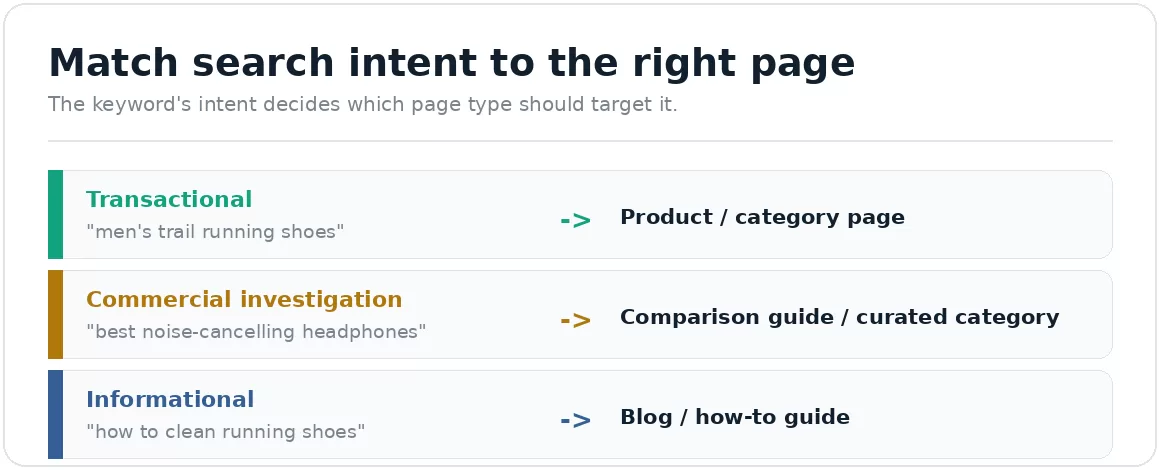
The keyword’s intent decides which page type should target it. Match scope to page, and each keyword to one page.
Why is ecommerce keyword research different?
Because the pages that matter are commercial, and their success depends on matching buyer intent, not just ranking for a popular word.
For a blog, you match articles to questions. For a store, you match product and category pages to purchase intent. You want the keyword whose searcher wants exactly what your page offers. Ranking a product page for a broad informational term brings visitors who aren’t ready to buy; ranking it for the buying term brings the ones who are. Intent, not volume, is the north star.
What is search intent, and why does it come first?
Search intent is what the searcher is trying to do. It comes first because a page only ranks and converts if it matches that intent.
Transactional, ready to buy (“men’s trail running shoes”). Match to product and category pages.
Commercial investigation, comparing (“best noise-cancelling headphones”). Match to comparison guides or curated categories.
Informational, researching (“how to clean running shoes”). Match to blog or guide content.
A quick way to check intent: search the term and see what Google already ranks. All product pages means transactional; all guides means informational.
Intent, page type, and the markup Google expects
Intent
Page type it maps to
Structured data Google documents for it
Transactional
Product page
Product (merchant listing: name, image, offers with price and priceCurrency)
Transactional, broader
Category page
BreadcrumbList
Commercial investigation
Comparison or buying guide
Product with review, incl. positiveNotes and negativeNotes (editorial reviews only)
Informational
Guide or article
FAQPage where the page genuinely answers questions
Page types and intent labels are standard SEO practice, not a Google taxonomy. The markup column is sourced: each type and its requirements come from Google Search Central’s structured data documentation. Note that the pros and cons properties are limited to editorial review pages, not merchant product pages or customer reviews.
How do I find the right keywords?
Start from your products and your buyers’ language, then expand with tools and by studying what already ranks. Prioritize by intent match and realistic difficulty, not raw volume.
Start with your catalog. List how buyers describe each product, in their words.
Mine real sources. Google autocomplete, “People also ask”, related searches, and your own site-search queries.
Use keyword tools for volume and difficulty, but treat them as directional.
Study the current results to see the intent Google assigns and the bar to clear.
Prioritize by intent match first, then by whether you can realistically rank.
How do I match keywords to product vs category pages?
Category pages target broader commercial terms; product pages target specific ones. Map each keyword to the page whose scope matches the query.
A category page targets the broader head term for the group it contains (“men’s running shoes”). Individual product pages target specific long-tail terms (“Brand X trail shoe size 10”). Trying to rank one product page for the broad category term usually fails and can make the two compete. Map deliberately: broad to category, specific to product.
How do I avoid keyword cannibalization?
Give each keyword one target page. Cannibalization happens when multiple pages target the same term and compete, splitting ranking signals so neither ranks well.
This trap quietly hurts large catalogs. If three category pages and a blog post all target “running shoes”, Google doesn’t know which to rank, and they undercut each other. The fix is a keyword map: one primary keyword per page, documented, so you catch overlaps early. When two pages serve the same intent, consolidate or differentiate them. It’s the same discipline behind a well-built content cluster, each article owns a distinct query and links up to one pillar.
How does keyword research connect to conversion?
The right keyword brings a visitor whose intent your page can satisfy, the first requirement for converting them.
Ranking for a buying term brings someone ready to act; your page then has to deliver: clear information, trust, an easy path to purchase. Research earns the right visitor, CRO makes sure the page converts them. High rankings for mismatched terms just inflate traffic without sales. The conversion half is in Shopify CRO: the complete guide.
We map keywords to pages by intent, then make those pages convert.
We research the terms your buyers actually use, match each to the right page type, and prevent cannibalization with a clean keyword map, then hand it to our conversion optimization work so the ranking pages actually convert the intent-matched traffic they earn.
On one engagement, pairing the right traffic with a rebuilt buying path lifted conversion 6% and revenue per visitor 7%, A/B tested at 95% confidence.
Frequently asked questions
Should I target high-volume keywords for product pages?
Not by default. Intent match and realistic difficulty matter more than volume. A lower-volume term whose searchers want exactly what you sell, and that you can rank for, usually drives more sales.
What keywords should category pages target?
Broader commercial head terms for the group they contain (for example “men’s running shoes”). Product pages handle specific long-tail variants. Matching scope to page type prevents competition.
How do I know a keyword's search intent?
Search it and look at what Google ranks. All product pages means transactional; all guides means informational; a mix means commercial investigation.
What is keyword cannibalization?
When multiple pages target the same keyword and compete, splitting ranking signals so none ranks well. Prevent it with a keyword map that gives each page one primary target.
Keep reading
Sources
Guidance reflects established SEO practice on search intent and internal competition; intent classification aligns with how Google surfaces commercial vs informational results.
Google Search Central, creating helpful, intent-matched content — developers.google.com
Intent-to-markup table: page types and intent labels are standard SEO practice, not a Google taxonomy. The structured data column is sourced to Google Search Central’s Product, BreadcrumbList and FAQPage documentation; the pros and cons properties are limited to editorial review pages.