CRO / AEO
How to Rank in AI Search (AEO): Getting Cited by ChatGPT, Perplexity, and Google AI
// the goal is the citation, not just the ranking

By Fracto Solutions
September 15, 2026
The short answer
To rank in AI search, structure content so answer engines can extract and cite it: lead each section with a direct 40 to 60 word answer, use question-shaped headings, add FAQPage and Article schema, name specific facts, and keep it fresh. This is Answer Engine Optimization (AEO), and it sits on top of SEO.
4
engines to win: ChatGPT, Perplexity, Google AI, Claude
40-60
word answer block, the highest-leverage AEO move
On top
of SEO, not instead of it, engines pull from ranking pages
What is answer engine optimization (AEO)?
AEO is the practice of structuring your content so AI answer engines, ChatGPT, Perplexity, Google AI Overviews, and Claude, can extract it, trust it, and cite it as the answer to a user’s question. Where classic SEO rewards the page that ranks, AEO rewards the source that gets quoted.
The shift is subtle but important. Traditional SEO aims to win a click from a results page; AEO aims to be the source an AI names inside its answer, whether or not the user ever clicks. As more buyers ask questions directly of AI tools, the citation becomes the prize. The good news for anyone who’s done real SEO: AEO isn’t a separate discipline you start from scratch. It’s a layer of structure and clarity added on top of solid SEO, and the techniques are concrete and consistent across the engines. The full definition and how it differs from SEO is in what is answer engine optimization.
Does AEO replace SEO?
No. AEO sits on top of SEO, it doesn’t replace it. Answer engines don’t crawl a separate web; they pull from pages that are already crawlable, indexed, and ranking. So the SEO foundation (crawlability, authority, Core Web Vitals) is the prerequisite, and AEO is the structural layer on top.
This is the single most important thing to understand, and it’s where a lot of AEO hype gets it wrong. Answer engines aren’t magic; they read the same web search does. Google’s AI Overviews still draw substantially on pages that rank organically, but the link is weaker than it was and weakening fast. Ahrefs found 76% of AI Overview citations came from top-10 results in mid-2025; by early 2026, across 863,000 keywords and 4 million cited URLs, that had fallen to 38%. BrightEdge, using a different method, puts it closer to 17%. Read those together and the honest conclusion is not “rank first and you’ll be cited” but something more useful: the majority of citations now come from outside the top 10, which means a page can earn citations before it wins the ranking. That is an opening for smaller sites, not a barrier. Perplexity and ChatGPT similarly favor crawlable, well-structured, authoritative pages. So the foundation is unchanged, be crawlable and indexed, earn authority, pass Core Web Vitals, all covered in ecommerce SEO: how to rank and convert. AEO is what you add once that foundation is solid.
What techniques actually get content cited by AI?
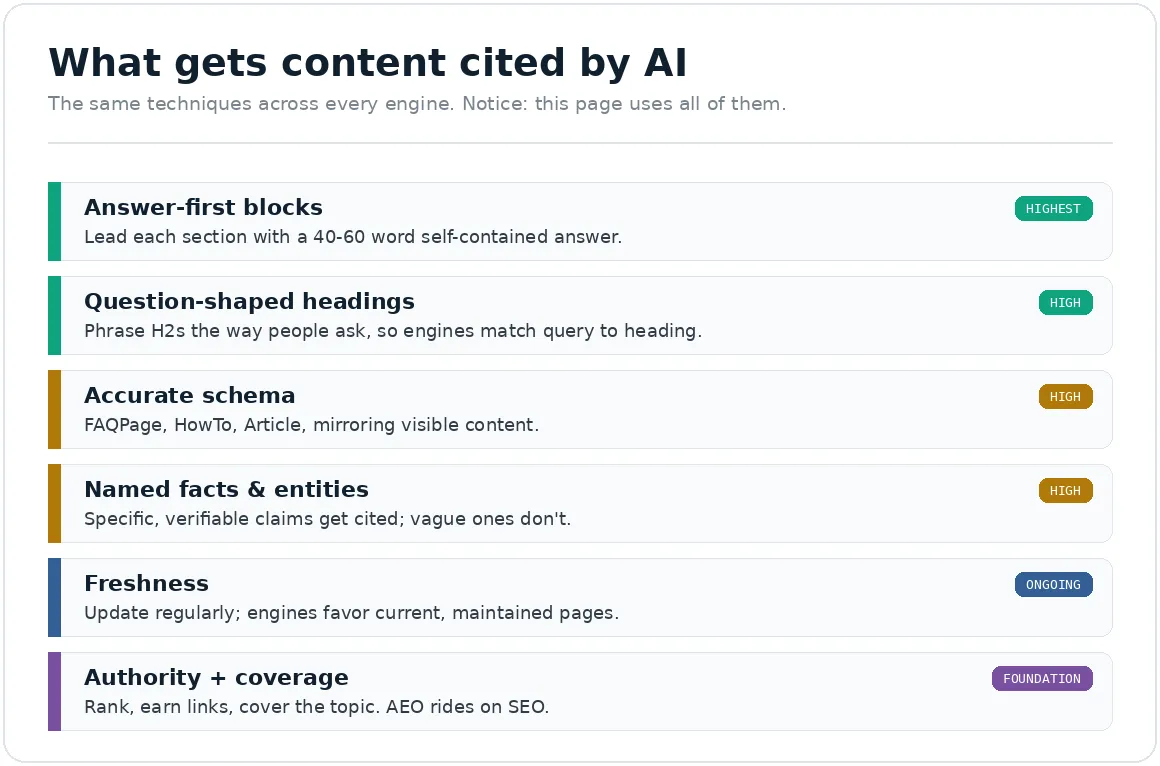
A consistent set across every engine: lead with a direct answer, use question-shaped headings, add the right schema, name specific facts and entities, and keep content fresh. These aren’t tricks, they make your content easy for an engine to extract confidently.
The techniques are strikingly consistent across sources:
Technique
Why it earns citations
Answer-first (40 to 60 word) blocks
Engines lift the clearest self-contained answer they can find
Question-shaped headings
Let engines match your heading directly to the user's query
FAQPage, HowTo, Article schema
Makes your meaning explicit rather than inferred (must mirror visible content)
Named entities and specific facts
Verifiable, specific claims get cited; vague generalities don't
Freshness (regular updates)
Engines have a recency bias and favor maintained pages
Authority and topical coverage
Well-cited, comprehensive sources are trusted more
*Techniques consistent across multiple 2026 AEO analyses. Note: Google’s own guidance is conservative, it states there’s nothing special required for AI Overviews beyond being crawlable with structured data consistent with visible text.*
You may notice these are exactly the techniques this very page uses, and it’s not a coincidence. The full how-to is in how to structure content so AI engines cite you.
- The AEO techniques
Why does answer-first structure matter so much?
Because answer engines lift the clearest, most self-contained answer they can find. If your answer is buried three paragraphs down, an engine may skip it for a competitor who put theirs up front. Leading with a crisp answer hands the engine exactly what it needs to quote.
This is the highest-leverage AEO technique, and the most consistently cited across every source. Think about what an engine is doing: it’s scanning pages for a short, quotable, self-contained answer to a specific question. A page that opens each section with a direct 40 to 60 word answer makes that trivial; a page that meanders before getting to the point makes the engine work harder and often lose to a clearer competitor. The discipline is the “inverted pyramid”: answer first, then expand with context, examples, and detail beneath. It helps human readers too, which is why it’s a rare technique that serves both audiences at once.
How do schema and structured data help?
Schema (FAQPage, HowTo, Article) makes your content’s meaning explicit so engines can classify and surface it confidently, rather than inferring it from prose. It’s one of the cheapest AEO wins, but it only works when it mirrors the visible content on the page.
Structured data is the machine-readable layer that tells an engine exactly what your page contains. FAQPage schema maps directly to the question-and-answer format these engines use internally, so a page with FAQPage markup containing a real question has a structural advantage over one where the answer is buried in running text. Two firm rules, both consistent across sources and Google’s own guidance: schema must reflect content that’s actually visible on the page (marking up hidden or fake content violates guidelines and backfires), and it reinforces, rather than replaces, good content and authorship signals. Done right, it’s a low-effort, high-value part of AEO. The technical detail overlaps with the schema section of ecommerce SEO.
How do I measure whether AEO is working?
Ask the engines directly. Take your most important buyer questions, ask them in ChatGPT, Perplexity, and Google AI Overviews, and record whether your brand is named, quoted, or absent while competitors appear. Repeat monthly to track the trend. It’s manual, but it’s the ground truth.
AEO measurement is genuinely different from SEO measurement, and honestly, the tooling is still immature. The most reliable method right now is manual: pick 15 to 20 questions your buyers actually ask (including bottom-of-funnel, purchase-intent ones), ask each across the major engines, and log whether you’re cited, how you’re described, and who’s cited instead. Repeat on a regular cadence. This gives you a real baseline and shows whether your AEO work is moving citations, which clicks and rankings won’t fully capture. Success in AEO shows up as citations, influence on how AI describes your category, and assisted conversions, not just traffic. This kind of manual visibility tracking is exactly the discipline behind Fracto’s own approach to AI visibility.
Is AEO worth it for a small ecommerce store?
Yes, and arguably more so, because most categories have no established AI-cited incumbent yet. A smaller store that structures its content well can get cited alongside or ahead of bigger competitors who haven’t adapted, since answer engines reward clarity and structure, not just brand size.
Traditional SEO often favors big, high-authority domains, which makes ranking hard for smaller stores. AEO tilts the field somewhat, because being cited depends heavily on how extractable and specific your content is, not only on domain authority. A small store that answers a buyer’s exact question clearly, with the right structure and schema, can earn a citation that a larger, vaguer competitor misses. That’s not a loophole, authority and ranking still matter, but it’s a genuine opening, especially in categories where no one has optimized for AI citation yet. The practical move for a small store is the same as for a large one: pick the questions your buyers actually ask, answer them clearly and specifically, and structure the page so an engine can lift the answer. The cost is mostly discipline, not budget, which is what makes it accessible.
We build content the way answer engines reward, because it's how we build all content, and we measure citations, not just rankings.
Getting cited by AI isn’t a bolt-on for us; the structure that earns citations, answer-first blocks, question-shaped headings, real schema, specific sourced facts, freshness, is the same structure we build into every piece by default. On top of that, we track AI visibility the honest way: asking the engines your key questions on a cadence and watching whether you’re cited.
It’s the same measurement-first discipline behind our conversion optimization and SEO work: define the metric that matters, then move it. And it rests on trustworthy data, because you can’t improve what you can’t measure.
// we would rather show up in your reporting than in your inbox
Frequently asked questions
What is answer engine optimization (AEO)?
AEO is structuring your content so AI answer engines like ChatGPT, Perplexity, Google AI Overviews, and Claude can extract, trust, and cite it as the direct answer to a user’s question. Where SEO rewards the page that ranks, AEO rewards the source that gets quoted inside the AI answer.
Does AEO replace SEO?
No. AEO sits on top of SEO. Answer engines pull from pages that are already crawlable, indexed, and ranking, so a solid SEO foundation is the prerequisite. AEO is the structural layer, answer-first content, schema, entities, added on top of that foundation.
What's the fastest way to get cited by AI?
Lead every important section with a clear, self-contained 40 to 60 word answer to the question it addresses, use question-shaped headings, and add FAQPage schema. Answer engines lift the clearest direct answer they can find, so handing them one is the highest-leverage move.
Does schema markup help with AI citations?
Yes, when it mirrors your visible content. FAQPage, HowTo, and Article schema make your meaning explicit so engines can classify and surface it confidently. It’s one of the cheapest AEO wins. But never mark up hidden or fake content, that violates guidelines and backfires.
How do I measure AI search visibility?
Manually, for now. Ask your most important buyer questions in ChatGPT, Perplexity, and Google AI Overviews, and record whether your brand is cited, quoted, or absent while competitors appear. Repeat monthly to track the trend. The tooling is still immature, so this manual check is the ground truth.
Sources
Overlap between AI Overview citations and the organic top 10: Ahrefs reported 76% in mid-2025 and 38% in early 2026 (863,000 keywords, 4 million cited URLs); BrightEdge reported approximately 54% in October 2025 and approximately 17% in February 2026 on a different methodology; Originality.ai reported 52% on a top-100 analysis. We removed the “38 to 46 percent” band that appeared in an earlier draft: the 46% figure could not be traced to any study, and the narrow band misrepresented what is genuinely a 17% to 76% spread that has moved sharply over eighteen months. Treat any single overlap figure as a snapshot, not a rule. https://rankwyre.com/blog/answer-engine-optimization-get-cited-by-ai ; https://llmrefs.com/answer-engine-optimization
Google’s guidance is conservative: it publishes no special requirements for AI Overview inclusion beyond its ordinary guidance on crawlable content and structured data that matches what is visible on the page (Google Search Central, structured data guidelines). We cite Google directly here rather than the secondary AEO guides that paraphrase it.
Measurement is currently manual (ask the engines directly and log citations). https://contextbolt.com/blog/answer-engine-optimization/