SMS / Lifecycle
Abandoned Cart SMS: How to Recover Sales by Text
// catch the cart while intent is fresh

By Fracto Solutions
October 2, 2026
The short answer
Abandoned cart SMS recovers sales by texting shoppers who left items in their cart, usually within a short window while intent is fresh. Because SMS is read within minutes, it recovers carts email can miss. It requires prior opt-in consent, a clear reminder with a link back to the cart, and an opt-out.
Minutes
Consent
1-2
Why does SMS work so well for cart recovery?
Because timing is everything in cart recovery, and SMS reaches shoppers within minutes while intent is still high. An email might be read hours later, after the moment has passed; a text is read almost immediately, so it catches the shopper while they’re still deciding.
Cart abandonment recovery is a race against fading intent. The moment a shopper abandons, their interest starts cooling, so the speed of your reminder matters enormously. This is exactly where SMS’s near-instant read rate becomes a real advantage: a text sent shortly after abandonment reaches the shopper while the product is still on their mind and the decision is still live. Email cart recovery works and remains essential (it’s cheaper and can carry more detail), but SMS adds a fast, high-read first touch that email can’t match on timing. That’s why cart recovery is one of the two or three flows where adding SMS pays off most, it plays directly to the channel’s strength. The broader cart-abandonment problem and its email side are covered in how to reduce Shopify cart and checkout abandonment.
Do I need consent to send cart-recovery texts?
Yes. Like all marketing SMS, cart-recovery texts require prior express written consent, the shopper must have opted in to receive texts. You can’t text someone just because they abandoned a cart; they must have given SMS consent (typically via a checkout or popup opt-in) first.
This is a critical compliance point people get wrong. An abandoned cart is not consent to text. Under TCPA, you need prior express written consent before sending any marketing SMS, including cart reminders, so the shopper must have opted into SMS beforehand, usually through a checkout checkbox or a popup where they provided their number and agreed to texts. If they only gave an email address, you can send a cart-recovery email but not a text. This is why capturing SMS consent early (at the popup or checkout stage) matters: it’s what makes the high-performing cart-recovery text legal to send. Every cart SMS also needs a visible opt-out and must respect quiet hours, and both of those have moved since 2024, so two specifics are worth getting right.
“Reply STOP” is no longer enough on its own. Since 11 April 2025, the FCC requires businesses to honour a revocation of consent made through any reasonable method, not just a STOP keyword. An email, a phone call, a website form, a reply on social, or a customer telling your support team in a chat all count, and you have 10 business days to action it across every channel. A store that only processes STOP replies is non-compliant today, however clean its opt-in flow is. Make sure whoever handles your inbox and DMs knows that an opt-out arriving there is legally an opt-out.
Quiet hours have a number. The federal window is 8am to 9pm in the recipient’s local time zone, not yours, which matters the moment you sell across time zones. Several states are stricter: Florida, Oklahoma and Washington all cut off at 8pm. Since cart-recovery SMS fires on a timer rather than on your schedule, check that your platform suppresses and queues overnight sends rather than firing them at 2am local time.
One thing you can stop worrying about: the FCC’s “one-to-one consent” rule never took effect. It was vacated by the Eleventh Circuit in January 2025 and formally removed by the FCC later that year, so a single clear opt-in can still cover more than one seller. If your team rebuilt consent flows for that rule in 2024, that work is no longer required. The full compliance framework is in SMS marketing for ecommerce. (Guidance, not legal advice, confirm your region’s rules.)
Step
Timing
What it does
Abandon
0
Shopper leaves items in cart
First SMS
~20 to 60 min
Reminder + link back to cart (while intent is fresh)
Optional follow-up
Hours or next day
Light nudge, maybe a modest incentive
Coordinate
Alongside
Sequence with email so they don't collide
Requires prior SMS consent. Lead with the reminder, not a discount. One or two texts, no more.
What's the right timing for a cart-recovery SMS?
Send the first text fairly soon after abandonment, while intent is fresh (many stores use a short delay like 20 to 60 minutes), then optionally a follow-up later. Don’t over-send: one or two well-timed texts recover most of what SMS will recover; more just drives opt-outs.
Timing is the whole game in cart recovery, and SMS lets you act fast. A common, effective structure: – First text: a short while after abandonment (often somewhere in the 20-to-60-minute range), soon enough that intent is still warm, not so instant that it feels intrusive. – Optional second text: some hours later or the next day, perhaps with a gentle incentive, for shoppers who didn’t return. – Coordinate with email: if you also run an email cart flow, sequence them so the shopper isn’t hit by identical messages at once, let SMS lead on speed and email follow with detail, or alternate.
Resist the urge to send more. One or two timely texts capture most of the recoverable revenue; a barrage annoys people and drives opt-outs, costing you the subscriber entirely. Test your exact timing, but keep it few and well-placed.
- Cart-recovery SMS flow
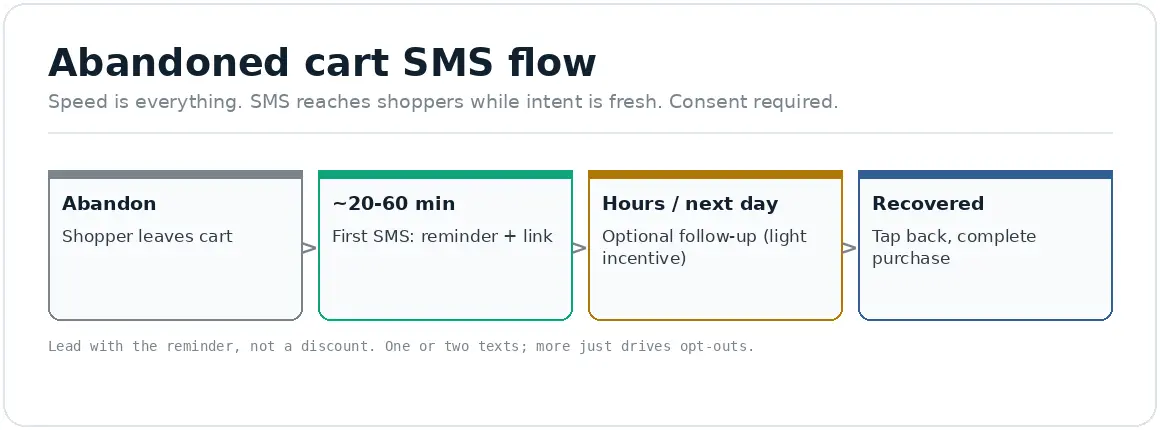
Speed is everything. Consent required; lead with the reminder, not a discount.
What should a cart-recovery text say?
Keep it short and specific: identify your brand, remind them what they left, add a clear link back to the cart, and include the opt-out. A light nudge (or a modest incentive on a later message) helps, but lead with the reminder, not a discount.
Effective cart-recovery SMS copy is brief and focused, because the format demands it and the shopper already knows the product. The elements: – Brand identifier, so they know who’s texting. – The reminder, reference the cart or item (“Your cart’s waiting”). – A clear link back to the cart (use a tracked link, not a spammy free shortener) so returning is one tap. – The opt-out (“Reply STOP”), required in the message.
Lead with the reminder, not a discount. Many shoppers just needed the nudge, and reflexively offering money trains people to abandon carts on purpose to trigger a code. If a first reminder doesn’t convert, a later message can add a modest incentive. Keep the whole thing under about 160 characters so it sends as one clean message. The same “don’t lead with a discount” logic applies to email cart and win-back flows.
How do I measure cart-recovery SMS?
Track the recovery rate (share of abandoned carts recovered via the SMS flow), the click and conversion rates on the texts, revenue per recipient, and the opt-out rate. Judge it on recovered revenue and list health together, a flow that recovers sales but spikes opt-outs isn’t winning.
Measure the flow on outcomes, not activity. The key metrics: – Recovery rate: what share of abandoned carts the SMS flow brings back, the headline number. – Click and conversion rate on the texts: are shoppers tapping through and buying? – Revenue per recipient / recovered revenue: the bottom-line value of the flow. – Opt-out rate: the health check, if recovery comes at the cost of people leaving your list, the timing or frequency is off.
Read recovered revenue and opt-out rate together: the goal is to recover sales while keeping subscribers, so a flow that wins carts but burns the list needs adjusting. Test timing, copy, and whether/when to add an incentive, and benchmark against your own trend. This is the same measure-and-improve discipline behind all lifecycle work, and it connects to the broader cart-abandonment recovery strategy across channels.
We build compliant cart-recovery SMS that recovers sales without burning the list.
We send only to consented subscribers, time the first text while intent is fresh, coordinate with any email cart flow so they don’t collide, lead with the reminder rather than a reflexive discount, and watch opt-out rate alongside recovered revenue.
It’s part of our email and lifecycle work, and it plugs into the broader cross-channel cart recovery behind our conversion optimization.
// we would rather show up in your reporting than in your inbox
Frequently asked questions
Does abandoned cart SMS work?
Yes, it’s one of the highest-value SMS flows, because timing is critical in cart recovery and SMS reaches shoppers within minutes while intent is fresh. It recovers carts that a slower email might miss. It works best alongside email cart recovery, with SMS leading on speed and email following with detail.
Can I text everyone who abandons a cart?
No. You can only send cart-recovery texts to shoppers who gave prior express written SMS consent (usually via a checkout or popup opt-in). An abandoned cart alone is not consent. If they only gave an email, send an email instead. Every text also needs an opt-out and must respect quiet hours.
When should I send a cart-recovery text?
Fairly soon after abandonment while intent is fresh, many stores use a short delay in the 20-to-60-minute range, with an optional follow-up later. Don’t over-send: one or two well-timed texts recover most of what SMS will, and more just drives opt-outs. Coordinate with any email cart flow.
Should cart-recovery texts include a discount?
Lead with the reminder, not a discount. Many shoppers just need the nudge, and always offering money trains people to abandon carts deliberately to get a code. If a first reminder doesn’t convert, a later message can add a modest incentive. Keep the message short and include the opt-out.
Sources
SMS cart recovery relies on speed while intent is fresh; lead with a reminder rather than a discount; coordinate with email: consistent across 2026 SMS sources. Compliance specifics, current as of 2026. TCPA requires prior express written consent before any marketing text, and an abandoned cart is not consent. Quiet hours are 8am to 9pm in the recipient’s local time zone under federal rules, with Florida, Oklahoma and Washington stricter at 8pm. Since 11 April 2025 the FCC requires opt-outs made by any reasonable method, not only a STOP keyword, to be honoured within 10 business days across all channels; we corrected an earlier draft that described STOP as the standard opt-out. The FCC’s one-to-one consent rule was vacated by the Eleventh Circuit in January 2025 (Insurance Marketing Coalition v. FCC) and formally removed later that year, so it is not a requirement. A related “revoke-all” provision has been delayed and sources disagree on the new date, so check its status before relying on it. Note also that in February 2026 the Fifth Circuit held that oral consent suffices in Texas, Louisiana and Mississippi; written consent remains the standard elsewhere and the safer practice everywhere. This is guidance, not legal advice. https://www.omnisend.com/blog/sms-marketing-best-practices/ ; https://www.attnagency.com/blog/sms-marketing-ecommerce ; https://www.digitalapplied.com/blog/sms-marketing-compliance-tcpa-gdpr-guide-2026
Cart abandonment is a major recoverable-revenue opportunity (Baymard): see the cart-abandonment cluster.