CRO / AEO
What Is Answer Engine Optimization (AEO)?
// be the source, not just a result

By Fracto Solutions
September 15, 2026
The short answer
Answer engine optimization (AEO) is the practice of structuring content so AI answer engines, like ChatGPT, Perplexity, Google AI Overviews, and Claude, can extract, trust, and cite it as the direct answer to a question. Where SEO aims to rank a page, AEO aims to be the source an AI quotes.
Citation
the goal, not just a ranked link
On top
AEO depends on SEO, it doesn’t replace it
AEO=GEO
same practice, different acronym
What does answer engine optimization mean?
AEO is structuring your content so AI answer engines can extract it, trust it, and cite it as the answer to a user’s question. The target is the citation inside the AI’s answer, not just a ranked link on a results page.
Break the phrase down: an “answer engine” is any AI tool that responds to a question with a direct, synthesized answer rather than a list of links, ChatGPT, Perplexity, Google’s AI Overviews, Gemini, and Claude all qualify. “Optimization” here means structuring your content so those engines can confidently pull from it and name you as a source. The defining shift is the target: classic search optimization wants a click from a results page, while AEO wants your brand quoted inside the answer itself, whether or not the user clicks through. As more search journeys start (and sometimes end) inside an AI tool, that citation becomes valuable real estate.
How is AEO different from SEO?
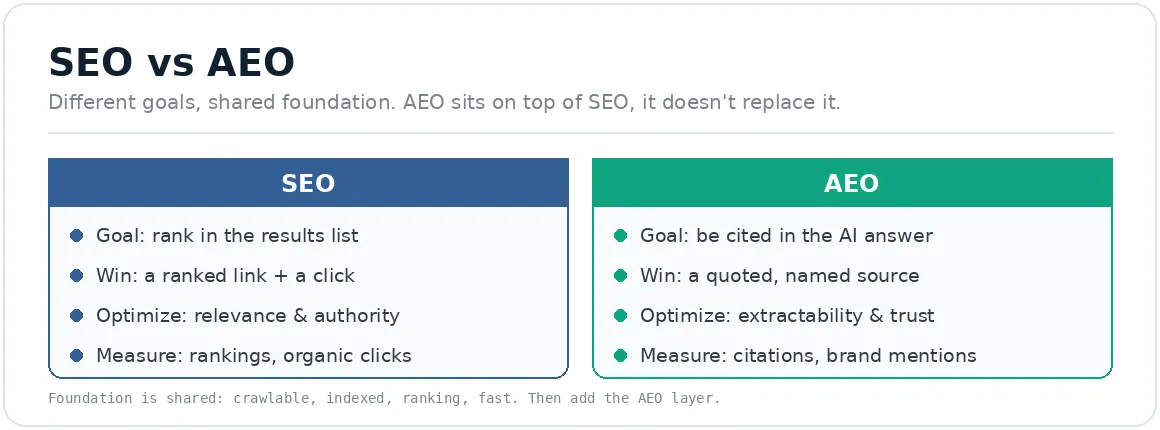
SEO optimizes to rank a page in the list of search results; AEO optimizes to be cited inside an AI-generated answer. SEO’s unit is the ranked link; AEO’s unit is the quoted source. They’re related but aim at different outcomes.
The clearest way to see the difference is what each is trying to win:
SEO
AEO
Goal
Rank in the results list
Be cited in the AI answer
Unit of success
A ranked link and a click
A quoted, named source
Optimizes for
Relevance and authority to rank
Extractability and trust to be quoted
Measured by
Rankings, organic clicks
Citations, brand mentions in answers
*AEO and SEO differ in goal and measurement but share the same technical foundation.*
The distinction matters because success looks different. A page can rank well yet never get cited by an AI (if its answer is buried), and understanding AEO means optimizing for the quote, not just the rank. But, crucially, this doesn’t make them rivals, which is the next point.
- SEO vs AEO
Does AEO replace SEO?
No. AEO sits on top of SEO and depends on it. Answer engines don’t crawl a separate web, they pull from pages that are already crawlable, indexed, and ranking. Without an SEO foundation, there’s nothing for an answer engine to cite.
This is the most important thing to understand about AEO, and where a lot of hype misleads. Answer engines read the same web that search does. Google’s AI Overviews draw heavily on pages already ranking in organic results, and ChatGPT and Perplexity favor crawlable, authoritative, well-structured pages. So the SEO fundamentals, being crawlable and indexed, earning authority and links, passing Core Web Vitals, remain the prerequisite. AEO is the layer of structure and clarity you add on top so those already-solid pages get extracted and quoted. Treating AEO as a replacement for SEO gets it backwards; it’s an extension of it. The SEO foundation itself is covered in ecommerce SEO: how to rank and convert.
Why does AEO matter now?
Because a growing share of search happens inside AI tools, and those tools show only a handful of cited sources. If buyers are asking AI about your category and you’re not cited, you’re invisible in that channel, no matter how well you rank the traditional way.
The shift in buyer behavior is what makes AEO urgent rather than academic. More people now ask ChatGPT, Perplexity, or Google’s AI Overview a question and act on the synthesized answer, which names only a few sources. That’s a winner-takes-few dynamic: being one of the cited sources is hugely valuable, and being absent means you don’t exist in that answer even if you’re on page one of classic results. For a category with no established AI-cited incumbent yet, there’s a real first-mover opportunity to become the source engines reach for, which is exactly the opening a deliberate AEO effort targets. That window matters because AI citations show early signs of stickiness: once an engine consistently reaches for a source on a topic, that pattern tends to reinforce itself, so the brands that structure their content well now are staking a claim before their category gets crowded. Waiting until AEO is mainstream means competing for citations that may already have defaulted to whoever moved first.
Is AEO the same as GEO?
Largely yes, they’re overlapping terms for the same goal. AEO (answer engine optimization) and GEO (generative engine optimization) both mean structuring content to be cited by AI answer engines. The techniques are the same; only the label differs.
You’ll see both terms, along with “LLM SEO” and “AI search optimization”, used more or less interchangeably. The nuances people draw between them are minor and not worth getting stuck on: all describe the practice of earning citations from generative AI answer engines. What matters is the work, not the acronym: lead with clear answers, structure for machines, use accurate schema, name specific facts, and stay fresh and authoritative. Whichever term your team prefers, the playbook is the one covered in how to rank in AI search. If you want a practical way to cut through the terminology, judge any AEO or GEO advice by a single test: does it help an answer engine extract a clear, trustworthy answer from your page? Techniques that pass that test are worth doing under any name; ones that don’t are just jargon, regardless of which acronym they’re sold under.
We treat AEO as a layer on solid SEO, then measure citations.
We get the SEO foundation right first (crawlable, ranking, authoritative), then add the AEO structural layer that earns citations, and we track whether you’re actually named by the engines, not just where you rank.
It’s part of our SEO work, feeding the same measurement-first discipline as our conversion optimization.
// we would rather show up in your reporting than in your inbox
Frequently asked questions
What is answer engine optimization in simple terms?
It’s structuring your content so AI tools like ChatGPT, Perplexity, and Google’s AI Overviews quote you as the source when they answer a question. Instead of aiming for a ranked link and a click, you’re aiming to be the source named inside the AI’s answer.
Is AEO different from SEO?
Yes in goal, no in foundation. SEO aims to rank a page; AEO aims to be cited in an AI answer. But AEO depends on SEO, engines pull from crawlable, ranking pages, so you need the SEO foundation first, then add the AEO structural layer on top.
Will AEO replace SEO?
No. Answer engines read the same web search does and favor pages that already rank. SEO remains the prerequisite; AEO is an extension that optimizes those pages to be extracted and cited. Treating AEO as a replacement gets the relationship backwards.
Is AEO the same as GEO?
Effectively yes. AEO (answer engine optimization) and GEO (generative engine optimization) are overlapping terms for the same goal, getting cited by AI answer engines. The techniques are identical; only the label differs. Don’t get stuck on the acronym.
Sources
AEO depends on SEO; answer engines pull from crawlable, ranking pages: https://rankwyre.com/blog/answer-engine-optimization-get-cited-by-ai
AEO and GEO used interchangeably for the same practice: general 2026 industry usage.