Underpinning all of it: trustworthy data. If your analytics is wrong, every diagnosis is wrong, which is why measurement quality comes first (see seven signs your analytics setup is broken).
Strategy / Growth
Ecommerce Growth Strategy: Where to Focus First
// grow the weakest lever, not the loudest one

By Fracto Solutions
September 15, 2026
The short answer
An ecommerce growth strategy comes down to one equation: revenue equals traffic times conversion rate times average order value times purchase frequency. To grow, you improve one of those four levers. The fastest wins usually come from your weakest lever, not the one that’s easiest or loudest, so the first job is diagnosing which lever is actually holding you back.
4
levers: traffic, conversion, AOV, purchase frequency
RPV
revenue per visitor = conversion x AOV, the north star
Weakest
lever first, because the terms multiply
What is the ecommerce growth equation?
Revenue equals traffic times conversion rate times average order value times purchase frequency. Every way to grow an ecommerce business improves one of those four levers, which is why they’re the foundation of any real growth strategy.
This single equation, consistent across 2026 growth frameworks from Shopify and others, is the most useful lens in ecommerce because it’s complete: every growth tactic maps to one of the four terms. Run more ads or improve SEO, you’re working traffic. Fix your checkout, you’re working conversion. Add a bundle, you’re working AOV. Build a reorder flow, you’re working purchase frequency. Because the terms multiply, a weakness in any one caps the whole result, and an improvement in any one flows through everything. That’s what makes it a strategy tool rather than a slogan: it tells you that the question isn’t “how do I grow?” but “which of these four is holding me back?”
Lever
What it means
Where it's covered
Traffic
Getting qualified visitors to the store
SEO and paid advertising
Conversion rate
Turning visitors into buyers
Conversion optimization (CRO)
Average order value
Getting each order bigger
AOV optimization
Purchase frequency
Getting customers to buy again
Retention and lifecycle
*Framework: the ecommerce revenue equation (traffic x conversion x AOV x frequency), consistent across 2026 Shopify and industry growth frameworks.*
- The growth equation
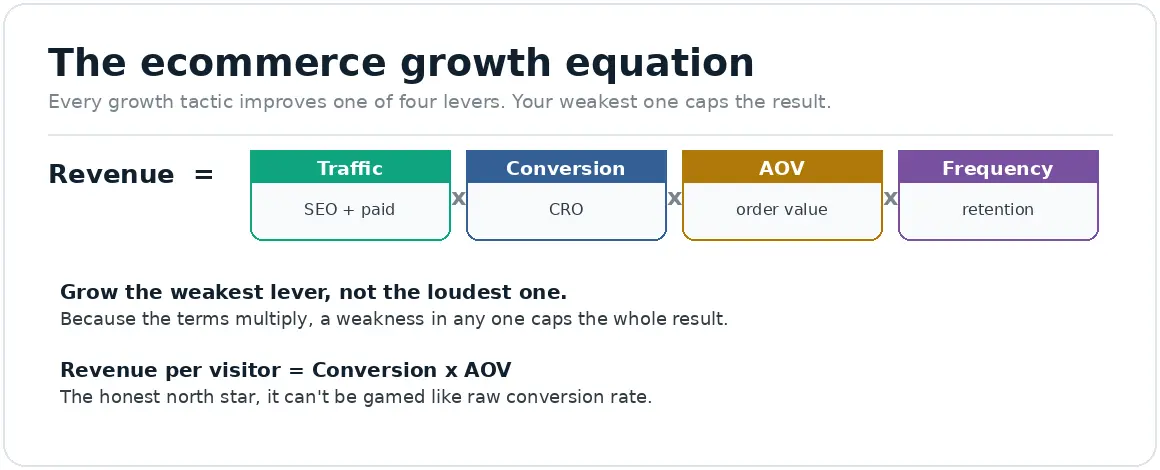
The E-commerce Growth Equation & Four Levers
Which lever should I focus on first?
Your weakest one, the lever most below where it should be for your category. Growth comes fastest from fixing your biggest constraint, not from pushing a lever that’s already strong. Diagnosis comes before tactics.
The instinct is to do more of what you already do, but that’s usually wrong. If your conversion rate is healthy and your traffic is thin, more conversion work has little left to give, you need traffic. If you’re buying lots of traffic that doesn’t convert, more ads just waste money, you need conversion. The discipline is to look at all four levers against your category norms and your own trend, find the one furthest behind, and focus there. This mirrors how a CRO audit works at the page level, applied to the whole business: fix the biggest leak first. The one nuance: because the levers multiply, even a strong lever can be worth pushing if the others are maxed, but for most stores, one lever is clearly lagging, and that’s the answer.
Should I focus on traffic or conversion first?
For most stores with existing traffic, conversion first. Improving conversion makes every visitor and every ad dollar worth more immediately, and it’s fully in your control, whereas traffic is capped by budget and rising costs. But if your conversion is already strong and traffic is genuinely thin, traffic is the constraint.
This is the most common version of the “where first” question, and it has a mostly-consistent answer: fix the leaky bucket before pouring in more water. Scaling traffic into a store that converts poorly just pays to lose more shoppers, and acquisition costs keep climbing, which makes wasted traffic increasingly expensive. We deliberately avoid quoting a single CAC benchmark here, because published figures disagree so sharply that any one number would mislead more than it helps. Improving conversion, by contrast, lifts the return on all your traffic at once and compounds. The exception is a genuinely well-converting store that simply isn’t getting enough qualified visitors, there, traffic is the real limit. The full decision, with the math, is in should you focus on traffic or conversion first.
What's the single most important metric to track?
Revenue per visitor (conversion rate times AOV), not conversion rate alone. It captures whether your traffic is actually producing revenue, and it can’t be gamed the way raw conversion rate can. Most sophisticated stores treat it as their north star.
Fixating on conversion rate in isolation is a classic mistake, because you can lift conversion while destroying revenue (deep discounts raise conversion but shrink AOV and margin). Revenue per visitor solves this by combining two of the four levers into one honest number: a store with a 1% conversion rate and a high AOV can out-earn a store with a 3% rate and a tiny AOV. Tracking revenue per visitor keeps you focused on actual revenue rather than a vanity percentage. It’s why our own conversion work is judged on revenue per visitor, not conversion rate alone. The broader set of numbers worth watching is in ecommerce KPIs that actually matter.
How does growth strategy change as a store matures?
Early on, growth leans on acquisition, you need customers before anything else. As you mature, the balance shifts toward conversion, AOV, and especially retention, because extracting more from existing customers has far better unit economics than constantly buying new ones.
Growth isn’t static; the right lever changes with your stage. A young store’s constraint is usually traffic and first purchases, so acquisition dominates. But acquisition gets more expensive as you scale and competition intensifies, so mature stores increasingly win by improving conversion, raising AOV, and driving repeat purchases, the levers that compound on customers you’ve already paid to acquire. This is why retention becomes disproportionately valuable over time (covered in how to improve ecommerce customer retention), and why the strongest brands shift from “growth at all costs” to profitable, habit-driven growth. The equation stays the same; the lever you lean on evolves.
What's the most common growth mistake?
Pushing the lever you’re comfortable with instead of the one that’s actually weak. Founders who love ads buy more traffic; designers rebuild the site; email marketers add flows, each fixing a lever that may already be fine while the real constraint goes untouched.
This is why diagnosis matters more than tactics. The most expensive mistake in ecommerce growth isn’t doing the wrong thing badly, it’s doing the wrong thing well: pouring skill and budget into a lever that wasn’t holding you back. A store with great traffic and a broken checkout doesn’t need more traffic; a store that converts well but nobody visits doesn’t need a new PDP. Both mistakes feel productive because something is improving, but revenue barely moves because the actual constraint is elsewhere. The discipline the equation forces is humbling but valuable: measure all four levers honestly, ignore which one you’d enjoy working on, and go where the numbers say the leak is. That’s the difference between activity and growth.
How do I build the strategy without guessing?
Measure all four levers, compare each to your category and your own trend, find the weakest, fix it, then re-measure and move to the next. Growth is a loop of diagnose, fix, measure, not a one-time plan.
The framework becomes a strategy when you run it as a cycle:
Measure the four levers. Traffic (and its cost, CAC), conversion rate, AOV, and purchase frequency, split by device and source where it matters.
Diagnose the constraint. Compare each lever to your category norms and your own history; the one furthest behind is your focus.
Fix the biggest leak first. Concentrate effort on the constraint, not on whatever’s easiest or most fashionable.
Measure the effect, ideally by testing. Confirm the change actually moved revenue (a proper A/B test where traffic allows), rather than assuming.
Repeat. Once the weakest lever is fixed, the next one becomes the constraint. Growth compounds through the loop.
How Fracto approaches this
We find your weakest lever and fix that, rather than selling you the tactic we happen to offer.
Because we work across analytics, CRO, paid, SEO, email, and development, we’re not incentivized to push one lever, we diagnose which of the four is actually constraining your revenue, fix the biggest one first, and prove the gain in your own numbers before moving to the next. It’s growth as a system, not a grab-bag of tactics.
It’s the same baseline-first discipline behind our conversion optimization work, where we identify which of the four levers is actually your constraint before touching any of them. And it starts with trustworthy analytics, because a wrong number means a wrong diagnosis.
// we would rather show up in your reporting than in your inbox
Frequently asked questions
What is the ecommerce growth equation?
Revenue equals traffic times conversion rate times average order value times purchase frequency. Every growth tactic improves one of these four levers. Because they multiply, your weakest lever caps the whole result, so growth strategy is really about finding and fixing that constraint.
Should I focus on getting more traffic or improving conversion?
For most stores with existing traffic, improve conversion first, it makes every visitor and ad dollar worth more immediately and is fully in your control, while traffic is capped by rising costs. The exception is a store that already converts well but genuinely lacks qualified visitors.
What's the most important ecommerce metric?
Revenue per visitor (conversion rate times AOV), not conversion rate alone. It reflects whether traffic is actually producing revenue and can’t be gamed by tactics that lift conversion while shrinking order value. A low-conversion, high-AOV store can out-earn a high-conversion, low-AOV one.
Where should a new store focus versus a mature one?
New stores usually need acquisition first, you need customers before you can optimize anything else. Mature stores shift toward conversion, AOV, and retention, because extracting more from existing customers has far better unit economics than constantly buying new ones as acquisition costs rise.
How do I know which growth lever is my problem?
Measure all four (traffic and CAC, conversion rate, AOV, purchase frequency), compare each to your category and your own trend, and find the one furthest behind. That’s your constraint. Fix it first, measure the effect, then move to the next weakest lever.
Keep reading
Sources
The ecommerce revenue equation (revenue = traffic x conversion rate x AOV x purchase frequency) and the “four levers” framework: consistent across 2026 growth frameworks.
Shopify;
Pattern
Revenue per visitor / RPU (conversion rate x AOV) as a truer north star than conversion rate alone:
Drip Agency;
Build Grow Scale
We removed the “$87 median ecommerce CAC” figure that appeared in an earlier draft. Shopify does publish it, but attributes it to a third-party agency analysis rather than to its own data, and the benchmark table on that same Shopify page gives $64 for organic and $68 for paid. Other figures in circulation for the same metric run from roughly $42 to $318 depending on what counts as acquisition spend. A number that unstable is not a benchmark, so we describe the direction only. Rising CAC and the shift toward retention as stores mature:
Shopify; and as compiled in the LTV:CAC and CAC clusters.