CRO / Ecommerce
What a CRO Audit Includes
// diagnosis before prescription

By Fracto Solutions
July 31, 2026
The short answer
A CRO audit is a structured diagnosis of why your store isn’t converting, and a prioritized plan to fix it. A real one reviews your analytics and tracking, funnel drop-off, user behaviour, and checkout, then hands you a ranked list of issues by revenue impact. Most audits take one to three weeks, depending on how many templates and how much data need reviewing.
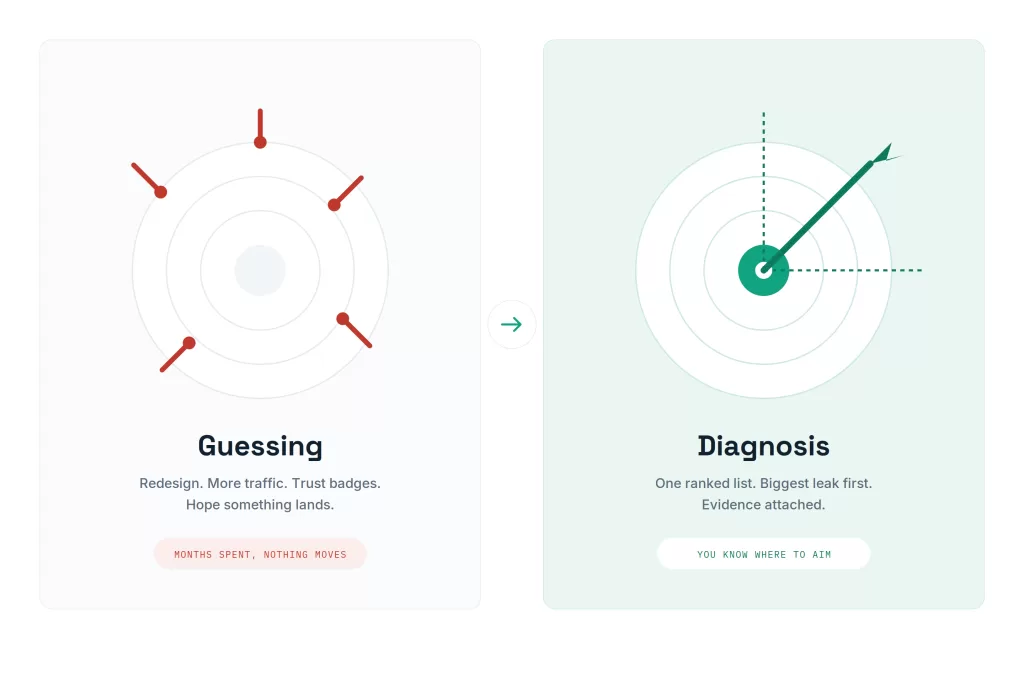
Most stores don’t need more traffic or a redesign. They need to know, specifically, where they lose people and what to fix first. That’s what an audit is for. It replaces guessing with a diagnosis.
The word gets used loosely, though. A five-page “audit” that lists generic best practices is not the same as a data-backed diagnosis of your funnel. This guide covers what a genuine CRO audit includes, what you should receive at the end, what it costs, and how to tell the two apart before you pay for one.
What is a CRO audit?
A systematic review of your store’s conversion performance that identifies why visitors aren’t buying and ranks what to fix by expected revenue impact.
Think of it as a diagnosis, not a treatment. The audit’s job is to find and prioritize the problems; fixing them is the work that follows. A good one is grounded in your actual data, your analytics, session recordings, and funnel numbers, rather than in an auditor’s opinion of how your site looks. Two stores can have the same “ugly” product page and completely different conversion problems, so an audit built on data beats one built on aesthetics every time.
It’s also distinct from a quick heuristic review. Anyone can run through a checklist of “add trust badges, shorten your forms.” A real audit tells you which of those things is actually costing you money, and how much, so you don’t spend three months fixing something that was never the leak.
What does a CRO audit include?
Five areas: analytics and tracking, traffic quality, funnel drop-off, user behaviour, and the checkout. Each answers a different question about where revenue leaks.
- What a real audit reviews
Five areas, one ranked output
01
Analytics & tracking
can you trustthe data?
02
Traffic quality
right visitorsor wrong?
03
Funnel drop-off
where they leave
04
User behaviour
why theyleave
05
Checkout & cost
the finalleak
All five feed one deliverable:
a ranked list of issues, ordered by revenue impact
A real audit isn’t a checklist. Each area answers a different question, and together they produce one prioritized roadmap rather than a pile of observations.
Analytics and tracking review. Before anything else, the audit confirms your data can be trusted. Broken or half-configured tracking makes a healthy store look broken and a broken one look fine. This step checks your GA4 and tag setup, verifies orders and events fire correctly, and rules out measurement problems that would corrupt everything downstream.
Traffic and source quality. Not all visitors are buyers. The audit segments traffic by channel to see whether low conversion is a store problem or a traffic problem.
Funnel and drop-off analysis. The core. The audit reads your funnel step by step and finds where the steepest drop happens, telling you whether the problem lives on product pages, in the cart, or inside checkout. We go deep on this in how to diagnose Shopify conversion issues.
User behaviour analysis. Numbers show where people leave; recordings and heatmaps show why, catching friction dashboards miss: a button that fails on mobile, a form that fights back, a hidden price.
Checkout and cost review. Because checkout is where committed buyers are lost, the audit examines the whole path for known abandonment triggers. This connects directly to why shoppers abandon checkout.
What deliverables should I expect from a CRO audit?
A prioritized findings report, a recommended action plan, and the evidence behind each finding, not just a list of opinions.
- A ranked list of issues by estimated revenue impact, so you know what to fix first.
- The evidence for each finding, the funnel number, the recording, the analytics view, so recommendations are defensible.
- A specific, sequenced action plan: what to change, in what order, and why.
- A sense of expected impact, at least directionally, so you can weigh effort against return.
Be wary of a deliverable that’s a long PDF of generic advice with no data attached. Length is not depth. A 40-page report that could apply to any store is worth less than a 10-page one built on your actual numbers.
How much does a CRO audit cost?
A one-time ecommerce CRO audit typically costs $2,000 to $15,000, driven by your site’s complexity, traffic, and how deep the analysis goes.
- CRO audit pricing, 2026 market
Engagement
Typical cost
What it covers
One-time ecommerce CRO audit
$2,000 to $15,000
Diagnosis + ranked roadmap
Hourly advisory / consulting
$150 to $500/hr
Single-project or advisory work
Lighter heuristic review
lower end
Best-practice walkthrough, less data
Source: 2026 CRO agency pricing guides (ConversionTeam, ClicksGeek, Convertibles, and others), compiled July 2026. Ranges reflect publicly stated rates; exact price scales with traffic, site complexity, and depth.
Simpler stores with clean data sit at the lower end; large or custom-built sites with high traffic sit higher, because there’s more to analyze and more revenue at stake. Some advisory work is billed hourly, commonly $150 to $500 per hour.
The way to judge cost isn’t the sticker price, it’s price against what fixing the findings is worth. A single change that lifts conversion a few percent on a store doing real revenue usually pays for the audit many times over. Cheap audits that hand you generic advice tend to be the expensive ones, because you pay again in wasted implementation time.
Is a CRO audit worth it?
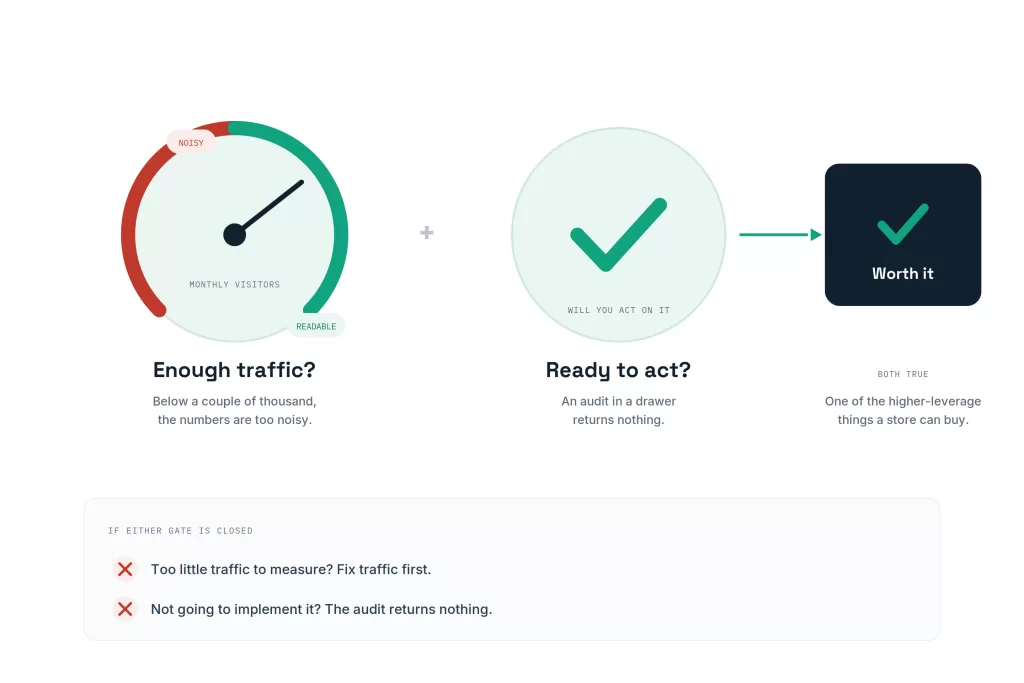
Worth it when you have enough traffic to diagnose and you’re prepared to act on the findings. Not worth it if your real problem is too little traffic to measure.
The honest test is twofold. First, do you have enough visitors for the data to mean something? Below roughly a couple of thousand monthly visitors, your funnel numbers are too noisy to draw firm conclusions. Second, will you actually implement the recommendations? An audit that sits in a drawer returns nothing; the value is entirely in acting on it.
When both are true, an audit is one of the higher-leverage things a store can buy, because it redirects effort you’re already spending toward the changes most likely to move revenue, instead of toward guesses.
How is a CRO audit different from a website or SEO audit?
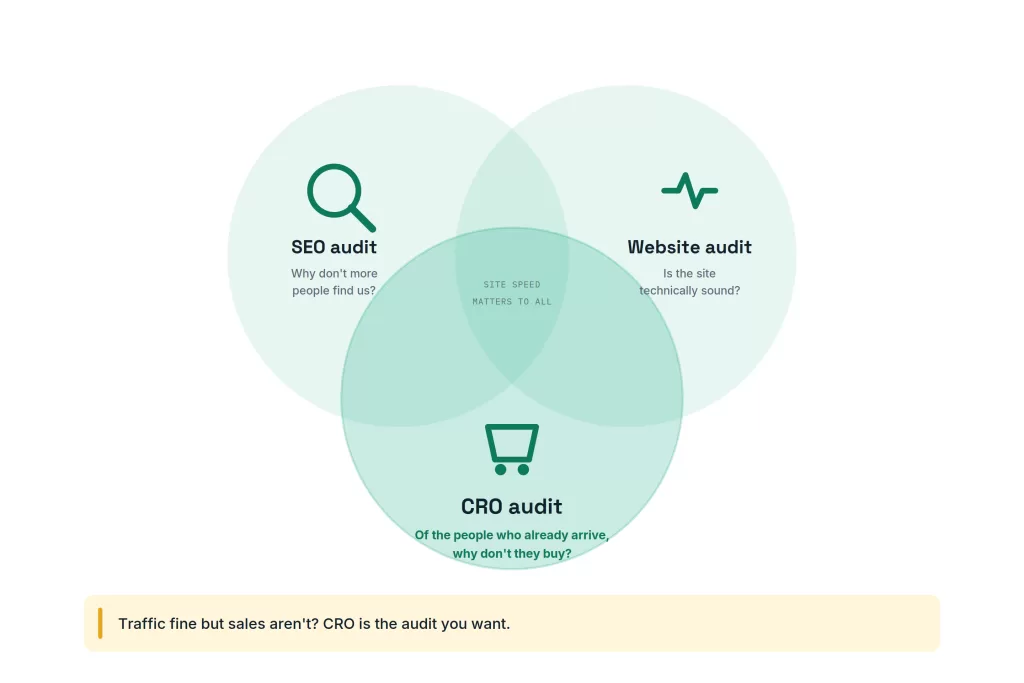
A CRO audit focuses on why visitors don’t convert. A website audit looks at general health; an SEO audit looks at search visibility.
An SEO audit asks “why don’t more people find this site?” A general website audit asks “is this site technically sound, fast, and accessible?” A CRO audit asks the money question: “of the people who already arrive, why don’t they buy, and what’s the fastest path to changing that?” The three overlap at the edges, site speed matters to all, but their purpose differs. If your traffic is fine and your sales aren’t, CRO is the audit you want.
We start every engagement with the audit.
Prescribing before diagnosing is how money gets wasted. Our process is baseline-first: we confirm your tracking is trustworthy, map your funnel, watch how real shoppers behave, and pinpoint where revenue actually leaks, then size what fixing each leak is worth.
On one recent engagement, that diagnostic approach led to a rebuilt buying path that lifted a client conversion rate by 6% and revenue per visitor by 7%, both A/B tested at 95% confidence. The audit is what told us where to aim.
Frequently asked questions
How long does a CRO audit take?
Most ecommerce audits take one to three weeks, depending on site complexity and data availability. Simpler stores with clean analytics are faster; large catalogs and messy tracking take longer, partly because fixing the tracking comes first.
What's the difference between a CRO audit and ongoing CRO?
The audit is a one-time diagnosis that finds and ranks problems. Ongoing CRO is the execution that follows, running tests, implementing fixes, and measuring lift over time.
Do I need a lot of traffic for a CRO audit to be useful?
For A/B testing you generally need a few thousand monthly visitors, but the diagnostic parts, tracking, funnel drop-off, session recordings, deliver value even at lower volumes.
Can I do a CRO audit myself?
Partly. Free tools like GA4 and Microsoft Clarity cover a lot. The value of a professional audit is the experience to interpret data quickly, size impact, and prioritize, which is where most self-audits stall.
What should a CRO audit report actually contain?
A ranked list of issues by revenue impact, the evidence behind each, and a sequenced action plan. If it’s a generic checklist with no data from your own store, it isn’t a real audit.
Keep reading
Sources
CRO audit pricing compiled from 2026 agency pricing guides: one-time ecommerce audits commonly $2,000 to $15,000; hourly advisory $150 to $500 (ConversionTeam, ClicksGeek, Convertibles, and others, 2026).
Fracto client engagement: rebuilt buying path, +6% conversion rate and +7% revenue per visitor, A/B tested at 95% confidence.