CRO / Testing
What Should You A/B Test First on a Shopify Store?
// test the leak, not the easy thing

By Fracto Solutions
September 10, 2026
The short answer
Test where your funnel actually leaks, not where it’s easy. For most Shopify stores that means checkout, product pages, and the mobile experience, in that rough order, because that’s where committed buyers are lost. Prioritize by revenue impact and by how much traffic each test needs, and start with bold changes.
3
highest-impact areas: checkout, product pages, mobile
~1 in 5
tests win, so aim them where it counts
Bold
changes beat cosmetic tweaks for low-traffic stores
How do I decide what to test first?
Let your data decide, not your opinion. Find where your funnel loses the most shoppers, then test bold changes there. The best first test targets your biggest leak, not the easiest thing to change.
The principle is simple: test where the money is leaking. That means starting with diagnosis, not a list of ideas. Use your analytics to see where shoppers drop in the funnel (product page, cart, checkout) and session recordings to see why. The step with the steepest drop-off, weighted by how many shoppers and how much revenue it touches, is where your first test belongs. This is the same diagnostic logic behind a CRO audit and our conversion optimization service: fix the biggest leak first. Testing there gives the largest possible payoff from a single experiment.
Why not just test button colors and small tweaks?
Because small tweaks usually produce effects too small to detect, and even when they win, they rarely move revenue much. They’re popular because they’re easy, not because they work.
There are two problems with starting small. First, statistical: a button-color change might lift conversion a fraction of a percent, and detecting an effect that tiny needs enormous traffic most stores don’t have, so the test never reaches a conclusion. Second, practical: even a “winning” micro-tweak rarely changes your revenue meaningfully. The stores that get real results from testing focus on changes big enough to matter, which are also big enough to detect. Save the polish for after you’ve fixed the things that actually lose sales. Put differently: the first test should be the one that, if it wins, you’d genuinely notice in revenue, not one whose result you’d struggle to see outside the testing tool.
Area to test
Why it's high-impact
Typical change size
Checkout
Committed buyers abandon here
Bold (guest checkout, fewer steps)
Product pages
The decision moment
Bold (layout, images, social proof)
Mobile experience
Most traffic, converts lower
Bold (mobile checkout, tap targets)
Value proposition
Affects every visitor
Bold (messaging, hero)
Cosmetic tweaks
Rarely moves revenue
Small (avoid as first tests)
Source: prioritization reflects where cart/checkout abandonment and mobile conversion gaps concentrate; see the linked cart-abandonment and mobile pillars.
What are the highest-impact things to test on Shopify?
For most stores: checkout, product pages, and mobile. These are where committed buyers are lost and where bold changes produce large, measurable lifts.
Checkout. This is where shoppers who already decided to buy abandon, so it’s usually the highest-value area. Test removing friction: guest checkout, fewer form fields, clearer costs shown earlier, added trust signals.
Product pages. The moment of decision. Test the add-to-cart prominence, image presentation, how information is structured, and social proof placement.
Mobile experience. Most traffic is mobile and it converts lower than desktop, so mobile-specific tests (layout, tap targets, mobile checkout flow) often have the most headroom.
The value proposition. Testing how clearly your homepage or landing pages communicate what you sell and why to buy can produce large lifts, because it affects everyone.
Notice these are all substantial changes, not cosmetic ones. That’s deliberate: they can produce the large effects that are both worth having and possible to detect.
- What to test first
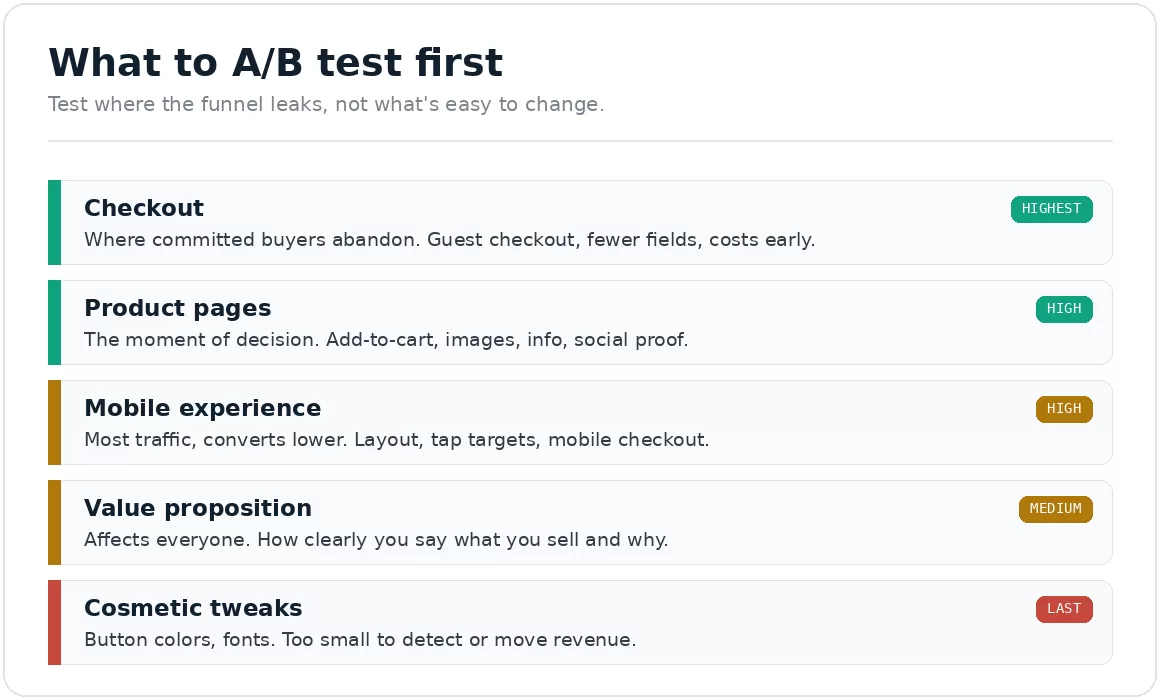
Test where the funnel leaks, not what is easy to change.
How do I balance impact against the traffic a test needs?
Weigh each candidate test by two things: how much revenue it could move, and how much traffic it needs to reach significance. The best first tests are high-impact and achievable with your traffic.
Impact alone isn’t enough, a high-impact test you can’t power is just a test that never finishes. So for each candidate, estimate both the potential revenue effect and the sample size required (which depends on the size of change you’re making). A bold change at your biggest leak is ideal because it scores high on impact *and*, being a big change, has a large detectable effect that needs less traffic. A subtle change at a minor leak is the worst of both worlds. If you’re traffic-constrained, this balance pushes you even harder toward bold changes at major leaks. The sample-size math behind this is in how much traffic you need for a valid A/B test.
What should I test after the first wins?
Work down your ranked list of leaks, and use what you learn to inform the next hypothesis. Testing is a loop: each result, win or lose, sharpens where you look next.
Once you’ve tested your biggest leak, move to the next-biggest, keeping the same discipline: bold changes, proper sample size, revenue as the metric. Just as importantly, feed the learning forward. A win tells you something about what your shoppers respond to; a loss rules out a hypothesis and often hints at a better one. Over time this compounds into real knowledge of your specific customers, which is the durable asset A/B testing builds, beyond any single winning variant. The overall loop is covered in the pillar guide.
Should I test one thing at a time or several?
For most Shopify stores, test one clear change at a time (a clean A/B). It’s easier to power, faster to conclude, and it tells you exactly what caused the result. Save multi-variant testing for high-traffic stores.
Testing several things at once (multivariate testing) sounds efficient but needs far more traffic and makes it harder to know which change drove the outcome. For the traffic levels most Shopify stores have, a sequence of clean, one-change-at-a-time A/B tests produces clearer, more trustworthy answers. It also keeps each test’s sample-size requirement manageable. Once you have the traffic to support it, multivariate testing can explore combinations, but it’s rarely the right place to start.
We test where your funnel actually leaks, not where it's easy.
We diagnose your funnel first (analytics for where, session recordings for why), rank the leaks by revenue impact, then test bold changes at the biggest one. That’s how a single experiment returns the most, rather than spreading effort across cosmetic tweaks.
It’s the same baseline-first discipline behind our conversion optimization work, where the first test is chosen by where the funnel actually leaks rather than by what is quickest to build.
Frequently asked questions
What's the best first A/B test for a Shopify store?
Whatever targets your biggest funnel leak, usually a checkout or product-page change for most stores. Diagnose where shoppers drop first, then test a bold change there. There’s no universal “best test”, the best one is specific to where your store loses shoppers.
Should I test button colors?
Rarely worth it as a first test. The effect is usually too small to detect without huge traffic, and too small to move revenue much. Focus on substantial changes to checkout, product pages, or mobile instead. Cosmetic polish can come later.
How do I know where my funnel leaks?
Use analytics to see where shoppers drop between steps (product view, add to cart, checkout, purchase) and session recordings to see why. The steepest drop, weighted by traffic and revenue, is your priority. This is the core of any conversion diagnosis.
Is it better to test big changes or small ones?
Big changes, for most stores. They produce larger effects that are both more valuable and easier to detect with limited traffic. Small changes need traffic most stores lack and rarely move revenue meaningfully. Be bold where it counts.
Keep reading
Sources
Prioritization by funnel leak and testing bold changes over cosmetic tweaks; small effects need impractical traffic for most stores. Corroborated across multiple 2026 A/B testing guides. https://www.mantasdigital.com/cro-2/ab-testing-small-ecommerce-stores/ ; https://grow-conversions.com/blog/ab-testing-best-practices/
Highest-impact ecommerce test areas (checkout, product page, mobile) reflect where cart/checkout abandonment and mobile conversion gaps concentrate. See the cart-abandonment and mobile figures in the linked pillars.