SEO / Ecommerce
Ecommerce SEO: How to Rank and Convert Organic Traffic
// ranking is half the job; converting is the other half

By Fracto Solutions
September 4, 2026
The short answer
Ecommerce SEO is the work of getting your store’s pages to rank in search and turning that organic traffic into sales. In 2026 it has four parts: technical health (speed, crawlability), structured data (Product schema), buyer-intent content (category and comparison pages), and trust signals. Ranking brings the visitor; your funnel still has to convert them.
Most ecommerce SEO advice stops at “rank higher.” But traffic that doesn’t convert is just a bigger bill. Real ecommerce SEO does two jobs: earn the visit, then make it count. This guide covers both, and the point most guides miss, that ranking and converting are separate problems.
What is ecommerce SEO?
Optimizing an online store so its category and product pages rank in organic search for the queries buyers actually use, and so those visitors go on to buy.
It differs from content SEO because the pages that matter most are commercial, category and product pages, not blog posts. It also spans more surfaces than before: classic organic results, Google Shopping’s merchant listings, and increasingly AI answer engines. Winning one doesn’t automatically win the others, so a modern approach treats technical health, structured data, content, and trust as one system.
The scale is different too. A blog might have fifty pages a person could review by hand. A store can generate tens of thousands of URLs from a few hundred products once variants, filters, and sort orders multiply, and most of them are near-duplicates nobody should ever land on. So ecommerce SEO is as much about controlling what gets crawled and indexed as it is about improving individual pages.
And the job doesn’t end at the click. A blog post succeeds when someone reads it. A product page succeeds when someone buys. That means the same page has to satisfy a search engine, a shopper skimming for whether the thing fits, and a checkout that has to not lose them. Optimizing for the first while ignoring the other two is the most common way stores waste an SEO budget.
What are the main parts of ecommerce SEO?
Four: technical performance, structured data, buyer-intent content, and trust signals. Pages that do all four rank and convert.
- The four parts of ecommerce SEO
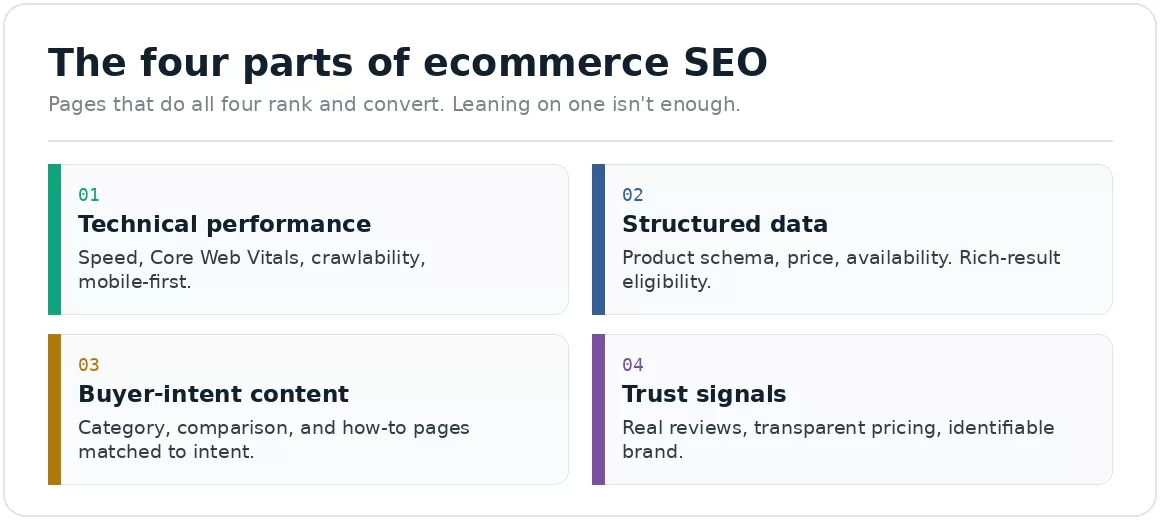
Pages that do all four rank and convert. Leaning on just one, schema-only or speed-only, isn’t enough anymore.
Technical performance (speed, crawlability, mobile-first) is the foundation, see the technical SEO checklist. Structured data (Product schema) makes pages eligible for rich results. Buyer-intent content matches pages to what buyers search. Trust signals (real reviews, transparent pricing) matter to shoppers and engines.
Does technical SEO still matter for ecommerce?
Yes, it’s the foundation. If engines can’t crawl your pages, or shoppers abandon slow ones, no amount of content will save your rankings.
Two areas carry the most weight. Site speed and Core Web Vitals: Google’s thresholds are LCP under 2.5s, INP under 200ms, CLS under 0.1, measured on real users at the 75th percentile. And crawlability: large catalogs generate huge numbers of URLs (especially via faceted navigation), and uncontrolled that wastes crawl budget. Full list in the technical SEO checklist; speed’s effect on sales in how speed impacts conversion.
Worth being precise about how much weight to give this. Core Web Vitals are used by Google’s ranking systems, but Google’s own people have described them as more of a tiebreaker than a major factor, and they do not override relevance. A fast page will not outrank a genuinely better answer. Where speed earns its keep is that it works twice: it helps at the margin in search, and it directly affects whether the visitor stays long enough to buy. That second effect is usually the larger of the two.
What is the role of structured data (schema)?
Product schema tells engines exactly what a page is, product, price, availability. It makes pages eligible for rich results, but it is not a direct ranking signal.
- Key schema types for ecommerce (Google documentation)
Schema type
What it does
Ecommerce use
Product
Describes item, price, availability
Every product page (required: name plus one of offers, review, aggregateRating)
BreadcrumbList
Shows page hierarchy in results
Category and product pages
AggregateRating
Shows review stars in results
Product pages with real reviews only
FAQPage
Can surface Q&As in results
Guides and informational pages
Source: Google Search Central, product structured data documentation. Requirements shown are for product snippets. Merchant listings, the format used when shoppers can buy directly from your page, require more, including image and an offers block with price and priceCurrency. Check which experience you are targeting before implementing.
Google has stated repeatedly that structured data does not by itself rank a page higher, it makes pages eligible for rich results and merchant listings, which can improve click-through. One firm rule: never mark up data that isn’t real or visible on the page. Fabricated schema (fake ratings, placeholder prices) violates Google’s guidelines and can get rich results removed.
How does content strategy work for ecommerce SEO?
Match content to buyer intent: commercial pages (category, product) for people ready to buy, informational pages (guides, comparisons) for people still deciding. Both feed the funnel.
Category pages should target commercial queries and be genuinely useful. Product pages should be complete and well-marked-up. Informational content captures buyers earlier and builds the topical authority that helps commercial pages rank. This hub-and-spoke structure is exactly how this cluster is built. Keyword research aligns each page to real demand, see keyword research for ecommerce product pages.
The failure mode here is thin category pages. A page with a heading, a grid of products, and nothing else gives an engine almost nothing to understand and gives a shopper no reason to trust the selection. A category page earns its ranking by answering the questions someone browsing that category actually has: what the differences between these options are, who each suits, what to check before choosing.
The other failure mode is writing informational content that never connects to anything you sell. A guide that ranks and sends every reader away has cost you money. Each informational page should have an obvious next step into the commercial pages it supports, which is what turns a set of articles into a funnel rather than a library.
Does AI search change ecommerce SEO?
It adds a surface, it doesn’t replace the fundamentals. AI answer engines increasingly summarize and cite sources, so the same clean structure that wins rich results also helps a page be understood and cited, but the core work is unchanged.
The honest position, given how fast this is moving, is to be careful about specific claims. What’s well established: Google and other engines are surfacing AI-generated answers above or alongside traditional results, and those answers pull from pages they can parse confidently. What that rewards is exactly what good ecommerce SEO already rewards, clear structure, accurate Product schema, complete and trustworthy content, so there’s no separate “AI SEO” checklist to chase. Be wary of vendors quoting precise figures about AI citation rates; those numbers are still early, vary by study, and often can’t be traced to a clean primary source. The durable move is to get the fundamentals right and treat AI visibility as a benefit of that, not a separate game with its own tricks. That’s the same reason this content program is built to be genuinely useful and sourced, rather than optimized for any single engine’s current behavior.
How is ranking different from converting?
Ranking gets the visitor to your page; converting turns them into a customer. Separate problems, separate solutions, and winning one doesn’t guarantee the other.
This is where our angle differs. You can rank first and still lose the sale to a slow page, a confusing product page, or a checkout full of friction. SEO’s job ends when the visitor arrives; conversion optimization takes over. A store investing in rankings while ignoring conversion is filling a leaky bucket. That’s why our SEO always connects to the funnel it feeds, more in Shopify CRO: the complete guide.
There is actually a step before that one, and it catches people out. Ranking does not even guarantee the click, let alone the sale. Here is a live example from one of our own client accounts.
Same site, same period: rank does not equal clicks
Query type
Avg. position
Impressions
Clicks
CTR
Branded (exact brand name)
2.0
67
32
47.8%
Informational (long-tail question)
1.9
59
4
6.8%
Informational (high-volume question)
4.8
1,580
5
0.3%
Whole site, all queries
10.7
145,000
935
0.6%
Source: Google Search Console for one Fracto client site, US traffic, web search only, three months to August 2026. Client anonymized. Read the first two rows together: at effectively the same position, the branded query earned seven times the click-through rate of the informational one. Position was not the variable. Intent was. The third row is the one worth sitting with: a page-one ranking against 1,580 impressions returned five clicks, because that question gets answered on the results page itself. Caveat: this is a single non-ecommerce client account, shown to illustrate the mechanism, not as an ecommerce benchmark. Do not read these percentages as targets for a store.
So the funnel has three gates, not two. A page has to rank, then earn the click, then convert. Informational queries increasingly lose at the second gate because the answer is served in the results, which is a good reason to make sure your informational content links into commercial pages rather than existing to collect impressions.
We treat SEO and conversion as one system.
Rather than chasing rankings in isolation, we tie SEO to the metric that pays the bills, which is where our conversion optimization work picks up. We get the technical foundation right, target content to real buyer intent, and make sure the pages that rank are pages that convert. Ranking a page that then leaks its visitors is a half-finished job.
On one engagement, the same baseline-first discipline, rebuilding the buying path so arriving visitors converted, lifted a client’s conversion rate by 6% and revenue per visitor by 7%, both A/B tested at 95% confidence.
Frequently asked questions
How long does ecommerce SEO take to work?
Typically months, not weeks. Technical fixes can act faster, but ranking gains from content and authority build over time. SEO compounds, it rewards patience over quick wins.
Is structured data a ranking factor?
No. Google has stated it’s not a direct ranking signal. It makes pages eligible for rich results and merchant listings, which can improve click-through. Never mark up data that isn’t real.
Product pages or content, what matters more?
Both, connected. Product and category pages capture ready buyers; informational content captures them earlier and builds authority that helps commercial pages rank.
Does site speed affect ecommerce SEO?
Yes, on two fronts. Core Web Vitals are a documented ranking consideration, and speed strongly affects conversion. Meeting Google’s thresholds helps both rankings and sales.
Can I do ecommerce SEO myself?
Parts of it. Keyword research, content, and basic technical checks are learnable. Technical fixes at scale, structured data, and crawl management on large catalogs often need specialist help.
Keep reading
Sources
Google Search Central, product structured data documentation. Product snippets require name plus one of offers, review, or aggregateRating; merchant listings additionally require image and offers with price and priceCurrency. Structured data is not a direct ranking signal — developers.google.com
Google, Core Web Vitals thresholds (LCP <2.5s, INP <200ms, CLS <0.1), each assessed at the 75th percentile of real page views. Used by Google’s ranking systems, but described by Google as closer to a tiebreaker than a major factor — web.dev
Rank-versus-clicks table: Google Search Console, one Fracto client site, US traffic, web search only, three months to August 2026. Single non-ecommerce account, shown to illustrate the mechanism rather than to benchmark stores. Client anonymized.
Fracto client engagement: +6% conversion rate, +7% revenue per visitor, A/B tested at 95% confidence.