Conversion / Shopify
Shopify Redesign vs CRO: Which Does Your Store Actually Need?
// don't rebuild what you can fix

By Fracto Solutions
September 2, 2026
The short answer
For most Shopify stores, CRO beats a full redesign: it’s cheaper, lower-risk, and every change is measurable. A redesign changes everything at once, so you can’t tell what helped or hurt, and you risk discarding elements that already convert. Redesign only when the site is genuinely outdated, broken, or unable to support the business.
“Our site feels dated, should we redesign it?” is one of the most expensive questions in ecommerce, because the instinctive answer, yes, rebuild it, is usually the wrong one. Here’s the honest comparison, expanding on the redesign question raised in the Shopify CRO guide.
- Redesign vs CRO, at a glance
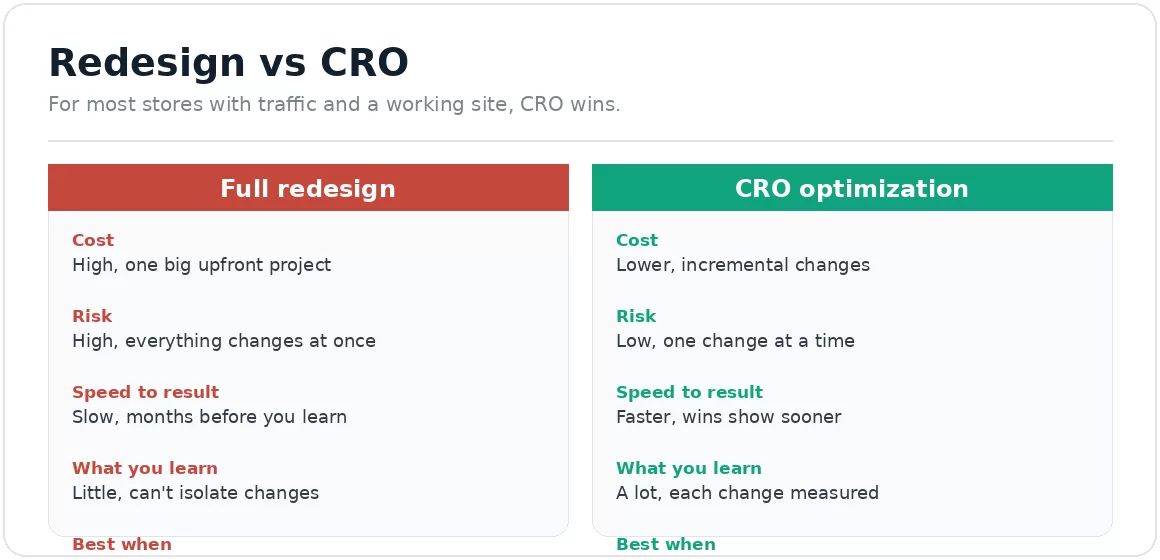
For most stores with traffic and a working site, CRO wins on cost, risk, speed, and what you learn.
What's the difference?
A redesign rebuilds look and structure all at once. CRO changes specific elements deliberately and measures each. One is a big bet; the other is a series of small, tested improvements.
The core difference isn’t cosmetic, it’s about risk and knowledge. A redesign gives you a new site but little certainty about what works; CRO gives you a steadily better site and precise knowledge of why.
Why does a full redesign carry more risk?
Because it changes everything at once, so if conversion drops you can’t tell why, and you may discard elements that were quietly converting well.
Your current site, even if dated, contains things that work, a layout shoppers understand, a checkout they’re used to, trust signals in familiar places. A redesign can unknowingly remove those, and since everything changed at once, you can’t isolate the cause of a drop. Plenty of beautiful redesigns have quietly tanked conversion. It’s also slow and expensive before you learn whether it helped.
Why is CRO usually the better first move?
Cheaper, faster to show results, lower-risk, and it teaches you what actually works, knowledge a redesign would then build on.
CRO targets the specific things costing you sales, one at a time, and proves each. You spend less, see results sooner, and every win is measured. You also learn which changes move your shoppers, so if you ever redesign, it’s informed by evidence rather than taste. The economics of converting existing traffic are in the Shopify CRO guide.
When is a redesign actually right?
When the site is genuinely outdated, technically broken, unmaintainable, or unable to support the business.
Technically broken or unmaintainable, slow at the code level, buggy, or on a platform you can’t extend.
Can’t support the business, you’ve outgrown the structure or need capabilities it can’t accommodate.
Genuinely outdated in ways that damage trust, not just “we’re bored of it”.
Mobile fundamentally broken, structurally poor, not a fixable friction point.
Even then, bring CRO learnings into the redesign so you rebuild on evidence and don’t discard what was working.
Can I do both?
Yes, and the best approach often sequences them: optimize first to learn what works, then let a redesign build on that evidence.
The mistake is redesigning blind. The stronger path is CRO first, gather evidence, and if a redesign is genuinely needed, carry those findings into it so it preserves what converts. A CRO audit tells you whether your problems are fixable frictions or genuinely structural.
How do I decide for my store?
Functional but leaking → CRO first. Broken, unmaintainable, or unable to support the business → redesign, informed by CRO.
If your site works and gets traffic but doesn’t convert well, the problem is friction, and CRO fixes friction far more cheaply and safely than a rebuild. Most stores asking the question are in that camp, which is why “optimize first” is usually right.
We tell you honestly which one your store needs.
Our conversion optimization process is baseline-first: confirm your tracking is trustworthy, map your funnel, watch how real shoppers behave, pinpoint where revenue leaks, then test the highest-impact fix. We’d rather ship one change that measurably moves revenue than a dozen that look busy.
On one engagement, that approach lifted a client’s conversion rate by 6% and revenue per visitor by 7%, both A/B tested at 95% confidence.
Frequently asked questions
Is a redesign or CRO cheaper?
CRO is almost always cheaper, a series of targeted changes versus a large upfront project. It also starts returning value sooner.
Will a redesign improve my conversion rate?
Not reliably. It changes many things at once, so it can hurt as easily as help, and you won’t know which change did what. CRO improves conversion deliberately and measurably.
How do I know if my site is too outdated to optimize?
If it’s functional and gets traffic, it’s almost always worth optimizing first. “Outdated” is a redesign trigger only when the look damages trust or the build can’t support the business.
Should I redesign if my mobile experience is bad?
First check whether it’s fixable friction (CRO handles that) or a structural failure (which may need a rebuild). Many “bad mobile” problems are specific, fixable issues.
Keep reading
Sources
The redesign versus CRO comparison reflects established optimization practice rather than a single study: incremental, measured change isolates cause and reduces risk against a wholesale rebuild. We label it as our position, not as a research finding.
Conversion benchmarks referenced on this page defer to the linked Shopify CRO guide and its source, Littledata (Shopify benchmark, 2,800 sites, 2023 data).
Fracto client engagement: +6% conversion rate, +7% revenue per visitor, A/B tested at 95% confidence. Client remains anonymous.