There is no rule against both. Once your funnel converts in the top tier, scaling spend while continuing to optimise is how healthy brands grow. “Conversion first” is about order under constraint: fixing efficiency before adding volume means the volume you add later is more profitable. Foundation first, then scale. To find which side of 3.2% you are on and what is holding you there, a CRO audit gives you the read.
CRO / DTC
Should You Improve Conversion or Increase Ad Spend First?
// fix the engine before you add fuel

By Fracto Solutions
August 7, 2026
The short answer
For most DTC brands, improve conversion first. Below Littledata’s 3.2% top-20% threshold, a conversion fix lowers your effective CAC and compounds on every future visitor, while more spend at the same rate just buys more of the same loss. Scale spend once you are above 3.2% with a healthy LTV:CAC. The exception is traffic: if you cannot run a test, get traffic first.
It is one of the most common growth questions a DTC founder faces, and the instinct, buy more traffic, is usually the wrong first move. Here is the honest comparison: what each choice does, where the threshold actually sits, and when the answer flips.
It builds on how CRO lowers CAC, which explains the underlying mechanics.
What's the difference between the two approaches?
Increasing ad spend buys more visitors at your current conversion rate. Improving conversion gets more customers from the visitors you already have. One scales volume; the other scales efficiency.
They solve different problems. More ad spend is a volume lever: more traffic at a fixed conversion rate means proportionally more sales, at proportionally more cost. Conversion improvement is an efficiency lever: without spending more, you turn more existing traffic into customers, which lowers the cost of every sale. The question is not which is good, it is which to do first.
- Same $10,000, two different funnels
At the Shopify average
Conversion 1.4%
20,000 visitors
280 customers
$35.71
effective CAC
At the top-20% threshold
Conversion 3.2%
20,000 visitors
640 customers
$15.62
effective CAC
Same spend, same traffic, 129% more customers. Doubling your ad budget at 1.4% would also give you more customers, but your CAC would stay at $35.71. Improving conversion is the only one of the two that changes the cost per customer.
Arithmetic at a fixed $10,000 spend and 20,000 visitors. Conversion figures are Littledata’s Shopify average and top-20% threshold, so both ends of this comparison are real benchmark positions rather than illustrative numbers.
Where exactly is the threshold?
At 3.2%, which is where Littledata’s top 20% of Shopify stores begin. Below it there is documented room to improve; above it you are already in the top tier.
- Where your store sits on Shopify
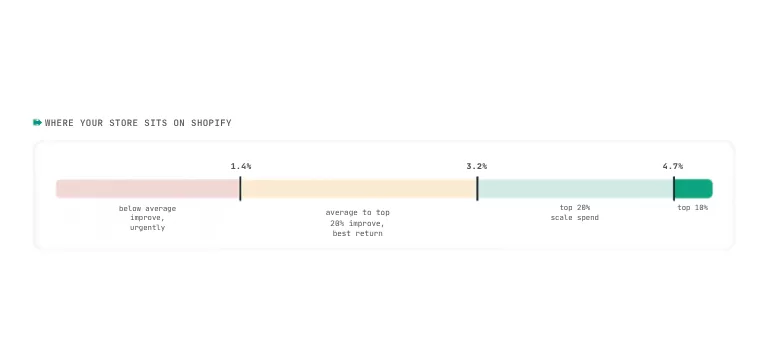
Littledata’s Shopify benchmark: 1.4% average, top 20% above 3.2%, top 10% above 4.7%, all session-to-order, from its 2023 study of 2,800 sites. Four in five Shopify stores sit below 3.2%, which is why “improve conversion first” is the default answer rather than a slogan.
Why improve conversion first, in most cases?
Because it lowers CAC, compounds over time, and multiplies the return on any ad spend you add later. You fix the engine before adding fuel.
Three reasons stack up. It directly lowers effective CAC, because more customers come from the same spend. It compounds, since a better funnel improves the conversion of all your traffic, on every future visitor, from every channel. And it makes later ad spend more efficient: scaling into a poorly converting funnel just buys more of the same loss. The full arithmetic is in how improving conversion rate reduces CAC.
What happens if I increase ad spend into a leaky funnel?
You amplify the leak. More traffic through a poorly converting store means you pay to acquire visitors and lose the same share of them, at greater total cost.
A store at the 1.4% average that doubles its ad budget doubles its traffic and its customers, from 280 to 560 in the example above, but its effective CAC stays at $35.71. Nothing about the unit economics improved; the same inefficiency simply got bigger and more expensive. With acquisition costs rising, scaling before fixing conversion locks in a high CAC exactly when acquisition is getting harder.
When should I increase ad spend first instead?
When your funnel already converts in the top tier with healthy unit economics, or when you do not yet have the traffic to run a test.
- The decision rule
IF
Conversion below 3.2%, and enough traffic to test
below Littledata’s top-20% threshold
Improve conversion first
Four in five Shopify stores are here. Biggest opportunity, lowers CAC, and compounds on every future visitor.
IF
Conversion 3.2% or above, and LTV:CAC at least 1.5:1
Littledata top 20% · Foundry CRO healthy DTC band
Increase ad spend
You are in the top tier with economics that support scaling. Pour fuel on a working engine.
IF
Not enough traffic to run a test
see the sample sizes below
Increase ad spend
CRO needs data. You cannot diagnose or validate a change you have no power to measure. Revisit conversion once you can.
Two thresholds, both from published benchmarks: 3.2% is Littledata’s top-20% mark for Shopify stores, and 1.5:1 is the bottom of Foundry CRO’s healthy band for DTC ecommerce. Neither is a rounded rule of thumb.
How much traffic do I need before CRO is worth it?
It depends on how big a lift you are trying to detect. Small lifts need far more traffic than most stores expect, which is why the honest answer is a table rather than a number.
To call a test result reliable you need enough visitors to distinguish a real lift from noise. The requirement is set by statistics, not opinion, and it rises sharply as the lift you are chasing gets smaller.
- Visitors needed to detect a lift
Lift you want to detect
+100%
+50%
+20%
Conversion moves
1.4% → 2.8%
1.4% → 2.1%
1.4% → 1.7%
Visitors per variant
1,640
5,500
30,400
Total visitors
3,300
11,000
60,700
Standard two-proportion sample size at 95% confidence and 80% power, calculated from a 1.4% baseline. These are arithmetic, not estimates: you can recompute them in any sample-size calculator. Below roughly 3,000 monthly visitors, A/B testing is not realistic, but analytics and session recordings still tell you where the leak is.
So the traffic answer has two halves. Below about 3,000 monthly visitors you cannot A/B test meaningfully, so getting traffic first is genuinely the right call. Between 3,000 and 11,000 you can test large changes but not small ones, which is an argument for bold redesigns rather than button colours. Above that, most of the CRO toolkit is open to you.
There is a third case worth naming: a genuine launch or demand moment. Sometimes capturing a time-sensitive opportunity justifies spending before the funnel is ready. Just know you are trading efficiency for speed, and that the CAC you lock in will be the higher one.
Can't I do both at once?
Eventually yes, and the strongest brands do. But if you are sequencing under constraint, conversion first sets up ad spend to perform better.
How Fracto approaches this
We help you sequence the two, starting where your leverage is.
We read your funnel and unit economics to tell you which move actually pays off first for your store, then, if conversion is the answer, fix the leak and prove the CAC reduction in your own numbers.
On one engagement, a rebuilt buying path lifted conversion 6% and revenue per visitor 7%, both A/B tested at 95% confidence.
// we would rather show up in your reporting than in your inbox
Frequently asked questions
Is it always better to improve conversion before spending more on ads?
Not always, but usually. Four in five Shopify stores sit below the 3.2% top-20% threshold, so for most brands there is documented room to improve. The two exceptions are having too little traffic to run a test, and already converting above 3.2% with a healthy LTV:CAC, in which case scaling spend is the right call.
How much traffic do I need before conversion optimization is worth it?
For A/B testing, it depends on the size of the lift you want to detect. From a 1.4% baseline at 95% confidence and 80% power, detecting a 100% lift needs roughly 3,300 visitors in total, a 50% lift around 11,000, and a 20% lift about 60,700. Below roughly 3,000 monthly visitors, testing is not realistic, though analytics and session recordings still tell you where the leak is.
What conversion rate means I should scale instead?
3.2% or above, which is Littledata’s top-20% threshold for Shopify stores, paired with an LTV:CAC of at least 1.5:1, the bottom of Foundry CRO’s healthy band for DTC ecommerce. Meeting one without the other is not enough: a strong conversion rate on weak unit economics still scales a loss.
Does improving conversion reduce how much I spend on ads?
It reduces cost per customer, not necessarily total spend. Each ad dollar produces more customers, so you get more for the same budget, or the same for less. Moving from 1.4% to 3.2% at a fixed $10,000 spend takes effective CAC from $35.71 to $15.62.
What if my ads are already profitable?
Then you have a strong case to scale, especially with a healthy LTV:CAC. Improving conversion still makes scaling more profitable, but a profitable, well-converting funnel is one to confidently spend behind rather than hold back.
Keep reading
Sources
Shopify conversion tiers: average 1.4%, top 20% above 3.2%, top 10% above 4.7%, session-to-order, from a benchmark of 2,800 Shopify sites studied in 2023 — Littledata.
LTV:CAC healthy band for DTC ecommerce, 1.5:1 to 3:1 — Foundry CRO, 2026.
The conversion and CAC relationship is arithmetic (effective CAC = ad spend ÷ customers acquired); worked example holds spend at $10,000 and traffic at 20,000 visitors throughout.
Sample sizes are a standard two-proportion calculation at 95% confidence and 80% power from a 1.4% baseline, rounded, and can be reproduced in any sample-size calculator.
Fracto client engagement: +6% conversion rate, +7% revenue per visitor, A/B tested at 95% confidence.