White-label / Agencies
White-Label CRO for Agencies: How It Works
// senior execution under your brand

By Fracto Solutions
September 3, 2026
The short answer
White-label CRO lets your agency offer conversion rate optimization under your own brand, while a specialist partner does the work behind the scenes. You keep the client relationship; they supply the testing, analysis, and reporting. It’s how agencies add CRO without hiring a full in-house team, and it scales up or down with demand.
Plenty of agencies are asked for conversion optimization they can’t yet staff. Hiring a full CRO team is slow and expensive, especially if demand is uneven. White-label CRO solves that: a specialist partner delivers the work under your brand, so you can offer the service today without building the team first.
- How white-label CRO works
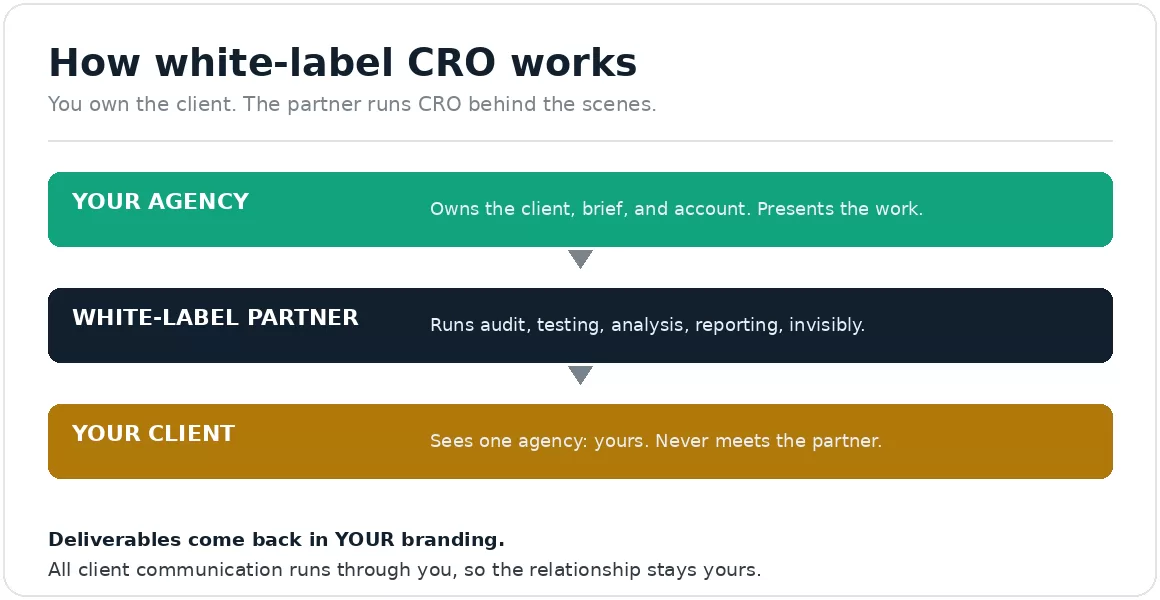
You own the client and the relationship. The partner supplies the CRO expertise behind the scenes. The client sees one agency: yours
What is white-label CRO?
Conversion optimization delivered by a specialist partner but presented to your client as your own service. Your brand stays on everything; the partner stays invisible.
Your agency owns the client relationship, the strategy conversation, and the account; a behind-the-scenes team supplies the CRO expertise, audits, hypotheses, A/B tests, analysis, and reporting. It’s the same model agencies already use for development or paid media, applied to conversion work.
It helps to be precise about what “white-label” means here, because the term gets stretched. It is not simply outsourcing, and it is not a referral. In a referral you hand the client to another firm and step back; in a subcontract the client often knows a third party is involved. White-label sits apart from both: the client relationship stays entirely yours, the delivery is done by a partner, and the seam between the two is invisible to the client by design. That single distinction, you keep the relationship while someone else supplies the depth, is what makes the model useful to a growing agency.
How does it work?
Your agency handles the client and brief; the partner runs the CRO process and delivers in your branding; you review and present. The client sees one agency, yours.
You bring the client and context. The partner runs the loop: audit the funnel, prioritize leaks, form hypotheses, test, measure. Deliverables come back in your branding, you review, add your account layer, and present. Client communication stays with you. Detail in how white-label CRO partnerships work.
Why do agencies use white-label CRO?
To offer a service clients want without the cost, time, and risk of building an in-house CRO team, and to scale capacity with demand.
Client demand outpaces capacity. Clients expect CRO, but a full team is a major hire.
Uneven demand. White-label capacity flexes with your pipeline, no paying for idle specialists.
Speed to market. Offer CRO now, not after months of hiring.
Senior expertise. A partner brings experience across many stores, hard to replicate with one or two hires.
The result is a new revenue line and a stickier client relationship, without the fixed overhead.
- In-house vs white-label vs referral, for adding CRO
Model
Who owns the client
Upfront cost
Speed to offer
Best when
Build in-house
You
High
Slow
CRO volume is high and steady
White-label partne
You (partner invisible)
Low
Fast
Demand exists but is uneven
Referral / handoff
The other firm
None
Fast
You don't want to own delivery at all
Structural comparison of delivery models, not survey data. The distinguishing feature of white-label is that you keep the client relationship while a partner delivers behind your brand.
What does a partner actually deliver?
The full CRO process under your brand: audits, a prioritized roadmap, hypothesis design, A/B testing, analysis, and clear reporting, all defensible with data.
Expect a structured CRO audit that ranks issues by revenue impact, properly designed experiments, statistically sound analysis, and reporting written for you to hand to clients. What separates a good partner from a risky one is discipline, evidence behind every recommendation and honest reporting. How to judge it: what to look for in a white-label CRO provider.
How is white-label CRO priced for agencies?
Typically the partner charges your agency, per project or on a retainer, and you set your own client-facing price on top; the margin between the two is your agency’s. This turns white-label from a cost into a revenue line.
The two common structures mirror how CRO itself is sold. A project rate covers a defined scope, an audit plus a testing sprint, for example, and suits agencies testing the service or handling one-off needs. A retainer covers ongoing capacity for continuous optimization, and suits agencies with steady demand. In both cases you price to your client based on the value delivered, not the partner’s cost, and keep the difference. Because you avoid the fixed overhead of salaries, tooling, and management, the model stays profitable even when client demand is uneven, you pay for capacity only when you use it.
The economics are worth weighing against building in-house. An internal CRO function carries fixed cost whether or not you have work to fill it, so it only pays off once your CRO volume is high and consistent. White-label converts that fixed cost into a variable one, which is why it fits agencies that are adding CRO, scaling into it, or smoothing out uneven demand. Many use it as a bridge: offer the service now, prove the demand and margin, then revisit an in-house hire once volume clearly justifies the overhead.
Does the client know it's white-labeled?
That’s your call, and a good partner works either way. Most arrangements keep the partner invisible; the client experiences it as your service.
Your brand is what the client sees. Whether you disclose a delivery partner is your decision. Either way, a professional partner operates behind the scenes, delivers in your branding, and never approaches your client directly. Protecting your relationship is the whole point.
What are the risks of white-label CRO, and how are they managed?
The main risk is that work delivered under your name isn’t up to standard. It’s managed by choosing a disciplined partner and keeping a review step before anything reaches your client.
Because the client sees only your brand, a weak partner’s mistakes become yours, so the risk is real and worth naming. Three things contain it. First, vet for rigor before committing: sound testing, honest reporting that includes losing tests, and results tied to revenue. Second, keep a review gate, you check every deliverable before it goes to the client, so nothing reaches them unseen. Third, agree standards and communication up front, defined turnaround, clear briefs, and a firm rule that the partner never contacts your client directly. Handled this way, the model’s risk is manageable and its upside, offering a specialist service without the fixed overhead, is what makes it worth doing. The vetting criteria are covered in what to look for in a white-label CRO provider.
When does it make sense (and when not)?
It fits when you have client demand for CRO but not the in-house team, or when demand is uneven. It fits less once you have steady, high-volume work that justifies your own team.
Best when you want to offer CRO without fixed overhead, when demand fluctuates, or when you need senior expertise faster than you could hire. Less of a fit when volume is high and consistent, or when you want deep daily control over every experiment. Many agencies use white-label to launch and prove the service, then bring it in-house once volume justifies it.
A useful way to decide: estimate how many CRO engagements you can reliably sell in the next six months. If it’s a steady, predictable pipeline, the economics eventually favor hiring. If it’s a handful of opportunities you can’t yet staff, or demand you want to test before committing headcount, white-label lets you say yes today and convert those wins into revenue without carrying a team through the quiet months. The two aren’t permanent choices; the common path is white-label first, in-house later.
We deliver senior CRO execution quietly under your brand.
Agencies use our team as behind-the-scenes execution: we run the audit, testing, and analysis with the same baseline-first discipline we apply to our own clients, and hand it back in a form you can present as your own. You keep the relationship; we supply the depth.
On one recent engagement (delivered directly, representative of the standard we bring to partner work), a rebuilt buying path lifted a client’s conversion rate by 6% and revenue per visitor by 7%, both A/B tested at 95% confidence.
Frequently asked questions
What is white-label CRO?
Conversion optimization delivered by a specialist partner but presented under your agency’s brand. You own the client relationship; the partner supplies audits, testing, analysis, and reporting behind the scenes.
How is it different from a referral or subcontract?
A referral hands the client to someone else; white-label keeps the client yours. The partner works invisibly under your brand.
Will my client know I'm using a partner?
Only if you choose to tell them. The model is built so the partner stays behind the scenes and delivers in your branding.
Is it cheaper than hiring in-house?
Usually, when demand is uneven or you’re starting out, you avoid the fixed cost of a full team. Once volume is high and steady, in-house may become more economical.
What should I look for in a partner?
Discipline and evidence: structured audits, sound testing, honest reporting including losing tests, revenue-tied results, and a commitment to staying invisible.
Keep reading
Sources
Fracto offers white-label execution for agencies (senior execution delivered under the agency’s brand, client relationship kept intact) .
Fracto client engagement (representative standard): +6% conversion rate, +7% revenue per visitor, A/B tested at 95% confidence.