International / Shipping
International Shipping for Ecommerce: Duties, Carriers, and DDP
// no surprise bills, no refused parcels

By Fracto Solutions
October 7, 2026
The short answer
International shipping for ecommerce means getting orders across borders without surprise costs or refused parcels. The essentials: collect duties at checkout (DDP) so customers face no bill at delivery, assign correct HS codes, choose the right carriers, and set international shipping rates (often with a higher free-shipping threshold than domestic).
58%
DDP
EUR 3
Why are duties the biggest international shipping problem?
Because unexpected customs bills are the number-one cause of refused parcels. When a customer is charged duties they didn’t expect at delivery, many refuse the package or leave a bad review. Handling duties correctly, ideally by collecting them at checkout, is the most important part of international shipping.
Duties, the import taxes charged by the destination country, are the hidden landmine of cross-border shipping. The scenario repeats endlessly: a customer buys, the parcel ships, and the carrier demands a customs fee at the door that nobody warned them about. The result is a refused package returned at your cost, a chargeback, or a one-star review. The fix is to make the duty visible and paid upfront, which is the DDP model, and it is why the duty decision matters more than carrier choice or rate.
Factor
DDP (recommended)
DDU / DAP
Who pays duties
Customer, at checkout
Customer, at delivery
Customer experience
Full cost upfront, no surprises
Surprise bill at the door
Result
Clean delivery, few refusals
Refusals, returns, bad reviews
Setup effort
Slightly more
Simpler for you
Duties are the top cause of refused cross-border parcels. DDP is strongly recommended.
What's the difference between DDP and DDU?
DDP (Delivered Duty Paid) means you collect all duties and taxes at checkout, so the customer pays the full landed cost upfront and owes nothing on delivery. DDU (Delivered Duty Unpaid, or DAP) means the customer is billed at delivery, causing surprises, refusals, and returns. DDP is strongly recommended.
This is the central choice in international shipping, and it shapes the whole customer experience:
DDP (Delivered Duty Paid): you calculate and collect duties and import taxes at checkout, and ship on a DDP label so they’re prepaid. The customer sees the true total cost before buying and gets their parcel with no further charges. Clean, transparent, and it prevents refusals.
DDU / DAP (Delivered Duty Unpaid): you don’t collect duties; the carrier bills the customer at delivery. It’s simpler for you operationally but creates the surprise-bill problem. Censuswide surveyed 8,242 consumers across eight countries for Avalara in May 2024 and found that 58% of cross-border buyers had been hit with a surprise customs charge on delivery, that 49% refuse delivery of a package with hidden costs altogether, and that 75% would reconsider buying from that business again. Those are self-reported intentions rather than measured carrier refusal rates, and the fieldwork predates the 2026 rule changes, but every one of those outcomes costs you the parcel, the return freight, and the customer.
We treat DDP as the default, because the small extra setup effort prevents the expensive, reputation-damaging refusals that DDU causes. One caution: if you collect duties (DDP) but ship on a DDU label by mistake, the customer gets charged twice, so make sure your collection and your shipping label match. Shopify Markets supports DDP duty calculation at checkout.
- DDP vs DDU
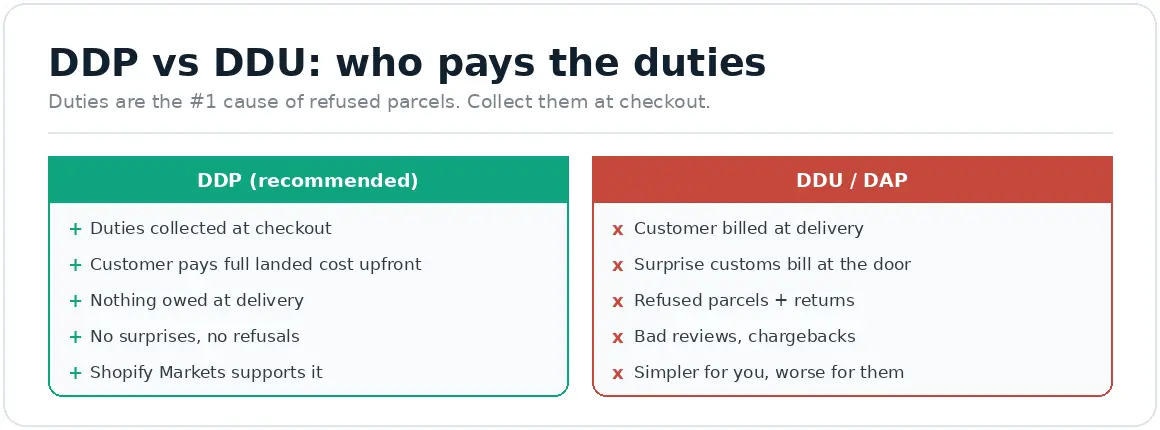
Duties are the #1 cause of refused parcels. Collect them at checkout.
How do HS codes and country of origin work?
HS (Harmonized System) codes classify each product for customs, and country of origin states where it was made. Together they determine the duty rate a destination charges. Assigning correct codes per product is what makes accurate duty calculation, and clean customs clearance, possible.
Accurate customs paperwork starts at the product level. Every product needs:
An HS code: the internationally standardized code that classifies what the product is, customs authorities use it to determine the applicable duty rate. The wrong code means wrong duties and potential customs delays or penalties.
A country of origin: where the product was manufactured, which also affects duty rates (trade agreements can lower or eliminate duties for certain origins).
You assign HS codes and country of origin at the product level, and Shopify Markets uses them with the destination to calculate duties at checkout. This is not optional busywork: wrong codes cause miscalculated duties, held parcels, and compliance problems, and under the EU’s per-declaration-line duty they can change what the customer pays. For large catalogs it is a real data task, and classification tools exist to help.
What changed in 2026, and what does it cost?
Both of the biggest destination markets removed their low-value duty exemptions. The EU’s EUR 150 customs duty relief ended on 1 July 2026, replaced by a temporary flat EUR 3 per customs declaration line, with a separate EUR 2 per item handling fee adopted but not yet in force. The US $800 de minimis exemption is suspended indefinitely. Pricing built before mid-2026 understates landed cost.
This is the single most important thing to re-check on this page, because it changes the arithmetic on every low-value order, and most cross-border guidance still in circulation predates it.
EU, since 1 July 2026: the EU’s EUR 150 customs duty relief ended on 1 July 2026, replaced by a temporary flat-rate duty of EUR 3 that runs until 1 July 2028, when the EU Customs Data Hub takes over. It applies where the total intrinsic value of the consignment does not exceed EUR 150, and it is charged per declaration line on the customs declaration, not per parcel. How many lines that means depends on which declaration dataset your carrier files: on a simplified H7 or H6 declaration, lines sit at the six-digit level, so three garments falling under one six-digit subheading are a single EUR 3; on a full H1 declaration they sit at the ten-digit TARIC level, so the same three goods under three TARIC codes are EUR 9. Worth knowing: the Commission’s own public-facing page describes the measure loosely as “EUR 3 per item,” which does not match its technical guidance, so ask your broker how your declarations are filed before you model this. Council Regulation (EU) 2026/382 of 11 February 2026 is the binding instrument, following political agreement in Council on 13 November 2025, and the Commission’s guidance for member states is dated 2 June 2026 and was published on 8 June 2026.
EU, the new handling fee: separately from duty, the Commission adopted a delegated regulation on 21 September 2026 introducing a Union Handling Fee of EUR 2 per item, not per parcel, with no value threshold at all, so it reaches consignments above EUR 150 too and a multi-item parcel pays it on every item. Member-state guidance points to 1 November 2026, but the act left its application date as a placeholder and is still under European Parliament and Council scrutiny, so treat the date as unsettled and re-check before you reprice.
EU VAT is separate and unchanged: the Commission is explicit that the existing VAT schemes are untouched by the duty reform, so IOSS still covers consignments up to EUR 150. One point to check with your adviser rather than assume: an IOSS importation is VAT-exempt, so no import-VAT base arises for the EUR 3 duty to sit in, but outside IOSS customs duty normally does form part of the import VAT taxable amount.
US, current position: the $800 de minimis exemption went in stages, China and Hong Kong on 2 May 2025 and all other countries on 29 August 2025. CBP then published two interim final rules on 24 June 2026 suspending it indefinitely, with different effective dates: non-postal modes from 24 June 2026, mail from 24 July 2026. The postal rule created an informal entry process for mail valued at $2,500 or less, with duties paid through Pay.gov by the seventh of the following month rather than at delivery. The statutory exemption terminates 1 July 2027.
The consequence is the same in both directions: there is no longer a value below which a cross-border parcel is reliably duty-free, so any shipping model that assumed one needs rebuilding. It also raises the stakes on DDP, because when every parcel can attract duty, more customers meet a surprise bill at the door unless you collect at checkout. Both regimes are still moving, so re-check against the primary sources before you price.
Which carriers and rates should I use?
Choose carriers with strong international networks (DHL Express, FedEx, UPS, and regional or postal options), set shipping rates per market (flat, weight-based, or carrier-calculated live rates), and rate-shop across carriers where volume justifies it. Match carrier and service level to each lane’s cost and speed.
Carrier and rate strategy is the operational layer on top of duties. Key points:
Carriers: the major international couriers (DHL Express, FedEx, UPS) offer fast, reliable cross-border service and integrate with Shopify Shipping for live rates; postal services (USPS and national posts) can be cheaper for lighter, less urgent parcels. Choose per lane based on cost, speed, and reliability.
Rates: set international shipping rates per market in Shopify, flat rates (simple), weight-based (fairer), or carrier-calculated live rates (most accurate). Tools like ShipStation or Easyship enable rate-shopping across carriers if your volume justifies it.
Reliability matters: a cheap carrier that loses parcels or clears customs slowly costs more in support and refunds than it saves.
Configure this per market in Shopify Markets, since the right carrier and rate differ by destination. The goal is shipping that’s affordable for you and predictable for the customer.
Should international free shipping thresholds be different?
Yes. Set your international free-shipping threshold higher than your domestic one, because cross-border shipping costs several times more and now carries duty on top. We typically start at two to three times the domestic threshold and then test, which is our operating practice rather than a published benchmark.
Free shipping is a proven conversion and AOV lever (covered in do free shipping thresholds actually work), but applying your domestic threshold abroad can wreck margins, because a cross-border parcel can cost several times a domestic one. We start at two to three times the domestic threshold, and to be clear about that number: it is our starting point from client work, not published research, so expect to move it. It also has to absorb more since 1 July 2026, with EU duty landing on top of freight. Treat it as a margin calculation, test a couple of levels per major market, and judge by net margin rather than AOV.
We ship cross-border so customers face no surprises and parcels don't get refused.
We collect duties at checkout (DDP), assign correct HS codes and country of origin, choose the right carriers per lane, and set international shipping rates and thresholds that protect margin, so cross-border shipping is predictable for the customer and profitable for you.
It’s part of our ecommerce operations work, and the free-shipping-threshold math ties to the AOV and conversion optimization side.
// we would rather show up in your reporting than in your inbox
Frequently asked questions
What is DDP shipping?
DDP (Delivered Duty Paid) means you collect all duties and import taxes at checkout, so the customer pays the full landed cost upfront and owes nothing at delivery. It’s strongly recommended for ecommerce because it prevents the surprise customs bills that cause refused parcels, returns, and bad reviews. Shopify Markets supports DDP.
Who pays customs duties on international orders?
It depends on your model. With DDP (recommended), you collect duties at checkout and the customer pays nothing extra at delivery. With DDU/DAP, the carrier bills the customer at delivery, an unexpected charge that causes refusals and complaints. Collecting duties at checkout (DDP) gives the best experience.
What are HS codes and do I need them?
HS (Harmonized System) codes classify each product for customs and, with country of origin, determine the duty rate. Yes, you need them for accurate duty calculation and clean customs clearance, incorrect codes cause miscalculated duties, held parcels, and compliance problems. Assign them per product in Shopify.
Should international shipping be free?
You can offer it, but set the free-shipping threshold higher than domestic because cross-border shipping costs much more and EU consignments up to EUR 150 now carry a flat EUR 3 duty per customs declaration line as well. We start at two to three times the domestic threshold as our own operating practice, not a published benchmark, then test. Treat it as a margin calculation: high enough that the extra order value covers the shipping and duty you absorb.
Sources
Surprise customs charges and refused deliveries: survey conducted by Censuswide for Avalara, 8,242 consumers across the UK, US, India, Brazil, Australia, Canada, Mexico and Denmark, fielded 10 to 16 May 2024. 58% of cross-border buyers reported surprise customs charges on delivery, 30% describing them as shocking; 49% refuse delivery of a package with hidden costs altogether; 75% would reconsider future purchases from that business. Self-reported consumer intentions, not measured carrier refusal rates, and the fieldwork predates the 2026 US and EU rule changes. Avalara, 9 July 2024
EU, end of the EUR 150 duty relief: from 1 July 2026 until 1 July 2028 a temporary flat-rate customs duty of EUR 3 applies where the total intrinsic value of a consignment does not exceed EUR 150. The Commission’s guidance for member states is explicit that it is charged per declaration line on the customs declaration, not per parcel or per item: on a simplified H7 or H6 declaration lines sit at the six-digit level, so several goods under one six-digit subheading are a single EUR 3, while on a full H1 declaration they sit at the ten-digit TARIC level. Note that the Commission’s own public-facing page describes the measure as “EUR 3 per item,” which conflicts with its technical guidance; we follow the guidance and flag the discrepancy. Binding instrument: Council Regulation (EU) 2026/382 of 11 February 2026, following political agreement in Council on 13 November 2025. Guidance dated 2 June 2026, published 8 June 2026. European Commission: guidance and legal text, 8 June 2026 ; European Commission: Council agreement, 13 November 2025 ; https://www.s-ge.com/export/en/articles/export-knowhow/eu-flat-rate-customs-duty-small-parcels-new-july-2026
EU, Union Handling Fee: the Commission adopted a delegated regulation on 21 September 2026 (C(2026) 6694 final, supplementing Regulation (EU) 2026/2108) introducing a handling fee of EUR 2 per item, with no value threshold, so it reaches consignments above EUR 150 as well. The act remains subject to European Parliament and Council scrutiny and left its application date as a placeholder; member-state guidance points to 1 November 2026. We state it as not yet settled. Irish Revenue: Union Handling Fee, updated 30 September 2026
EU, import VAT and IOSS: the Commission states that the existing VAT schemes for consignments up to EUR 150, meaning IOSS, the Special Arrangement and the standard procedure, are not changed by the EUR 3 duty. The EUR 10,000 figure often quoted is the intra-EU OSS distance-selling threshold, available only to suppliers established in a single member state, so a merchant shipping from outside the EU cannot reach it. Whether the EUR 3 duty itself attracts import VAT is not addressed in the guidance: an IOSS importation is VAT-exempt so no import-VAT base arises, but outside IOSS customs duty normally forms part of the import VAT taxable amount. We present that as a question for your adviser, not as a sourced fact. European Commission: One Stop Shop portal ; European Commission guidance, 8 June 2026
US, $800 de minimis: suspended for China and Hong Kong from 2 May 2025 (Executive Order 14256) and for all other countries from 29 August 2025 (Executive Order 14324). CBP published two interim final rules in the Federal Register on 24 June 2026 suspending it indefinitely, with different effective dates: all modes other than the international postal network from 24 June 2026, and mail shipments from 24 July 2026. The postal rule created an informal entry process for mail valued at $2,500 or less, with duties paid through Pay.gov by the seventh day of the month following arrival. The statutory exemption terminates 1 July 2027 under the One Big Beautiful Bill Act. Federal Register: all modes other than postal, effective 24 June 2026 ; Federal Register: mail shipments, effective 24 July 2026
Duties at checkout in Shopify: Shopify Markets calculates duty at checkout from the product HS code and the destination, which requires HS codes and country of origin on each product; the fee is 0.5% per transaction, temporarily lowered on 2 February 2025, applying regardless of payment provider and with no published end date, against a regular 0.85% with Shopify Payments or 1.5% without. https://help.shopify.com/en/manual/international/duties-and-import-taxes/charging-duties ; https://www.shopify.com/international/pricing
Carriers: DHL, FedEx, UPS and national postal operators integrate with Shopify Shipping; rates and service levels are carrier and destination specific, so we name no comparative figures here. https://help.shopify.com/en/manual/fulfillment/shopify-shipping
Stated as Fracto’s position, not research: starting with one or two markets before expanding; setting international free-shipping thresholds at roughly two to three times the domestic threshold and then testing; and preferring deliberate local pricing over raw currency conversion. We have not found a primary study that isolates these from everything else that changes when a store is properly localized, so we label them as our operating practice.