International / Cross-border
How to Sell Internationally on Shopify
// a customer base many times larger, if you handle the borders right

By Fracto Solutions
October 7, 2026
The short answer
To sell internationally on Shopify, use Shopify Markets, the built-in feature that adds local currency, translated content, local pricing, and duty collection to your existing store. Start with one or two markets, collect duties at checkout (DDP) so customers face no surprise bills, and get HS codes and taxes right. One store handles most cross-border selling.
EUR 3
DDP
1 to 2
What's the first step to selling internationally on Shopify?
Use Shopify Markets, the built-in feature, free on every plan, that lets one store sell abroad with local currency, language, pricing, payments, taxes, and duties configured per country or region. You don’t need a separate store for each market.
You almost certainly don’t need a second store. Shopify Markets turns your existing one into a multi-market store: add target countries as “markets,” then configure local currency, translated content, local pricing, payment methods, taxes, and duty handling for each from one backend. Go to Settings, then Markets, add a country or region, and configure it. A basic single-market setup takes a few hours; a full expansion is a multi-week project. A separate store only makes sense when you genuinely need a different catalog, legal entity, or inventory.
Piece
What it does
Where
Shopify Markets
One store, per-market config, free on every plan
Settings, Markets
Currency + localization
Local currency, language, pricing, domain
Per market
Duties (DDP)
Collect at checkout so no surprise bills
Per market
HS codes + tax
Correct codes; VAT/sales tax per market
Product + tax settings
Shipping
Zones, carriers, rates per market
Shipping and delivery
Start with one or two markets; get duties (DDP) and localization right before expanding.
Which markets should I start with?
Start with one or two, not forty. Pick markets that are close to your home market in language, logistics, and buying behavior, and where you already see demand. For US stores, the UK, Canada, and Australia are common low-complexity first choices; expand once the first markets work.
The most common cross-border mistake is selling everywhere at once, which spreads effort thin and multiplies compliance work. Bracket your markets instead: pick two or three where you already see international traffic and the operational lift is lowest, meaning shared language, straightforward shipping, similar buying norms. For US stores that is usually the UK, Canada and Australia; elsewhere, a nearby region. Get those working across currency, localization, shipping, duties and conversion before adding more, because each new market adds tax, compliance and fulfillment overhead. This mirrors the logic of ecommerce growth strategy.
How do I handle currencies and localization?
Enable multi-currency through Shopify Payments so shoppers see and pay in their local currency, and localize the experience: translated content, local pricing, and ideally a local domain or subfolder. Shopping in one’s own currency and language meaningfully improves conversion.
Localization is what turns a foreign visitor into a buyer, because people convert far better when the experience feels native. The core elements Shopify Markets supports:
Local currency: with Shopify Payments, customers see prices and pay in their own currency, with conversion handled automatically. Seeing a familiar currency (not a foreign one they have to mentally convert) reduces friction and abandonment.
Translated content: translate your storefront into the market’s language; even partial localization helps.
Local pricing: set market-specific prices (not just currency conversion) to match local purchasing power and psychology.
Local domain or subfolder: a local URL (yourbrand.fr or yourbrand.com/fr) builds trust and helps SEO, with hreflang tags (Shopify generates these) telling search engines which version to show.
Localization is consistently cited as a real conversion lever, shoppers trust and buy more from an experience in their own language and currency. Don’t just accept foreign orders; localize for them. The currency mechanics are covered in depth in Shopify Markets and multi-currency.
- Selling internationally
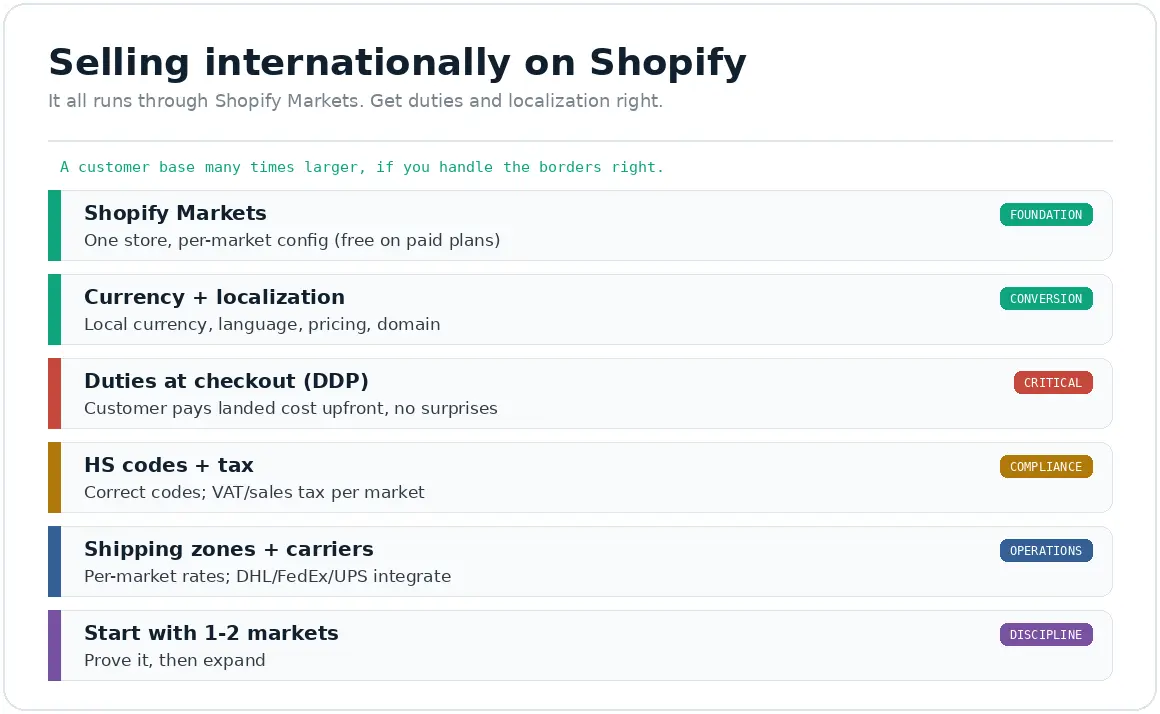
It all runs through Shopify Markets. Get duties and localization right.
Why must I collect duties at checkout (DDP)?
Because surprise customs bills are the number-one cause of refused international parcels. With DDP (Delivered Duty Paid), the customer pays all duties and taxes at checkout, so nothing surprises them at delivery. With DDU, they get an unexpected bill at the door, and often refuse the package.
This is the most important operational decision in cross-border selling, and getting it wrong causes returns, chargebacks and one-star reviews:
DDP (Delivered Duty Paid): you calculate and collect duties and import taxes at checkout, so the customer pays the full landed cost upfront and owes nothing on delivery.
DDU / DAP (Delivered Duty Unpaid): the carrier bills the customer for duties at delivery, an unexpected charge that leads to refused packages, returns, and bad reviews. Censuswide surveyed 8,242 consumers across eight countries for Avalara in May 2024 and found that 58% of cross-border buyers had been hit with a surprise customs charge on delivery, that 49% refuse delivery of a package with hidden costs altogether, and that 75% would reconsider buying from that business again. Those are self-reported intentions rather than measured carrier refusal rates, and the fieldwork predates the 2026 rule changes, but the direction is not in doubt.
Surprise customs bills are the single biggest cause of refused cross-border parcels, which is why we treat DDP as the default rather than an upgrade. Shopify Markets calculates duty at checkout from your product’s HS (Harmonized System) code and the destination, then adds it to the order total. The fee is 0.5% per transaction, a temporary reduction in place since 2 February 2025 that applies whatever payment provider you use and for which Shopify has published no end date; the regular rate behind it is 0.85% with Shopify Payments and 1.5% without. Two things to budget for: it is charged on every order with duties calculated at checkout even when the duty is zero, and never on domestic, EU-to-EU, or abandoned orders. It has been on every plan since February 2025, previously Advanced and Plus only. For a fully managed option, Shopify Managed Markets has Global-e act as merchant of record and handle DDP collection, tax remittance, and compliance for 3.5% per transaction, 3.25% on Plus, with no separate duty fee. Check eligibility first: it requires a business based in the US, Canada or the UK, and Shopify Payments. Whichever route, show the customer the true landed cost before they pay. The shipping and duties detail is in international shipping for ecommerce.
What about taxes, VAT, and HS codes?
You need the right HS codes and country of origin on every product, because they drive duty calculation, and you need to handle each destination’s tax rules separately: EU import VAT through IOSS, UK VAT at the point of sale, US sales tax at checkout. Shopify Markets applies the right tax once configured, but registering is your responsibility.
Two regimes changed in 2026 and both raise the landed cost of low-value orders, so treat anything written before mid-2026 as out of date. Keep duty and VAT separate in your head: they are different charges, set by different rules, and conflating them is the most common error we see in cross-border pricing.
HS codes and country of origin: assign the correct Harmonized System code and origin to every product. These drive duty calculation, and under the new EU regime the number of declaration lines in a parcel can change what the customer pays, so how your carrier files declarations is now a commercial question, not just a compliance one.
EU, duty: the EUR 150 customs duty relief ended on 1 July 2026, replaced by a temporary flat EUR 3 running until 1 July 2028 on consignments whose intrinsic value does not exceed EUR 150. It is charged per declaration line, not per parcel, and how many lines a parcel generates depends on how your carrier files the declaration, so the same three products can cost EUR 3 or EUR 9. That mechanism and its sourcing are set out in international shipping for ecommerce. Binding instrument: Council Regulation (EU) 2026/382 of 11 February 2026.
EU, the new handling fee: separately from duty, the Commission adopted a delegated regulation on 21 September 2026 introducing a Union Handling Fee of EUR 2 per item, with no value threshold, so it reaches consignments above EUR 150 too and a multi-item parcel pays it on every item. Member-state guidance points to 1 November 2026, but the act is still under European Parliament and Council scrutiny, so treat the date as unsettled.
EU, VAT: import VAT is a separate charge, and the Commission is explicit that the existing schemes are unchanged by the duty reform, so IOSS still covers consignments up to EUR 150. Do not confuse that with the EUR 10,000 figure you will see quoted: that is the intra-EU OSS distance-selling threshold, open only to suppliers established in a single member state, so a merchant shipping from outside the EU can never reach it.
UK: at or below GBP 135 per consignment you charge and account for UK VAT at the point of sale, which normally means registering for UK VAT. Three exceptions matter: a reverse charge if the buyer gives you a UK VAT number, no registration needed if you sell only to UK VAT-registered businesses, and marketplace sales, where the marketplace carries the liability. Above GBP 135, normal import VAT and customs rules apply. The test is on intrinsic value, which excludes transport and insurance only where they are not bundled into the price. This guidance covers Great Britain; Northern Ireland differs.
US: the $800 de minimis exemption is gone. China and Hong Kong lost it on 2 May 2025 and every other country on 29 August 2025, and CBP published two interim final rules on 24 June 2026 suspending it indefinitely, non-postal modes from 24 June 2026 and mail from 24 July 2026. The statutory exemption terminates on 1 July 2027. Sales tax is still added at checkout rather than included.
Shopify Markets applies the right VAT or sales tax at checkout once configured, and tools like Avalara integrate for complex setups, but registering is yours to do. These rules are moving quickly, so confirm your position with a broker or tax adviser before you price. This is not tax advice.
How do I set up international shipping?
Configure shipping zones and rates per market in Shopify, connect carriers (DHL, FedEx, UPS, and others integrate for live rates), decide DDP versus DDU per country, and consider a higher free-shipping threshold for international orders. Shipping is the operational backbone of cross-border selling.
Shopify Markets lets you configure shipping per market. The essentials: set international zones and rates (flat, weight-based, or carrier-calculated) under Settings, Shipping and delivery; connect carrier accounts, since DHL Express, FedEx, UPS, USPS and regional carriers integrate with Shopify Shipping for live rates; and pick your duty model per country, DDP by preference. One rule from our own client work, offered as practice rather than benchmark: set the international free-shipping threshold higher than the domestic one, starting around two to three times, since cross-border shipping costs more and EU orders now carry duty on top. The full playbook is in international shipping for ecommerce.
We expand deliberately, one or two markets done properly, rather than switching on forty countries and hoping.
Because cross-border complexity compounds, we help brands bracket their markets, start with the highest-opportunity, lowest-complexity ones, set up Shopify Markets properly (local currency, localization, DDP duty collection, correct HS codes and tax handling), and measure conversion and margin per market before expanding. The goal is profitable international revenue, not a flag-collection of markets that each leak money.
It’s the same measurement-first discipline behind our ecommerce operations and conversion optimization work: we agree the metric before the test runs, change one variable at a time, and report the result at the confidence level the test actually reached, because a localized international storefront still has to convert.
// we would rather show up in your reporting than in your inbox
Frequently asked questions
Can I sell internationally with one Shopify store?
Yes. Shopify Markets, free on every plan, lets a single store sell abroad with local currency, language, pricing, payments, taxes, and duties configured per country or region. You only need a separate store if you require a different catalog, a separate legal entity, or separate inventory pools, which most brands don’t.
What is Shopify Markets?
It’s Shopify’s built-in feature for international selling, and creating markets is free on every plan including Starter. It adds local currency, translated content, local pricing and domains, local payment methods, and duty and tax calculation at checkout, managed per market from one backend. Two fees sit on top: currency conversion at 1.5% per transaction for US stores or 2% in other Shopify Payments regions, and an optional 0.5% if you collect duties at checkout, against a regular 0.85% with Shopify Payments or 1.5% without. Shopify Managed Markets is the fully managed option, with Global-e as merchant of record, at 3.5% per transaction or 3.25% on Plus, and requires a business based in the US, Canada or the UK plus Shopify Payments.
What is DDP and why does it matter?
DDP (Delivered Duty Paid) means you collect all duties and import taxes at checkout, so the customer pays the full landed cost upfront and owes nothing at delivery. It matters because surprise customs bills are the number-one cause of refused international parcels. DDU (customer pays at the door) causes refusals, returns, and bad reviews.
Do I need to register for VAT to sell internationally?
Usually yes, and sooner than most sellers expect. Into the UK, at or below GBP 135 per consignment you charge and account for UK VAT at the point of sale, which normally means a UK VAT registration, with exceptions for B2B sales and for marketplace sales, where the marketplace carries the liability. Into the EU, IOSS registration lets you collect import VAT at checkout on consignments up to EUR 150 instead of leaving it to the carrier. The EUR 10,000 figure you may have seen is the intra-EU OSS threshold and does not apply to imports from outside the EU. Separately from VAT, the EU has charged a flat EUR 3 duty per customs declaration line since 1 July 2026. Confirm your position with a tax adviser.
Which countries should I sell to first?
Start with one or two low-complexity markets where you already see demand. For US stores, English-speaking markets like the UK, Canada, and Australia are common first choices because of shared language and simpler logistics. Prove the model there, currency, localization, shipping, duties, conversion, before expanding further.
Sources
Shopify Markets, plans and fees, verified October 2026: Markets is free on every plan and carries no separate subscription; multi-currency requires Shopify Payments or Adyen, and with any other processor all markets pay in the store default currency; currency conversion is 1.5% per transaction for US stores and 2% in all other Shopify Payments regions, charged whether exchange rates are automatic or manual, with PayPal wallet conversions at 3%; duties at checkout cost 0.5% per transaction, temporarily lowered effective 2 February 2025, applying to all merchants regardless of payment provider, with no published end date, against a regular 0.85% with Shopify Payments or 1.5% without; the fee applies even when calculated duty is zero but not to domestic, EU-to-EU or abandoned orders; customizing themes and checkout pages per market requires Advanced or higher, while checkout block and business-entity customization is Plus only. https://www.shopify.com/international/pricing ; https://help.shopify.com/en/manual/markets/getting-started/requirements-and-considerations ; https://help.shopify.com/en/manual/markets/customizations/local-currencies
Shopify Managed Markets: Global-e acts as merchant of record; 3.5% per transaction, 3.25% on Shopify Plus; requires Shopify Payments and a business based in the United States, Canada or the United Kingdom, with Canada and the UK generally available from July 2026 (Shopify changelog, 15 July 2026). We found no published plan-tier requirement, so we do not state one. https://help.shopify.com/en/manual/international/managed-markets/overview ; https://www.shopify.com/international/pricing
Duties at checkout on all plans: extended from Advanced and Plus to every Shopify plan, announced 5 February 2025, feature enabled 2 February 2025. https://changelog.shopify.com/posts/shopify-duty-calculator-now-available-for-all-shopify-plans ; https://help.shopify.com/en/manual/international/duties-and-import-taxes/charging-duties
EU, end of the EUR 150 duty relief: from 1 July 2026 until 1 July 2028 a temporary flat-rate customs duty of EUR 3 applies where the total intrinsic value of a consignment does not exceed EUR 150. The Commission’s guidance for member states is explicit that it is charged per declaration line on the customs declaration, not per parcel or per item: on a simplified H7 or H6 declaration lines sit at the six-digit level, so several goods under one six-digit subheading are a single EUR 3, while on a full H1 declaration they sit at the ten-digit TARIC level. Note that the Commission’s own public-facing page describes the measure as “EUR 3 per item,” which conflicts with its technical guidance; we follow the guidance and flag the discrepancy. Binding instrument: Council Regulation (EU) 2026/382 of 11 February 2026, following political agreement in Council on 13 November 2025. Guidance dated 2 June 2026, published 8 June 2026. European Commission: guidance and legal text, 8 June 2026 ; European Commission: Council agreement, 13 November 2025 ; https://www.s-ge.com/export/en/articles/export-knowhow/eu-flat-rate-customs-duty-small-parcels-new-july-2026
EU, Union Handling Fee: the Commission adopted a delegated regulation on 21 September 2026 (C(2026) 6694 final, supplementing Regulation (EU) 2026/2108) introducing a handling fee of EUR 2 per item, with no value threshold, so it reaches consignments above EUR 150 as well. The act remains subject to European Parliament and Council scrutiny and left its application date as a placeholder; member-state guidance points to 1 November 2026. We state it as not yet settled. Irish Revenue: Union Handling Fee, updated 30 September 2026
EU, import VAT and IOSS: the Commission states that the existing VAT schemes for consignments up to EUR 150, meaning IOSS, the Special Arrangement and the standard procedure, are not changed by the EUR 3 duty. The EUR 10,000 figure often quoted is the intra-EU OSS distance-selling threshold, available only to suppliers established in a single member state, so a merchant shipping from outside the EU cannot reach it. Whether the EUR 3 duty itself attracts import VAT is not addressed in the guidance: an IOSS importation is VAT-exempt so no import-VAT base arises, but outside IOSS customs duty normally forms part of the import VAT taxable amount. We present that as a question for your adviser, not as a sourced fact. European Commission: One Stop Shop portal ; European Commission guidance, 8 June 2026
UK, GBP 135 consignment threshold: at or below GBP 135 the overseas seller charges and accounts for UK VAT at the point of sale, with a reverse-charge exception where the buyer supplies a UK VAT registration number; above GBP 135 normal import VAT and customs rules apply. Registration is not universal: a seller supplying only UK VAT-registered businesses does not have to register. Where the sale goes through an online marketplace, the marketplace rather than the seller is liable for the VAT. The GBP 135 test is on intrinsic value, which excludes transport and insurance only where those are not included in the price or are separately itemised, and excludes other taxes and charges identifiable by customs. This guidance is written for Great Britain; Northern Ireland differs. GOV.UK: VAT and overseas goods sold directly to customers in the UK
US, $800 de minimis: suspended for China and Hong Kong from 2 May 2025 (Executive Order 14256) and for all other countries from 29 August 2025 (Executive Order 14324). CBP published two interim final rules in the Federal Register on 24 June 2026 suspending it indefinitely, with different effective dates: all modes other than the international postal network from 24 June 2026, and mail shipments from 24 July 2026. The postal rule created an informal entry process for mail valued at $2,500 or less, with duties paid through Pay.gov by the seventh day of the month following arrival. The statutory exemption terminates 1 July 2027 under the One Big Beautiful Bill Act. Federal Register: all modes other than postal, effective 24 June 2026 ; Federal Register: mail shipments, effective 24 July 2026
Surprise customs charges and refused deliveries: survey conducted by Censuswide for Avalara, 8,242 consumers across the UK, US, India, Brazil, Australia, Canada, Mexico and Denmark, fielded 10 to 16 May 2024. 58% of cross-border buyers reported surprise customs charges on delivery, 30% describing them as shocking; 49% refuse delivery of a package with hidden costs altogether; 75% would reconsider future purchases from that business. Self-reported consumer intentions, not measured carrier refusal rates, and the fieldwork predates the 2026 US and EU rule changes. Avalara, 9 July 2024
Stated as Fracto’s position, not research: starting with one or two markets before expanding; setting international free-shipping thresholds at roughly two to three times the domestic threshold and then testing; and preferring deliberate local pricing over raw currency conversion. We have not found a primary study that isolates these from everything else that changes when a store is properly localized, so we label them as our operating practice.