Web Development / Platform
How Much Does a Shopify Store Really Cost?
// the monthly plan is the small number; the real cost is everything around it

By Fracto Solutions
September 29, 2026
The short answer
A Shopify store’s cost has four parts: the platform plan ($39 to $399 a month for the three main tiers; Plus from $2,300), apps ($50 to $300+ a month), payment processing (roughly 2.9% plus a fixed fee), and the one-time build (from a few hundred dollars DIY to $25,000+ for a custom agency build). The plan is the smallest piece.
4
Plan
Build
What are the four costs of a Shopify store?
Every Shopify store has four cost buckets: the platform subscription, apps, payment processing fees, and the one-time build or setup. Budgeting only for the monthly plan is the classic mistake, the other three usually add up to far more.
Thinking in these four buckets is the honest way to budget, because it stops the “it’s just $39 a month” trap:
Cost bucket
What it covers
Rough 2026 range
Platform plan
Core Shopify subscription
$39, $105 or $399/mo (about 25% less annually); Plus from $2,300/mo
Apps
Added functionality (reviews, email, subscriptions)
~$50 to $300+/mo
Payment processing
Fees on each transaction
~2.9% + a fixed fee (varies)
Build / setup
One-time design and development
Few hundred (DIY) to $25,000+ (custom agency)
Ranges compiled across multiple 2026 Shopify pricing sources; exact plan prices vary by source and change over time, always check Shopify’s current pricing page.
The plan is usually the smallest and most predictable of the four. The build varies the most and is where budgets go wrong, so most of this guide focuses there.
How much are Shopify's plans?
Shopify offers tiered plans, Basic at $39/month ($29 annually), Grow at $105/month ($79 annually), Advanced at $399/month ($299 annually), and Shopify Plus for enterprise (contract pricing, commonly cited around $2,300/month). Exact prices change, so verify current figures.
The plan ladder scales with your needs: lower tiers suit new and small stores, higher tiers add lower transaction fees, more staff accounts, and advanced features, and Plus is for high-volume brands needing checkout customization, B2B, and higher API limits. Two honest caveats. First, the exact prices differ between sources and Shopify adjusts them (and renames plans) periodically, so the numbers above are directional, check Shopify’s live pricing page for today’s figures. Second, annual billing typically reduces the monthly rate, so factor that in. The key point for budgeting: for most growing brands the plan is a modest, predictable cost, the decision that actually moves your total is which build you choose, not which plan.
- The four Shopify costs
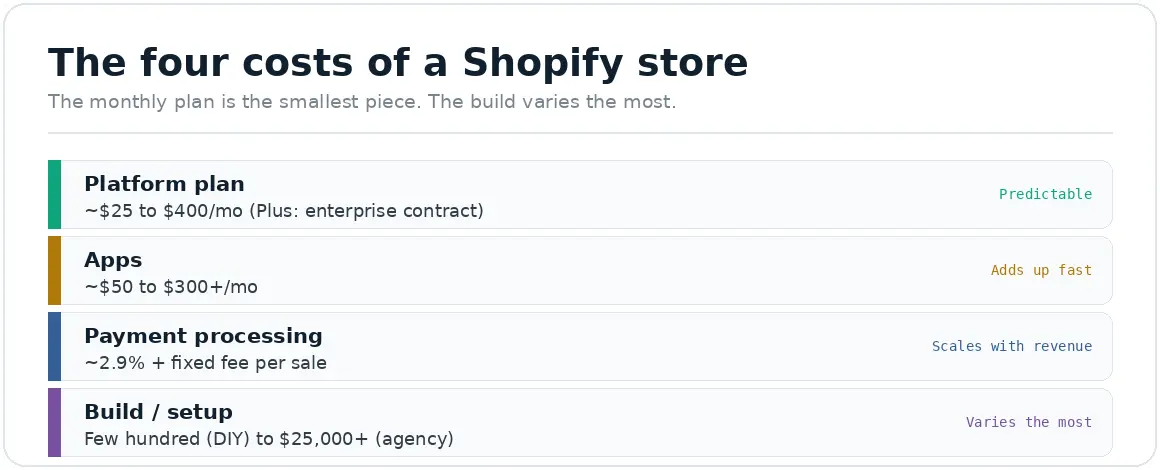
The monthly plan is the smallest piece. The build varies the most.
Why does the build cost vary so much?
Because “building a Shopify store” spans everything from a DIY theme setup to a fully custom headless build, a range of hundreds of dollars to well over $100,000. The cost depends on design customization, custom features and integrations, and who does the work.
The build is where the same question has wildly different answers, and it’s driven by three things: how custom the design is, how many custom features and integrations you need, and whether you DIY, hire a freelancer, or hire an agency. Here’s the directional 2026 picture:
Build approach
Typical one-time cost
DIY (free or premium theme, self-setup)
~$0 to $500
Freelancer (theme customization)
~$2,500 to $10,000
Agency (custom design, standard)
~$5,000 to $25,000
Shopify Plus build
~$40,000 to $120,000+
Headless / composable
~$40,000 to $200,000+
*Directional ranges across multiple 2026 sources; figures vary widely by scope. Get scoped quotes for your specific requirements.*
Notice the ranges overlap and are wide, that’s real, not vagueness, because “a Shopify store” isn’t one thing. The right number depends entirely on what you actually need, which is why a scoped quote beats any published average.
What does it cost to run a Shopify store per month?
Ongoing, most small-to-mid brands spend somewhere from around $50 to several hundred dollars a month once you add the plan, apps, and any recurring tools, on top of payment processing fees taken per sale. Larger and Plus stores run into the thousands monthly.
Beyond the one-time build, your recurring cost is the plan plus apps plus payment fees (and any paid tools like email or subscriptions software). For a typical small store, that’s often in the low hundreds of dollars a month all-in; for a mid-market brand with more apps and a higher plan, several hundred to a couple of thousand; for a Plus brand, meaningfully more. The commonly quoted “most beginners spend $50 to $150 a month” is a reasonable starting range but climbs quickly as you add functionality. Payment processing (around 2.9% plus a fixed fee per transaction, lower on higher plans and with Shopify Payments) is easy to overlook because it’s taken per sale, but at scale it’s a significant line, factor it into your margins, which is exactly the kind of cost that shapes your break-even ROAS.
Is Shopify cheaper than the alternatives?
In year one, usually yes versus a custom build, and it’s competitive with WooCommerce once you count the true total cost. Shopify bundles hosting, security, and updates into the fee; WooCommerce is cheaper in license terms but you pay for hosting, maintenance, and more of the technical work yourself.
The honest comparison depends on what you value. Against a fully custom build, Shopify is far cheaper in year one because you’re not paying to build (and maintain) infrastructure from scratch. Against WooCommerce, it’s closer than the sticker prices suggest: WooCommerce software is free, but you take on hosting, security, updates, and more development work, costs that are real but less visible, which is why WooCommerce stores so often struggle with the speed and technical issues covered in why your WooCommerce store gets traffic but no sales. Shopify’s model is “pay a predictable fee, we handle the infrastructure”; WooCommerce’s is “pay less in license, do more yourself.” Neither is universally cheaper, the right choice depends on your team’s technical capacity and how much control you want.
When is a bigger investment (Plus or headless) worth it?
Only when the platform is genuinely your constraint, not by default. Shopify Plus is worth it for high volume needing checkout customization, B2B, or higher limits; headless is worth it only if a custom front end will materially lift conversion or performance enough to justify a large build and ongoing engineering. For most stores, neither is necessary.
This is where a lot of money gets wasted on capability nobody needed. Shopify Plus earns its cost when you have the volume and specific requirements (custom checkout logic, B2B, multi-storefront, API limits) that lower tiers can’t meet, not simply because you’ve grown a bit. Headless (a custom front end on Shopify’s backend) is the biggest commitment: a large upfront build plus ongoing engineering, and it’s only worth it if that custom experience drives materially higher conversion or performance than a well-built standard theme would. For the vast majority of stores, a well-optimized standard Shopify build converts just as well at a fraction of the cost. The decisions get their own guides: when to replatform your ecommerce store and is headless Shopify worth it.
What's the most common Shopify budgeting mistake?
Budgeting only for the monthly plan and being blindsided by the rest. The plan is the smallest, most visible cost; apps, payment fees, and the build are larger and easier to underestimate, which is how “it’s just $39 a month” becomes a much bigger real number.
The fix is simply to budget all four buckets from the start. Add up the plan, the apps you’ll realistically need (they accumulate quickly as you add reviews, email, subscriptions, and more), the payment processing taken on every sale, and the one-time build. Then add a little contingency, because scope tends to grow. Doing this upfront prevents the common shock of a store that costs several times the advertised plan price, and it lets you make the build decision (DIY, freelancer, agency, or more) with the full picture rather than discovering the true cost midway through.
We spec the build to what actually moves your revenue, not to the most impressive-sounding option.
Because we do the development and the conversion work, we’re not incentivized to sell you a bigger build than you need. We scope against your real requirements, recommend the plan and build that fit, and steer you away from expensive capability unless it will genuinely pay for itself in conversion, performance, or capability you can’t get otherwise.
It’s the same measurement-first discipline behind our web development and conversion optimization work, where the gains come from optimization rather than from an expensive replatform.
// we would rather show up in your reporting than in your inbox
Frequently asked questions
How much does a Shopify store cost per month?
As of 2026 the plans are Basic $39, Grow $105 and Advanced $399 a month, each about 25% cheaper on annual billing ($29, $79, $299), with Starter at $5 for social selling only and Plus from $2,300 on a three-year term. Add $50 to $300+ for apps and payment processing fees (around 2.9% plus a fixed fee per sale). Most small stores land in the low hundreds monthly all-in. Prices change, so check Shopify’s current pricing.
How much does it cost to build a Shopify store?
Anywhere from near $0 for a DIY theme setup to $2,500 to $10,000 with a freelancer, $5,000 to $25,000 with an agency for custom design, and $40,000 to $200,000+ for Shopify Plus or headless builds. The range is huge because “a Shopify store” spans from a template to a fully custom build. Get a scoped quote.
Is Shopify cheaper than WooCommerce?
It’s closer than the sticker prices suggest. Shopify bundles hosting, security, and updates into a predictable fee; WooCommerce’s software is free but you pay for hosting, maintenance, and more technical work yourself. Neither is universally cheaper, it depends on your team’s technical capacity and how much control you want.
What hidden costs does Shopify have?
The ones people forget: apps (which add up fast), payment processing fees (around 2.9% plus a fixed fee, taken per sale), transaction fees if you don’t use Shopify Payments, premium themes, and ongoing maintenance or development. Budget the four buckets (plan, apps, payments, build), not just the monthly plan.
Do I need Shopify Plus or a headless build?
Usually not. Plus is worth it for high-volume brands with specific needs (custom checkout, B2B, higher limits); headless only if a custom front end will materially lift conversion or performance enough to justify a large build plus ongoing engineering. Most stores convert just as well on a well-optimized standard build for far less.
Sources
Shopify cost structure (plan + apps + payment fees + build); plan tiers as published by Shopify for 2026: Starter $5, Basic $39 ($29 annual), Grow $105 ($79 annual), Advanced $399 ($299 annual), Plus from $2,300 on a three-year term or $2,500 on one year. We corrected an earlier draft that gave the range as “$25 to $400”: no Shopify plan costs $25, and the figure appears to be a stale Basic price. Note also that card rates fall by tier, 2.9% + 30c on Basic, 2.7% on Grow, 2.5% on Advanced, and that the third-party gateway surcharge (2%, 1%, 0.6%) disappears entirely if you use Shopify Payments. Grow rose from $79 to $105 in 2026, so pre-2026 guides understate it; build ranges (DIY near $0 to agency $5k-$25k to headless/enterprise $40k-$200k+); most small stores ~$50 to $150+/mo running cost: compiled across multiple 2026 sources (exact plan prices vary by source and change over time). https://projectcostestimator.com/shopify-store-cost ; https://factoryjet.com/blog/shopify-development-cost-2026 ; https://www.nudgify.com/how-much-does-shopify-cost/
Payment processing ~2.9% + fixed fee; annual billing reduces rates; Shopify bundles hosting/security/updates vs WooCommerce self-hosted. https://wearepresta.com/pricing-plans-ecommerce-platform-2026/
Headless is expensive and only worth it if it materially lifts conversion/performance. https://weaverse.io/blogs/shopify-headless-pricing