Email / Deliverability
Email Deliverability Best Practices for Ecommerce
// reach the inbox, or nothing else matters

By Fracto Solutions
September 30, 2026
The short answer
Email deliverability is getting your emails into the inbox rather than spam or the Promotions tab. The essentials: authenticate your domain (SPF, DKIM, DMARC), keep your list clean (remove bounces and unengaged subscribers), send relevant emails people engage with, and monitor bounce, complaint, and inbox-placement rates. Engagement is what mailbox providers reward.
SPF+DKIM
85-90%
Engage
What is email deliverability, and why does it matter?
Deliverability is whether your emails reach the inbox rather than the spam folder or Promotions tab. It matters because an email that isn’t delivered can’t be opened, clicked, or converted, so poor deliverability silently caps every other result no matter how good your content is.
It’s easy to assume that “sent” means “delivered”, it doesn’t. Between your send and the customer’s inbox, mailbox providers (Gmail, Outlook, Apple) decide whether your email is trustworthy enough to place in the primary inbox, route to Promotions, dump in spam, or block entirely. If a meaningful share of your emails don’t reach the inbox, your real performance is worse than your dashboard shows, and you may never know why revenue is soft. That invisible tax is why deliverability is the first thing to check when email underperforms. And it’s entirely manageable: mailbox providers use fairly predictable signals, and getting those right keeps you in the inbox.
How do I authenticate my domain (SPF, DKIM, DMARC)?
Set up three DNS records that prove your emails are really from you: SPF (authorizes sending servers), DKIM (cryptographically signs emails), and DMARC (tells providers what to do with unauthenticated mail). These are now effectively required by Gmail and Yahoo for bulk senders.
Authentication is the technical foundation of deliverability, and as of 2024 Gmail and Yahoo require it for bulk senders, so it’s no longer optional. The three records work together: – SPF (Sender Policy Framework) lists which servers are allowed to send email for your domain, so providers can spot spoofers. – DKIM (DomainKeys Identified Mail) adds a cryptographic signature proving the email genuinely came from you and wasn’t tampered with. – DMARC (Domain-based Message Authentication) ties SPF and DKIM together and tells mailbox providers how to handle mail that fails (monitor, quarantine, or reject).
Most email platforms (Klaviyo, and others) provide step-by-step setup, but the records live in your domain’s DNS. Getting all three right is table stakes; without them, deliverability suffers immediately. A dedicated sending domain (rather than sending from a generic address) further strengthens your sender reputation.
Why does list hygiene matter so much?
Because sending to invalid or unengaged addresses damages your sender reputation, which lowers inbox placement for everyone on your list. Regularly removing bounces, invalid addresses, and chronically unengaged subscribers keeps your engagement rates high, which is exactly what mailbox providers reward.
Your list quality directly drives your deliverability. Every email to a dead address (a hard bounce) and every message to someone who never engages signals to mailbox providers that you might be a low-quality sender, which pushes more of your mail toward spam, hurting even your engaged subscribers. Good list hygiene reverses this: – Remove hard bounces immediately and invalid addresses regularly. – Use double opt-in so only real, interested people join. – Sunset unengaged subscribers: people who haven’t opened or clicked in a long window (often 90 to 180 days) should be moved to a re-engagement flow and then suppressed if they stay inactive. – Never buy lists, they’re full of traps and destroy reputation.
Counterintuitively, sending to fewer, more engaged people improves deliverability (and often total revenue) versus blasting a big, stale list. Quality beats quantity.
How does engagement affect deliverability?
Hugely. Mailbox providers watch how recipients treat your emails, opens, clicks, replies versus deletes-without-reading and spam complaints, and use it to decide inbox placement. High engagement earns the inbox; low engagement and complaints push you toward spam.
Modern deliverability is largely reputation-based, and engagement is the biggest reputation signal. When your subscribers open, click, and reply, mailbox providers read that as “people want this mail” and reward you with inbox placement. When they ignore, delete without reading, or mark as spam, providers conclude the opposite and start filtering you out. This is why the content and segmentation practices from the benchmarks pillar are also deliverability practices: sending relevant emails to engaged people keeps your reputation high, which keeps you in the inbox. The practical levers: send to engaged segments (not everyone), keep frequency sensible, make unsubscribing easy (a visible unsubscribe is far better than a spam complaint), and give people a reason to engage. Segmentation, covered in Klaviyo segmentation strategy, is one of the strongest deliverability tools you have.
What deliverability metrics should I monitor?
Watch inbox placement rate (aim for 85 to 90 percent or higher), bounce rate (under about 0.5 percent), spam complaint rate (under roughly 0.1 percent), and unsubscribe rate (under about 0.3 percent per campaign). When any of these slip, deliverability is degrading and needs attention before it hurts revenue.
You can’t manage what you don’t measure, and deliverability has clear warning signs. The thresholds consistent across sources:
Metric
Healthy target
Warning sign
Inbox placement
85 to 90%+
Below 80%
Bounce rate
Under ~0.5% (hard under ~0.1%)
Rising bounces
Spam complaint rate
Under ~0.1%
Above ~0.1%
Unsubscribe rate
Under ~0.3% per campaign
Sustained higher
Directional deliverability thresholds, consistent across 2026 sources.
Monitor these regularly, and treat a slip as an early warning. Spam complaints and rising bounces in particular compound quickly, catching them early prevents a reputation problem that’s slow and painful to repair. Tools like Google Postmaster and your ESP’s deliverability reports make these visible.
- Reaching the inbox
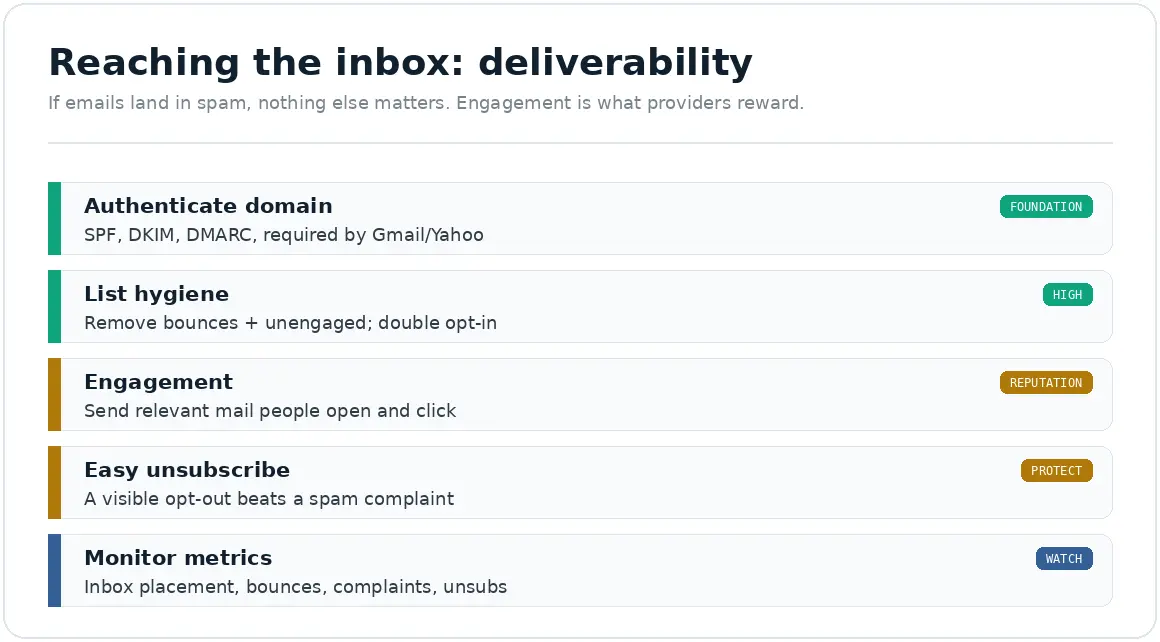
If emails land in spam, nothing else matters. Engagement is what providers reward.
We make sure your emails actually reach the inbox, then keep them there.
We set up domain authentication (SPF, DKIM, DMARC), keep your list clean, focus sends on engaged subscribers, and monitor inbox placement, bounces, and complaints, so deliverability stops quietly capping your results.
It’s part of our email and lifecycle work, protecting the revenue the flows and campaigns are meant to produce, the same measurement-first discipline as our conversion optimization.
// we would rather show up in your reporting than in your inbox
Frequently asked questions
What is email deliverability?
It’s whether your emails actually reach the inbox rather than the spam folder or Promotions tab. Since an undelivered email can’t be opened or convert, deliverability is the foundation under every other email metric, and poor deliverability silently caps your results regardless of how good the content is.
Do I need SPF, DKIM, and DMARC?
Yes, they’re effectively required. Since 2024, Gmail and Yahoo require authentication for bulk senders. SPF authorizes your sending servers, DKIM cryptographically signs your emails, and DMARC tells providers how to handle mail that fails. Without all three, deliverability suffers immediately. Your email platform provides setup guidance.
How do I keep emails out of spam?
Authenticate your domain (SPF, DKIM, DMARC), keep your list clean (remove bounces and unengaged subscribers), send relevant emails to engaged people, keep frequency sensible, and make unsubscribing easy. Deliverability is reputation-based, so high engagement and low complaints are what keep you in the inbox.
Should I remove unengaged subscribers?
Yes. Chronically unengaged subscribers drag down your engagement rates, which hurts deliverability for your whole list. Move people who haven’t engaged in 90 to 180 days into a re-engagement flow, then suppress them if they stay inactive. Sending to fewer engaged people usually improves both deliverability and revenue.
Sources
Every statistic is traced to its original publisher and dated. Email benchmark figures are directional and vary by source and sample; open rate is inflated by Apple Mail Privacy Protection, so this page relies on click, conversion, revenue, and deliverability rather than opens. Benchmark against your own trend.
Authentication (SPF, DKIM, DMARC) required by Gmail/Yahoo for bulk senders since 2024; list hygiene, engagement-based reputation, and deliverability thresholds (inbox placement 85 to 90%+, bounce <0.5%, complaints <0.1%, unsub <0.3%): consistent across 2026 email deliverability sources. https://retentionside.com/blog/ecommerce-email-marketing-benchmarks ; https://www.goshdigital.co/blog/klaviyo-benchmarks-by-industry
Engagement (opens, clicks, complaints) drives mailbox-provider reputation and inbox placement; sending to engaged segments improves deliverability: see the benchmarks pillar and its sources.