Subscription / Retention
How to Reduce Subscription Churn on Shopify
// two problems, two opposite fixes

By Fracto Solutions
October 5, 2026
The short answer
To reduce subscription churn, tackle its two forms separately: cut involuntary churn (failed payments) with dunning, automated payment retries and card-update prompts, and cut voluntary churn (cancellations) with pause and skip options, save flows, and genuine value. Start with involuntary churn; it’s the cheapest to fix and mostly recoverable.
2
40-70%
~40%
Why split churn into voluntary and involuntary first?
Because they’re different problems with opposite fixes. Voluntary churn (active cancellation) is a value and experience problem solved with persuasion and options; involuntary churn (failed payment) is an infrastructure problem solved with payment machinery. Lumping them together means fixing neither well.
Before you can reduce churn, you have to measure it split by reason, and this is where most brands go wrong. Your headline churn number, say 8 percent monthly, is actually two separate leaks: roughly 60 to 75 percent of it is usually voluntary (customers choosing to cancel) and roughly 20 to 40 percent involuntary (payments failing silently). The two respond to completely different actions: no cancel-flow offer saves an expired card, and no payment retry changes the mind of someone who decided your box isn’t worth it. So step one is always to separate them, measure voluntary and involuntary churn as distinct numbers, then apply the right fix to each. A store that discovers a third of its churn is just failed payments has found the cheapest revenue it will recover all year.
Churn type
Fix
Expected result
Involuntary (failed payments)
Dunning: smart retries + card-update prompts
Recover ~40 to 70% of failed renewals
Voluntary (cancellations)
Pause/skip, save flow, better value
Save a meaningful share of at-risk subs
Both (structural)
Shift willing subscribers to annual billing
Annual churns ~40% lower than monthly
Fix involuntary first, it’s the cheapest and mostly recoverable, then work the voluntary side.
How do I reduce involuntary churn (failed payments)?
With dunning: an automated system that retries failed payments on a smart schedule and prompts customers to update their card before the subscription lapses. It’s the cheapest, highest-return churn fix because these customers wanted to stay, their card just failed.
Involuntary churn is the best place to start because it’s almost entirely recoverable and requires no persuasion, just machinery. When a card expires, hits a limit, or gets declined, the subscription silently fails even though the customer never chose to leave. Dunning management fixes this automatically: – Smart retries: reattempt the failed charge on an optimized schedule (a common pattern is day 1, day 3, day 7) rather than giving up after one try. – Card-update prompts: email and SMS nudges guiding the customer to update their payment method, with an easy link. – Card updater services: automatically refresh expired card details where supported. – Grace periods: keep the subscription active briefly while recovery runs, rather than cancelling instantly.
Well-tuned dunning recovers a large share of failed renewals (industry recovery rates commonly fall in the 40 to 70 percent range, with a median around the high-40s). Since these subscribers already wanted your product, recovering them is the cheapest revenue in your subscription program, set this up first.
- Churn reduction levers
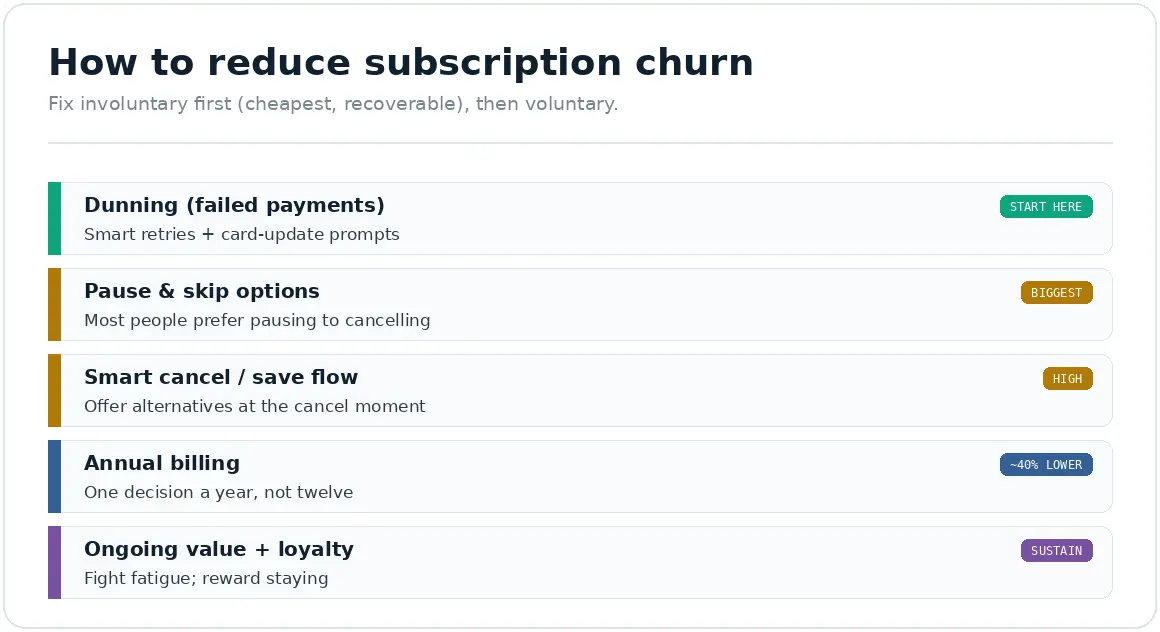
Fix involuntary first (cheapest, recoverable), then voluntary.
How do I reduce voluntary churn (cancellations)?
By removing reasons to cancel and offering alternatives to cancelling: flexible pause and skip options, a smart cancel-flow (save flow) that offers alternatives, genuine ongoing value, and rewards for staying. Most people who cancel would rather pause if you let them.
Voluntary churn is harder because it’s about the customer’s perception of value, but much of it is preventable with the right options and experience: – Offer pause and skip, prominently. Most cancellations are really “not this month”, surveys find a majority of consumers prefer pausing to cancelling if the option exists. Flexible skip/pause is consistently one of the biggest voluntary-churn reducers. – Build a smart cancel flow (save flow). When someone clicks cancel, offer alternatives first: pause, skip, change frequency, swap the product, or a retention offer. This saves a meaningful share of would-be cancellers. – Deliver ongoing value. Fight product fatigue (especially in curation) with variety, personalization, and perks; make staying feel worth it. – Reward loyalty. Subscribers enrolled in loyalty or rewards programs churn less; give people a reason to stay beyond the product.
The theme: make cancelling the last resort, not the only button. Flexibility and genuine value keep people subscribed.
One important constraint on save flows. A save flow is a legitimate retention tool, but cancellation is regulated and the rules tightened in 2025, so build it knowing where the line sits.
The federal picture is often misreported. The FTC’s “click-to-cancel” rule was vacated in full by the Eighth Circuit on 8 July 2025, days before it was due to take effect, so it never became law. Plenty of guides still describe it as binding. What did not go away is ROSCA, which applies to every online subscription and requires you to disclose terms before taking billing details, obtain express consent to the recurring charge itself, and provide a simple mechanism to cancel. The FTC still enforces that, and recent actions have targeted flows requiring a dozen actions across seven screens to cancel.
The state layer matters more in practice, and California is effectively national because it protects Californian customers regardless of where you trade from. Its AB 2863 amendments, in force since 1 July 2025, require cancellation through the same medium the customer used to sign up, so an online signup must have an online cancel. They also regulate save attempts specifically, setting out what you may and may not put in front of someone who has asked to cancel. At least 25 states now have auto-renewal laws of their own.
The practical test for your save flow: offering a pause, a skip or a cheaper plan on one screen, with an equally visible “cancel anyway” button, is retention. Adding screens, hiding the cancel link, or requiring a phone call after an online signup is friction that regulators are actively pursuing. Note also that the FTC took a preliminary step toward new subscription rulemaking on 30 January 2026, so this may tighten again. This is guidance, not legal advice.
Does annual billing reduce churn?
Yes, significantly. Subscribers on annual plans churn at markedly lower rates than monthly subscribers, because they’ve committed for the year and there’s no monthly cancel decision. Offering (and incentivizing) annual billing is one of the highest-impact structural churn reductions available.
One of the most effective structural moves is simply shifting willing subscribers to annual billing. Monthly subscribers face a cancel decision every single cycle; annual subscribers make one decision a year, so they churn far less, sources commonly cite annual plans churning around 40 percent lower than monthly. The trade-off is a bigger upfront commitment, so incentivize it (a discount versus monthly, a bonus) and offer it at the right moments (signup, or after a few successful cycles when the customer is happy). You won’t convert everyone, and monthly should stay available, but moving even a portion of your base to annual meaningfully lifts overall retention and lifetime value. It’s a pricing-structure lever, not a persuasion one, which makes it reliable.
How do I measure and track churn properly?
Measure monthly churn split by reason (voluntary vs involuntary), build cohort curves (churn by billing cycle) rather than one blended rate, exclude paused subscribers from “lost,” and benchmark against your category and your own trend. The trend and the split are what tell you what to fix.
Good churn measurement is what makes everything above actionable: – Split by reason: track voluntary and involuntary churn as separate numbers, so you know which fix to apply. – Use cohorts: measure churn by billing cycle number (how many cancel after cycle 1, 2, 3), which reveals where you lose people, often early, and whether you’re improving. A blended rate hides this. – Handle pauses correctly: don’t count paused subscribers as churned; they’re retained revenue on hold. – Benchmark against yourself and your category, not an overall average, and re-check quarterly.
This cohort-and-reason approach turns churn from a scary single number into a diagnosable set of problems you can actually fix, the same measurement discipline behind all good retention work in how to improve ecommerce customer retention.
We split your churn by reason, then fix each with the right tool.
We measure voluntary and involuntary churn separately and by cohort, set up dunning (smart retries and card-update prompts) for the failed-payment side, and add pause/skip, save flows, and annual-billing incentives for the cancellation side.
It’s part of our ecommerce operations work, and because it’s fundamentally retention, it connects to our broader conversion optimization and retention discipline.
// we would rather show up in your reporting than in your inbox
Frequently asked questions
What causes subscription churn?
Two different things: voluntary churn (customers actively cancelling, usually over value, price, or product fatigue) and involuntary churn (payments silently failing from expired or declined cards). They’re roughly 60 to 75 percent voluntary and 20 to 40 percent involuntary, and they need opposite fixes, so measure and tackle them separately.
What is dunning management?
It’s the automated system that fights involuntary churn by retrying failed subscription payments on a smart schedule (for example, day 1, 3, 7) and prompting customers to update their card before the subscription lapses. Since these customers wanted to stay, dunning recovers a large share of failed renewals, it’s the cheapest churn fix.
How do I stop subscribers from cancelling?
Offer alternatives to cancelling: prominent pause and skip options (most people prefer pausing), a smart cancel flow that offers pause, frequency changes, or a retention offer, genuine ongoing value, and loyalty rewards. Make cancelling the last resort rather than the only button, and much voluntary churn becomes preventable.
Does annual billing really reduce churn?
Yes, significantly, commonly cited around 40 percent lower churn than monthly, because annual subscribers make one commitment a year instead of a monthly cancel decision. Incentivize annual plans with a discount and offer them at signup or after a few happy cycles, while keeping monthly available. It’s a reliable structural lever.
Sources
Voluntary/involuntary split (~60 to 75% / ~20 to 40%) with opposite fixes; dunning (smart retries day 1/3/7, card-update prompts) recovers ~40 to 70% of failed renewals (median ~47.6%, Slicker); pause/skip and save flows cut voluntary churn; majority of consumers prefer pause to cancel (Chargebee): consistent across 2026 sources. https://www.recurpay.com/blog/subscription-churn-how-does-dunning-management-work-on-shopify ; https://www.digitalapplied.com/blog/ecommerce-subscription-retention-playbook-2026-churn-reduction ; https://recurx.app/subscription-churn-benchmarks
Annual plans churn ~40% lower than monthly; measure churn by cohort and reason: https://www.digitalapplied.com/blog/subscription-commerce-2026-recurring-revenue-guide
Cancellation compliance. The FTC’s “click-to-cancel” rule was vacated in full by the Eighth Circuit on 8 July 2025 (Custom Communications v. FTC) and never took effect; many guides still describe it as binding law. ROSCA continues to apply to every online subscription, requiring disclosure before billing, express consent to the recurring charge, and a simple cancellation mechanism, and the FTC still enforces it. State auto-renewal laws sit on top and are stricter: California’s AB 2863, in force since 1 July 2025, requires same-medium cancellation and specifically regulates save attempts, and at least 25 states now have their own ARL. The FTC began a preliminary step toward new rulemaking on 30 January 2026. Guidance, not legal advice.