Subscription / Tools
The Best Shopify Subscription Apps: How to Choose
// choose on fit, not on a ranking

By Fracto Solutions
October 5, 2026
The short answer
The best Shopify subscription app is the one that fits your model and includes the features that actually retain subscribers: strong dunning (failed-payment recovery), flexible pause and skip, a good customer portal, and clear churn analytics. Rather than chasing a ranking, choose on those retention features, integrations, and total cost.
No
Dunning
Total
Why is there no single "best" subscription app?
Because the right app depends on your subscription model, catalog, budget, and technical needs, all of which vary by store. An app that’s perfect for a simple replenishment brand may be overkill or a poor fit for a complex curation business. Choose on fit, not on a ranking.
Ranked “best app” lists are popular and largely unhelpful, because they rank apps against each other in the abstract, not against your specific needs. A small store selling one consumable on subscribe-and-save has very different requirements from a curation brand with variable boxes, or an enterprise brand needing deep customization. The features, integrations, and pricing that make an app “best” for one are irrelevant or wrong for another. So instead of asking “which app is best?”, ask “which app best fits my model, my must-have retention features, my other tools, and my budget?” That reframing, from ranking to fit, is what actually leads to a good choice, and the rest of this guide gives you the criteria to judge fit.
What to evaluate
Why it matters
Dunning / payment recovery
Recovers involuntary churn, the #1 feature
Pause, skip, frequency changes
Cuts voluntary churn directly
Customer self-service portal
Fewer support tickets and friction cancels
Churn & cohort analytics
You can't fix what you can't measure
Integrations (email/SMS, loyalty)
Loyalty-linked subscribers churn less
Total cost (monthly + transaction %)
The % cut dominates at scale
Choose on fit and retention features, not a ranking. Verify current pricing and capabilities directly.
What features actually matter in a subscription app?
The features that retain subscribers and reduce churn: robust dunning (failed-payment recovery), flexible pause and skip, an easy self-service customer portal, and clear churn and cohort analytics. These, not the length of the feature list, determine whether the app grows recurring revenue.
Because churn decides subscription success, the features that fight churn are the ones that matter most. Prioritize: – Dunning / failed-payment recovery. The single most important feature, automated smart retries and card-update prompts recover involuntary churn (the cheapest churn to fix). An app weak on dunning is leaking recoverable revenue. – Flexible pause, skip, and frequency changes. These directly reduce voluntary churn by giving customers alternatives to cancelling. – A good customer portal. Self-service management (skip, swap, update, pause) reduces support load and cancellations from friction. – Churn and cohort analytics. You can’t reduce what you can’t measure; the app should show churn split by reason and by cohort. – A smart cancel/save flow. Offering alternatives at the cancel moment saves would-be cancellers.
If an app nails these retention features, it will do more for your revenue than one with a long list of secondary bells and whistles. The connection to churn is covered in how to reduce subscription churn.
- Choosing a subscription app
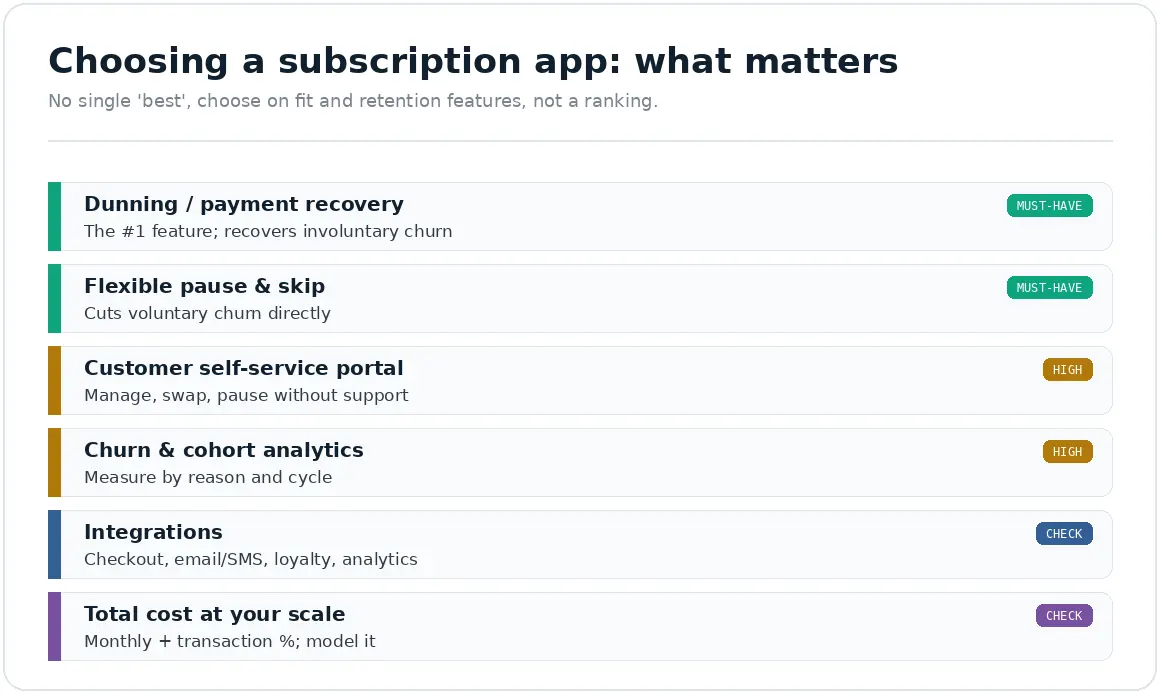
No single best, choose on fit and retention features, not a ranking.
What else should I evaluate?
Beyond retention features: how well it integrates with your stack (Shopify checkout, email/SMS, loyalty, analytics), its pricing model and total cost (including transaction fees), ease of setup and use, and the quality of support. Fit with your existing tools matters as much as the features themselves.
Retention features are necessary but not sufficient, an app also has to work well within your business: – Integrations. It should work cleanly with Shopify’s checkout and talk to your email/SMS platform, loyalty program, and analytics. Recurring orders that earn loyalty points, for example, retain notably better, so integration isn’t cosmetic. – Pricing and total cost. Understand the full cost: monthly fee plus any per-transaction percentage. A low monthly fee with a high transaction cut can be expensive at scale; a higher flat fee can be cheaper. Model it against your volume. – Ease of use. Both for you (setup, management) and your customers (the portal). Friction anywhere costs you. – Support and reliability. Subscription billing is mission-critical; a billing bug or downtime directly loses revenue, so responsive support and a solid track record matter.
Weigh these alongside the retention features. The best choice is the app that fits your model, has the retention features, integrates with your stack, and costs sensibly at your scale.
How do the popular options differ (at a high level)?
The main Shopify subscription apps differ mainly in complexity, customization, and pricing, from simple, affordable apps suited to smaller stores up to powerful, customizable platforms for complex or high-volume brands. Match the app’s sophistication (and cost) to your actual needs, not the maximum available.
Without endorsing any single one, the Shopify subscription app landscape (Recharge, Appstle, Loop, Skio, Recurpay, and others) spans a spectrum: – Simpler, lower-cost apps suit smaller stores or straightforward replenishment: quick to set up, affordable, covering the core retention features without heavy customization. – More powerful, customizable platforms suit complex catalogs, curation, or high-volume brands that need advanced logic, deep integrations, and scale, at a higher cost and setup effort.
The mistake is choosing the most powerful (and expensive) option when a simpler one covers your needs, or the cheapest when your complexity demands more. Evaluate each against the criteria above (retention features, integrations, cost, support) for your specific situation. App capabilities and pricing change, so verify current details directly before deciding, and consider that migrating subscription apps later is disruptive, so choosing one that fits as you grow is worth the upfront diligence.
How do I make the final decision?
Shortlist apps that have your must-have retention features and fit your model, check they integrate with your stack, model the total cost at your volume, and trial the top one or two. Prioritize dunning, flexibility, and analytics over feature-count, and choose the best fit, not the highest-ranked.
A practical decision process: – List your must-haves: your model, essential retention features (dunning, pause/skip, analytics), and required integrations. – Shortlist the apps that meet them, ignore rankings, filter on fit. – Model total cost (monthly plus transaction fees) at your subscriber volume. – Trial the top one or two if possible, testing the customer portal and dunning especially. – Decide on fit and total value, not on which list ranked it first.
Because switching later is disruptive, this diligence pays off. And whichever app you choose, remember the app is only the tool, the retention outcomes come from how you configure and use it (the playbook in how to reduce subscription churn). We help make this choice objectively in our ecommerce operations work.
We help you choose the subscription app that fits your model, objectively.
We shortlist on the retention features that actually matter (dunning, pause/skip, analytics), check integrations with your stack, model the total cost at your volume, and pick on fit rather than a ranking, because switching later is disruptive.
It’s part of our ecommerce operations work, and the retention outcomes come from how the tool is configured, the playbook behind our conversion optimization discipline.
// we would rather show up in your reporting than in your inbox
Frequently asked questions
What's the best Shopify subscription app?
There isn’t one universal best, it depends on your model, catalog, integrations, and budget. Choose on fit: the app that covers your must-have retention features (dunning, pause/skip, analytics), works with your stack, and costs sensibly at your volume. Ranked lists are less useful than matching an app to your specific needs.
What features should a subscription app have?
The ones that retain subscribers: robust dunning (failed-payment recovery), flexible pause and skip, a good self-service customer portal, clear churn and cohort analytics, and a smart cancel/save flow. These reduce both involuntary and voluntary churn, and they matter far more than a long list of secondary features.
How much do Shopify subscription apps cost?
It varies by app and model, typically a monthly fee, sometimes plus a per-transaction percentage. The transaction cut matters most at scale: a low monthly fee with a high percentage can cost more than a higher flat fee. Model the total cost against your subscriber volume before choosing.
Should I switch subscription apps?
Only with good reason, migrating is disruptive and risks billing errors and data issues. Switch if your current app genuinely lacks essential retention features (like proper dunning) or can’t scale with you. Otherwise, improving how you use your current app usually beats the risk and cost of migrating.
Sources
Subscription app selection should prioritize retention features (dunning, pause/skip, portal, analytics), integrations (loyalty, email/SMS), and total cost; loyalty-integrated subscribers churn less; the main apps span simple/affordable to powerful/customizable: consistent across 2026 Shopify subscription sources. https://www.atlasmktg.us/blog/shopify-subscription-commerce-recurring-revenue-2026 ; https://www.addwebsolution.com/blog/shopify-subscription-commerce-guide
Dunning as the key involuntary-churn feature; app capabilities and pricing change (verify current details): https://appstoreresearch.com/blog/shopify-subscription-churn
Cancellation compliance. The FTC’s “click-to-cancel” rule was vacated in full by the Eighth Circuit on 8 July 2025 (Custom Communications v. FTC) and never took effect; many guides still describe it as binding law. ROSCA continues to apply to every online subscription, requiring disclosure before billing, express consent to the recurring charge, and a simple cancellation mechanism, and the FTC still enforces it. State auto-renewal laws sit on top and are stricter: California’s AB 2863, in force since 1 July 2025, requires same-medium cancellation and specifically regulates save attempts, and at least 25 states now have their own ARL. The FTC began a preliminary step toward new rulemaking on 30 January 2026. Guidance, not legal advice.