Subscription / Recurring revenue
The Ecommerce Subscription Model: How It Works and When It's Worth It
// recurring revenue is only as good as your churn rate

By Fracto Solutions
October 5, 2026
The short answer
An ecommerce subscription model turns one-time purchases into recurring revenue through replenishment (subscribe and save), curation (boxes), or access (membership). It raises customer lifetime value dramatically, but churn decides whether it works. Churn comes in two forms, voluntary (cancellations) and involuntary (failed payments), which need opposite fixes, so measuring and reducing both is the whole game.
3
60-75%
Churn
What is the ecommerce subscription model?
It’s selling products on a recurring basis instead of one-off, so customers are billed and shipped automatically on a schedule. The three main types are replenishment (subscribe and save for consumables), curation (curated boxes), and access (membership or VIP perks).
At its core, a subscription model converts a purchase into an ongoing relationship: the customer signs up once and is billed and fulfilled automatically each cycle. There are three established models, each suited to different products:
Model
What it is
Best for
Replenishment (subscribe and save)
Auto-reorder of consumables at a small discount
Coffee, supplements, pet food, refills
Curation (boxes)
A curated selection delivered each period
Beauty, snacks, hobby and discovery products
Access (membership)
Recurring fee for perks, discounts, or content
Loyalty programs, VIP tiers, communities
The three subscription models, consistent across 2026 subscription-commerce sources.
Replenishment is the most durable because it rides a genuine need (you run out, you reorder); curation relies on ongoing novelty (which fades faster); access sells belonging or savings. The model you choose shapes your churn profile, which is the metric that decides everything.
Why is the subscription model so valuable?
Because it dramatically raises lifetime value and makes revenue predictable. A subscriber keeps buying automatically, so their lifetime value can be several times a one-time buyer’s, and recurring revenue is far easier to forecast and grow than one-off sales.
The appeal is durable, compounding revenue. A one-time buyer might purchase once and vanish; a subscriber keeps paying every cycle, so their cumulative value is far higher, sources commonly cite subscriber lifetime value at several times that of a one-time customer. That higher LTV changes your whole economics: it lets you afford more to acquire a customer (a healthier LTV:CAC ratio), and it makes revenue predictable in a way one-off sales never are, which helps with planning, inventory, and cash flow. The catch, and it’s a big one, is that all of this depends on subscribers staying. High LTV is a promise that only pays out if churn is low, which is why the rest of this guide is really about churn.
What actually determines subscription success?
Churn, above everything else. A subscription business succeeds or fails on how many subscribers it keeps each cycle, because acquisition only pays off if subscribers stay for several billing periods. A great product with high churn still loses; modest growth with low churn compounds.
Everything in subscription commerce comes back to retention math. Because you spend to acquire each subscriber (commonly cited around $40 to $80 for DTC), that cost only makes economic sense if the subscriber stays long enough to repay it and then profit, several billing cycles, not one. So churn isn’t just a metric; it’s the metric. At high churn, you’re on a treadmill, replacing your whole subscriber base every year just to stay flat (at 8 percent monthly churn, that’s roughly your entire base every 12 to 13 months). At low churn, every acquired subscriber compounds into durable revenue. This is why sophisticated subscription brands obsess over churn by cohort, and why the two supporting guides in this cluster focus on reducing it. Understanding the two kinds of churn is the first step.
What are the two types of subscription churn?
Voluntary churn (the customer actively cancels) and involuntary churn (a payment fails and the subscription silently lapses). They have opposite causes and opposite fixes, so you must measure and tackle them separately.
This distinction is the single most important concept in subscription retention, and most struggling brands miss it. Your total churn is actually two very different problems bundled together:
Churn type
Typical share
Cause
Fix
Voluntary
~60 to 75%
Customer chooses to cancel (price, value, fatigue)
Cancel/pause flows, better value, incentives
Involuntary
~20 to 40%
Payment failure (expired card, decline)
Dunning: automated retries + card-update prompts
Voluntary/involuntary split consistent across 2026 sources (Recurly and others); exact split varies by category and price.
The reason this matters so much: the two require opposite solutions. Voluntary churn is a persuasion and product problem, you fix it with better value, pause options, and save flows. Involuntary churn is an infrastructure problem, no amount of persuasion helps an expired card; you fix it with dunning (automated payment retries and card-update prompts). A store reporting 8 percent monthly churn might have 5.5 percent voluntary and 2.5 percent involuntary, and treating them as one problem means fixing neither well. The full playbook is in how to reduce subscription churn.
- Two kinds of churn
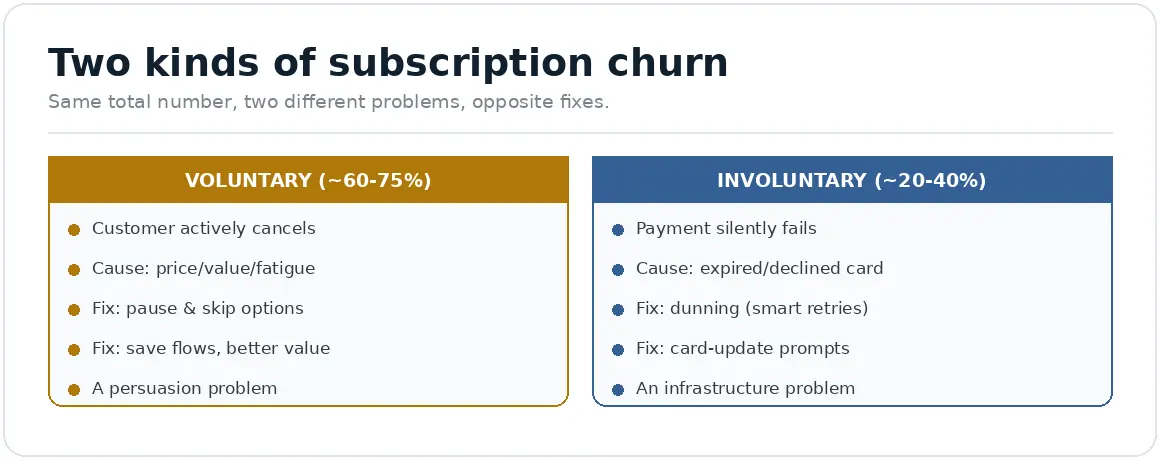
Same total number, two different problems, opposite fixes.
What's a healthy subscription churn rate?
It depends on the model, and you should benchmark against your category, not an overall average. Replenishment (consumables) commonly runs about 3 to 6 percent monthly, curation boxes higher at roughly 6 to 12 percent, and membership lower. Below your category norm is strong; well above it signals a structural problem.
There’s no single “good” churn number, because it varies so much by model, and anyone quoting one average is oversimplifying. Directional monthly churn ranges from 2026 sources: replenishment/subscribe-and-save around 3 to 6 percent (lowest, because it rides real need), curation boxes around 6 to 12 percent (higher, because novelty fades), and access/membership often lower still. Overall ecommerce subscription averages get cited anywhere from about 5 percent (Shopify’s guidance) up to 7 to 12 percent (other datasets), which is exactly why the average is nearly useless, use your category and, above all, your own cohort trend. A practical honest note: measure churn by cohort (churn by billing cycle number) rather than one blended rate, because that reveals whether you’re improving. The methodology is in the supporting guides.
How do I keep subscribers past the first few cycles?
Focus on the early cycles, because that’s where most churn happens. Deliver a strong first experience, make the value obvious quickly, offer flexibility (pause and skip) before frustration turns into cancellation, and use the post-purchase relationship to reinforce why staying is worth it.
Cohort data consistently shows churn is front-loaded: the biggest drop-off is in the first few billing cycles, before the habit forms. So the highest-return retention work is early. Nail the first delivery and onboarding so the subscriber immediately sees the value they signed up for. Give them control from the start (easy skip, pause, and frequency changes) so a busy month becomes a pause, not a cancel. And use the early post-purchase communication to reinforce the benefit and, for replenishment, to time reminders to actual usage. If you can carry a subscriber past those fragile first cycles into a genuine habit, their likelihood of long-term retention rises sharply, which is why the whole program should be built around surviving the early window, not just acquiring sign-ups. This is the subscription-specific edge of the broader retention work in how to improve ecommerce customer retention.
How do I decide if subscriptions are right for my store?
Subscriptions fit best when your product is consumed and reordered regularly (replenishment) or offers ongoing novelty or value worth a recurring commitment. If your product is a one-time or infrequent purchase, forcing a subscription rarely works. Match the model to genuine recurring need.
Not every product suits a subscription, and forcing one where there’s no recurring need just produces high churn. The test is honest: does your product get consumed and reordered on a predictable cycle (coffee, supplements, pet food, skincare)? Then replenishment is a natural fit with durable low churn. Does it offer ongoing discovery or curated value people will pay to keep receiving (beauty boxes, hobby crates)? Curation can work, but you must sustain novelty. Does membership unlock savings or perks worth a recurring fee? Access can work for the right brand. But if your product is a durable, one-time, or irregular purchase, a subscription is a poor fit, and you’re better served by the retention and repeat-purchase tactics in how to improve ecommerce customer retention rather than forcing recurring billing. Choose the model that matches real customer behavior, then obsess over churn.
We treat subscriptions as a churn problem first, because that's what decides whether recurring revenue compounds or leaks away.
Because subscription success lives and dies on retention, we start by measuring churn properly, split into voluntary and involuntary, tracked by cohort, then fix each with the right tool: dunning and card-update flows for the involuntary side, and pause/skip, save flows, and genuine value for the voluntary side. We match the model to real recurring need rather than forcing subscriptions where they don’t fit, and judge the program on retained revenue, not sign-ups.
It’s the same measurement-first discipline behind our ecommerce operations and conversion optimization work, because a subscription only compounds if the experience keeps people subscribed.
// we would rather show up in your reporting than in your inbox
Frequently asked questions
What is an ecommerce subscription model?
It’s selling products on a recurring basis, so customers are billed and shipped automatically on a schedule. The three main types are replenishment (subscribe and save for consumables), curation (curated boxes), and access (membership or perks). It turns one-time buyers into recurring revenue with much higher lifetime value.
Why are subscriptions valuable for ecommerce?
Because they dramatically raise customer lifetime value (a subscriber can be worth several times a one-time buyer) and make revenue predictable. That higher LTV improves your unit economics and lets you afford more to acquire customers, but only if subscribers stay, which is why churn decides everything.
What is a good subscription churn rate?
It depends on the model. Replenishment (consumables) commonly runs about 3 to 6 percent monthly, curation boxes higher at roughly 6 to 12 percent, and membership lower. Benchmark against your category and your own cohort trend rather than an overall average, which varies too much to be useful.
What's the difference between voluntary and involuntary churn?
Voluntary churn is when a customer actively cancels (usually a value, price, or fatigue issue); involuntary churn is when a payment silently fails (expired card, decline). They need opposite fixes, voluntary needs pause options and better value, involuntary needs dunning (automated payment retries and card-update prompts).
Is a subscription model right for my store?
It fits best when your product is consumed and reordered regularly (replenishment) or offers ongoing novelty or value worth a recurring commitment (curation, access). If your product is a one-time or infrequent purchase, forcing a subscription rarely works and produces high churn. Match the model to genuine recurring need.
Sources
Three subscription models (replenishment, curation, access); subscriber LTV several times one-time buyers; churn as the decisive metric; monthly churn by model (replenishment ~3 to 6%, curation ~6 to 12%, membership lower; overall averages vary ~5 to 12% by source): consistent across 2026 subscription-commerce sources. https://www.getonecart.com/subscription-ecommerce/ ; https://recurx.app/subscription-churn-benchmarks ; https://easyappsecom.com/guides/shopify-subscription-commerce-statistics
Voluntary vs involuntary churn split (~60 to 75% voluntary, ~20 to 40% involuntary), opposite fixes; involuntary is the cheapest to recover via dunning: Recurly and others. https://www.recurpay.com/blog/subscription-churn-how-does-dunning-management-work-on-shopify ; https://www.digitalapplied.com/blog/ecommerce-subscription-retention-playbook-2026-churn-reduction
Cancellation compliance. The FTC’s “click-to-cancel” rule was vacated in full by the Eighth Circuit on 8 July 2025 (Custom Communications v. FTC) and never took effect; many guides still describe it as binding law. ROSCA continues to apply to every online subscription, requiring disclosure before billing, express consent to the recurring charge, and a simple cancellation mechanism, and the FTC still enforces it. State auto-renewal laws sit on top and are stricter: California’s AB 2863, in force since 1 July 2025, requires same-medium cancellation and specifically regulates save attempts, and at least 25 states now have their own ARL. The FTC began a preliminary step toward new rulemaking on 30 January 2026. Guidance, not legal advice.