Email / Segmentation
Klaviyo Segmentation Strategy for Ecommerce
// right message, right people

By Fracto Solutions
September 30, 2026
The short answer
A Klaviyo segmentation strategy sends relevant emails to targeted groups instead of blasting everyone. The highest-impact segments: by engagement (to protect deliverability), by purchase behavior (new vs repeat vs lapsed), and by lifecycle stage. Segmenting lifts click, conversion, and revenue per recipient, and keeps unengaged people out of your sends.
Right
2
Both
Why is segmenting better than emailing everyone?
Because relevant emails to targeted groups convert far better than generic blasts, and because excluding unengaged people protects your deliverability. Blasting the whole list lowers engagement, which mailbox providers punish, so segmentation lifts both revenue and inbox placement.
Batch-and-blast feels efficient but costs you twice. First, relevance: an email sent to everyone speaks to no one in particular, so it converts poorly, while a message tailored to a segment’s interests and stage converts far better and earns more revenue per recipient. Second, deliverability: when you blast everyone, including people who never engage, your engagement rates drop, and mailbox providers read low engagement as a reason to filter you toward spam, hurting even your best subscribers. Segmentation solves both: you send relevant messages to people likely to care (lifting engagement and revenue) and you keep chronically unengaged people out of routine sends (protecting the reputation that keeps you in the inbox). It’s the rare lever that improves content performance and deliverability together.
Segment type
Example groups
Main benefit
Engagement
Engaged / moderate / unengaged
Protects deliverability
Purchase behavior
Lead, first-time, repeat, VIP, lapsed
Matches message to relationship
Lifecycle stage
New, active, at-risk, lapsed
Right message for the stage
Predictive (Klaviyo)
Next-order date, CLV, churn risk
Proactive timing and targeting
Start with engagement + purchase-behavior segments; layer on predictive ones as you mature.
How do I segment by engagement?
Group subscribers by how recently and often they engage: highly engaged (opened or clicked recently), moderately engaged, and unengaged. Send routine campaigns primarily to engaged segments, and route unengaged subscribers into a re-engagement flow rather than continuing to blast them.
Engagement segmentation is the most important for deliverability, and Klaviyo makes it straightforward with its engagement data. A practical structure: – Engaged (opened or clicked in, say, the last 30 to 60 days), your core audience; send campaigns here freely. – Moderately engaged (engaged in the last 90 days or so), include selectively. – Unengaged (no opens or clicks in 90 to 180 days), stop including these in routine campaigns; instead, run a re-engagement (win-back) flow, and suppress those who still don’t respond.
This protects your sender reputation (the deliverability benefit from email deliverability best practices) while focusing your sends on people who actually want to hear from you. Sending less, to more engaged people, usually raises total revenue, not lowers it.
How do I segment by purchase behavior?
Group customers by their buying history: never-purchased leads, first-time buyers, repeat customers, VIPs (high value), and lapsed customers. Each group needs different messaging, converting a lead is a different job from winning back a lapsed customer or rewarding a VIP.
Purchase-behavior segments let you match the message to where someone is in their relationship with you: – Leads (never purchased), focus on converting the first order (your welcome flow does much of this). – First-time buyers, nurture toward a second purchase, the critical step in building loyalty. – Repeat customers, encourage continued buying and higher order value. – VIPs (top spenders), recognize and reward them; they drive a disproportionate share of revenue. – Lapsed customers, win them back with relevant, timely outreach before they’re fully gone.
Klaviyo’s ecommerce integration (especially with Shopify) makes these segments easy to build from order data. Treating a VIP the same as a never-purchased lead wastes the relationship with both; segmenting by behavior lets each group get messaging that fits, which is what lifts revenue per recipient.
- Segmentation that lifts revenue
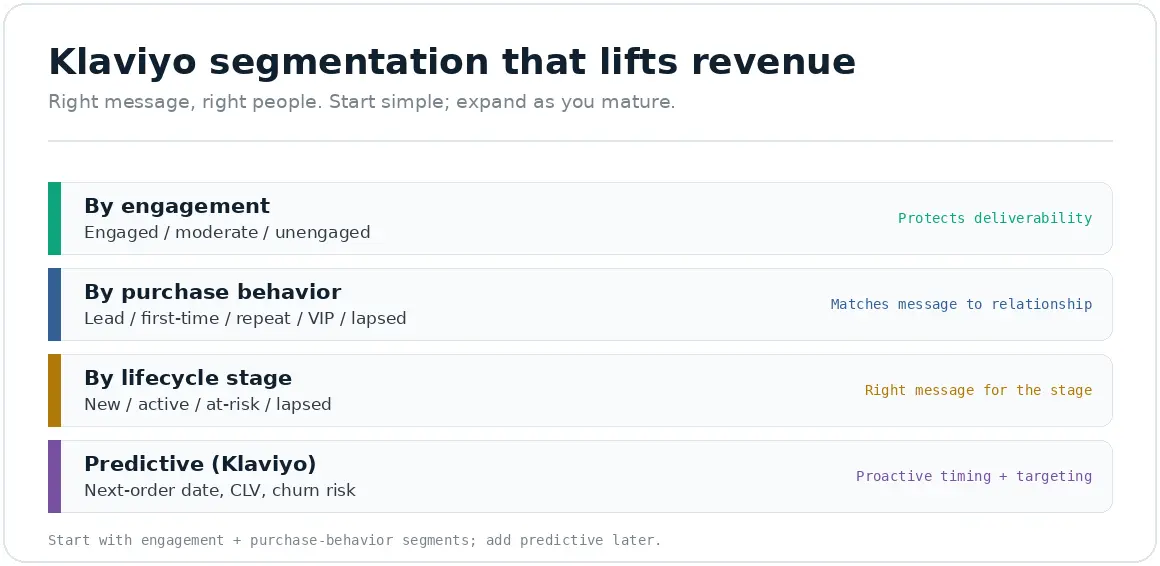
Right message, right people. Start simple; expand as you mature.
What lifecycle and predictive segments are worth building?
Beyond engagement and purchase history, build lifecycle segments (where someone is in their journey) and use Klaviyo’s predictive data (like predicted next-order date or predicted lifetime value) to time and target emails, for example, reaching a customer just before they’re due to reorder.
Klaviyo offers predictive analytics that turn segmentation from reactive to proactive. Worth building: – Lifecycle stage segments, new subscriber, active customer, at-risk, lapsed, so messaging matches the stage. – Predicted next-order date, reach customers just before they’re likely to reorder (powerful for consumables and replenishment). – Predicted lifetime value / CLV tiers, prioritize and tailor treatment for likely high-value customers. – Category or product affinity, segment by what someone browses or buys, so recommendations are relevant.
These are more advanced, but they’re where segmentation compounds, timing a replenishment reminder to a customer’s predicted reorder date, for instance, converts far better than a generic campaign. Start with engagement and purchase-behavior segments, then layer these on as you mature. The retention payoff connects to how to improve ecommerce customer retention.
How many segments do I actually need?
Start simple and expand. A handful of high-impact segments, engaged vs unengaged, and the core purchase-behavior groups, delivers most of the benefit. Don’t over-engineer dozens of tiny segments you can’t maintain; add complexity only when it earns its keep.
It’s tempting to build elaborate segmentation, but complexity you can’t maintain is worse than useful simplicity. The highest-return segments for most stores are few: an engagement split (to protect deliverability and focus sends) and the core purchase-behavior groups (leads, first-time, repeat, VIP, lapsed). Those alone move the needle on click, conversion, revenue per recipient, and deliverability. Add predictive and affinity segments once the basics are working and you have the volume and time to use them well. The goal isn’t the most segments, it’s the right ones, each tied to a message that changes because of it. Segmentation that no one acts on is just a tidy database; segmentation that changes what you send is what lifts revenue.
We build the segments that lift revenue and protect deliverability, starting simple.
We set up engagement segments (to protect your sender reputation) and purchase-behavior segments (leads, first-time, repeat, VIP, lapsed) so each group gets a relevant message, then layer on predictive segments as the program matures.
It’s part of our email and lifecycle work, and because good segmentation drives repeat purchases, it connects to our conversion optimization and retention work.
// we would rather show up in your reporting than in your inbox
Frequently asked questions
What is the best Klaviyo segmentation strategy?
Start with engagement segments (to protect deliverability and focus sends on people who engage) and purchase-behavior segments (leads, first-time buyers, repeat customers, VIPs, lapsed). These few high-impact segments deliver most of the benefit. Layer on lifecycle and predictive segments as you mature.
How does segmentation improve email revenue?
By sending relevant messages to the right people, segmented emails convert far better and earn more revenue per recipient than generic blasts. Segmentation also protects deliverability by keeping unengaged subscribers out of routine sends, which keeps engagement rates (and inbox placement) high, lifting results across the board.
Should I stop emailing unengaged subscribers?
Largely yes, for routine campaigns. Chronically unengaged subscribers drag down engagement rates and hurt deliverability for everyone. Move them into a re-engagement flow, then suppress those who stay inactive. Sending to fewer engaged people usually raises total revenue and protects your inbox placement.
What predictive segments does Klaviyo offer?
Klaviyo provides predictive analytics like predicted next-order date, predicted customer lifetime value, and churn risk, which let you time and target emails proactively (for example, a reminder just before a customer is due to reorder). Start with engagement and purchase segments, then add predictive ones as you mature.
Sources
Every statistic is traced to its original publisher and dated. Email benchmark figures are directional and vary by source and sample; open rate is inflated by Apple Mail Privacy Protection, so this page relies on click, conversion, revenue, and deliverability rather than opens. Benchmark against your own trend.
Segmentation (by engagement, purchase behavior, lifecycle, and predictive data) lifts engagement and revenue per recipient and protects deliverability; Klaviyo’s ecommerce/Shopify integration and predictive analytics support these segments: consistent across 2026 Klaviyo and email sources. https://www.goshdigital.co/blog/klaviyo-benchmarks-by-industry ; https://www.mantasdigital.com/cro-2/email-marketing-conversion-rate-benchmarks/
Excluding unengaged subscribers protects sender reputation and deliverability: see the deliverability article and the benchmarks pillar.