SEO / Architecture
Ecommerce Site Architecture for SEO
// keep the important pages shallow

By Fracto Solutions
September 28, 2026
The short answer
Good ecommerce site architecture is a clean hierarchy, home to category to subcategory to product, that keeps important pages within about three clicks of the homepage, flows authority to the pages that matter, and leaves no orphan pages. It helps Google crawl efficiently and helps shoppers navigate, at the same time.
~3
0
Home >
What is ecommerce site architecture?
Site architecture is how your pages are organized into a hierarchy and linked together. For ecommerce, the standard is home to category to subcategory to product, a clear tree that both search engines and shoppers can navigate logically.
At its simplest, architecture is the map of your store: which pages exist, how they’re grouped, and how they connect. The proven structure for ecommerce is hierarchical, the homepage at the top, then main categories, then subcategories, then individual products, each level more specific than the one above. This isn’t just tidiness; it’s how Google understands your store’s topics and importance, and how shoppers find what they want without frustration. A clear hierarchy does double duty: it helps crawlers reach and prioritize pages, and it helps users buy faster. A messy, flat, or tangled structure hurts both.
Level
Targets
Role
Homepage
Brand + general discovery
Build and route authority
Category
High-volume head terms
Ranking hubs
Subcategory
Attribute-specific terms
Narrower ranking + routing
Product
Long-tail queries
Convert; link back up
Keep key pages within about 3 clicks of the homepage; no page should be orphaned. Google says important pages should be reachable in “few clicks” but does not publish a number, so treat 3 as industry convention rather than a Google rule.
Why does site architecture matter for SEO?
Because it controls crawling, authority flow, and how Google understands your topics. A clean structure lets crawlers reach key pages efficiently, concentrates ranking authority on important pages, and clarifies what each part of your site is about. A poor structure buries pages and wastes crawl budget.
Architecture affects SEO in three concrete ways. First, crawling: Google has a limited crawl budget per site, and a clean structure ensures it spends that budget reaching your important pages rather than getting lost in navigation labyrinths. Second, authority flow: your homepage accumulates the most authority (from external links and navigation), and a good hierarchy channels that authority down to categories and products; a flat or broken structure lets it pool uselessly at the top. Third, semantic understanding: a logical hierarchy tells Google how your topics relate (this subcategory belongs to that category), strengthening topical relevance. Get architecture right and every other SEO effort works better on top of it.
- Site architecture
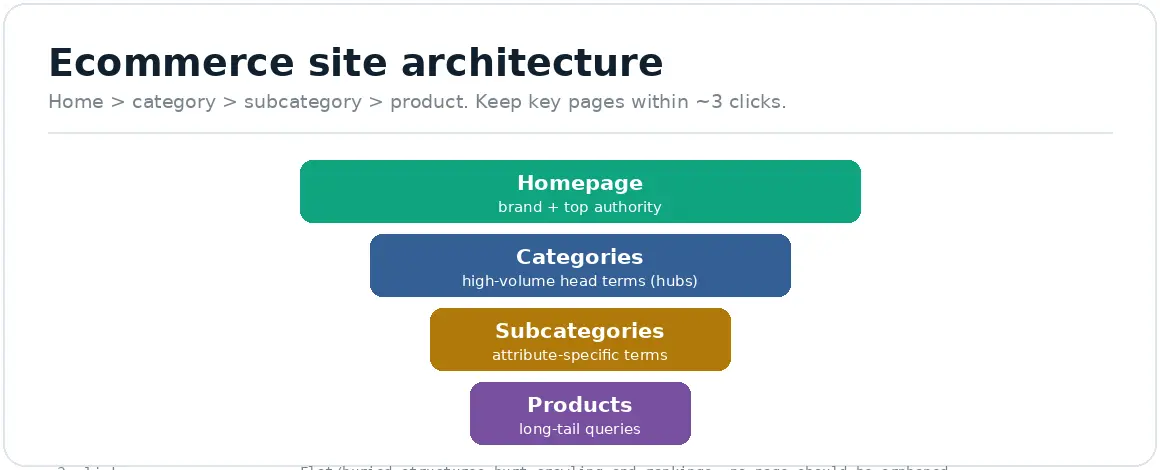
Home > category > subcategory > product. Keep key pages within ~3 clicks.
How shallow should my site be (crawl depth)?
Keep important pages within about three clicks of the homepage (three to four is a common benchmark). The shallower a page’s depth, the easier it is for crawlers to reach and the more authority it tends to receive. Deep, buried pages get crawled less and rank worse.
Crawl depth, how many clicks from the homepage a page sits, is one of the most useful architecture metrics. The widely-cited operational benchmark is to keep strategic pages (categories, key products, commercial pages) within roughly three clicks of the homepage. Why it matters: pages buried many clicks deep get crawled less frequently and receive less internal authority, so they rank worse, even if the products are great. Large catalogs are where this goes wrong, products end up five or six clicks deep behind endless pagination and filters. The fixes: a logical hierarchy, strong category and navigation linking, showing more products per page (48 or 96 rather than 24) to reduce pagination depth, and “view all” pages (noindexed but crawlable) so Google can reach every product efficiently. Monitor crawl depth regularly, because catalog growth quietly pushes pages deeper.
What are orphan pages, and why are they bad?
Orphan pages are pages with no internal links pointing to them, reachable only through site search or a direct URL. They’re bad because Google struggles to find them and they receive no internal authority, so they rarely rank, even when the products are worth selling.
An orphan page is stranded: nothing on your site links to it, so both crawlers and shoppers have trouble reaching it. This happens more than you’d think, discontinued-then-relisted products, categories dropped from navigation, pages created outside the normal structure. The consequences are real: Google may not discover or re-crawl them, they get none of the internal authority that helps ranking, and shoppers can’t browse to them. The fix is to find them (crawl your site and compare against your full product list to spot pages with zero internal links) and either link them into the structure properly or, if they shouldn’t exist, remove or redirect them. Prioritize linking your profitable categories and strategic products first. No page you want to rank should ever be an orphan.
What URL structure should ecommerce use?
Clean, hierarchical URLs that mirror your structure: yourdomain.com/category/subcategory/product-name. They reinforce topic and hierarchy for Google, are readable for shoppers, and should stay stable, if you must change one, 301-redirect the old URL to preserve its authority.
URLs are a small but real architecture signal. The ideal ecommerce pattern reflects the hierarchy: the homepage targets broad brand and category signals, /category/ targets high-volume category keywords, /category/subcategory/ targets attribute-specific terms, and /category/subcategory/product-name/ is the individual product. Clean, descriptive, keyword-relevant URLs reinforce what each page is about and where it sits. Two rules: keep them readable (avoid long strings of parameters and IDs where possible), and keep them stable, changing URLs loses the authority they’ve built unless you 301-redirect old to new. On platforms like Shopify the URL structure is partly fixed, so work within it and focus your energy on the levers you control (hierarchy, linking, faceted control).
How does architecture connect to category pages and internal links?
They’re three views of the same system. Architecture is the hierarchy, category pages are its hubs, and internal links are the connections that make authority flow through it. Optimizing one without the others leaves value on the table.
Architecture doesn’t work in isolation. Your category pages are the key nodes in the hierarchy (the hubs that receive and distribute authority), covered in ecommerce category page SEO. Internal links are the wiring that carries authority along the structure, from home to categories to products, covered in internal linking for ecommerce sites. And the architecture itself is the skeleton that determines what’s shallow, what’s reachable, and what’s orphaned. Fix all three together: a clean hierarchy, strong category hubs, and deliberate internal linking. That combination is what makes crawl budget, authority flow, and topical relevance all work in your favor, and it’s the foundation the rest of your ecommerce SEO builds on.
We build a clean hierarchy that flows authority to the pages that earn revenue.
We map your store to a shallow, logical hierarchy, fix orphan pages and buried products, and make sure crawl budget and authority reach your strategic categories and products, not filter noise.
It’s part of our SEO work, and because architecture also shapes how shoppers navigate, it connects to the conversion optimization that turns those visits into sales.
// we would rather show up in your reporting than in your inbox
Frequently asked questions
What is the best site structure for ecommerce SEO?
A clean hierarchy: home to category to subcategory to product, with important pages within about three clicks of the homepage. This helps Google crawl efficiently, flows authority to key pages, and helps shoppers navigate. Avoid flat, shallow structures where products are buried far from the homepage.
How many clicks deep should pages be?
Keep strategic pages (categories, key products) within about three clicks of the homepage, three to four is the common benchmark. Pages buried deeper get crawled less and receive less internal authority, so they rank worse. Reduce depth with good hierarchy, more products per page, and “view all” pages.
What is an orphan page?
A page with no internal links pointing to it, reachable only via site search or direct URL. Orphan pages are hard for Google to find and receive no internal authority, so they rarely rank. Find them by crawling your site, then link them into the structure or remove them.
Does URL structure matter for ecommerce SEO?
Yes, moderately. Clean, hierarchical URLs (/category/subcategory/product) reinforce topic and structure and are readable for shoppers. Keep them stable; if you must change one, 301-redirect the old URL to preserve its authority. On fixed platforms, work within the structure and focus on hierarchy and linking.
Sources
Hierarchical architecture (home > category > subcategory > product), keep key pages within roughly 3 to 4 clicks, crawl-budget and authority-flow benefits, orphan-page detection, clean hierarchical URLs: consistent across multiple 2026 ecommerce architecture and SEO sources. Two clarifications worth holding on to. Google’s own documentation says important pages should be reachable in few clicks but never states a number, so the “3 clicks” rule is industry convention rather than Google guidance. And it scales: for catalogues under roughly a thousand pages, 3 to 4 clicks for anything you want crawled is a reasonable target, while on very large catalogues the practical version is main categories within 1 to 2 clicks and products within 3 to 4, accepting more depth further down. https://www.incremys.com/en/resources/blog/site-architecture ; https://dynecom.com/the-ultimate-ecommerce-seo-geo-guide-for-2026/ ; https://keytomic.com/blog/ecommerce-category-page-seo-best-practices
Reduce pagination depth (more products per page, noindexed crawlable “view all”): https://www.lawrencehitches.com/ecommerce-internal-linking-strategy/