SEO / Internal linking
Internal Linking for Ecommerce Sites
// link deliberately toward the pages you want to rank

By Fracto Solutions
September 29, 2026
The short answer
Internal linking for ecommerce means deliberately connecting your pages so authority flows to the ones you want to rank. Use a hub-and-spoke model: category pages as hubs, receiving links from navigation and content, and passing authority to subcategories and products. Use descriptive anchor text, and make sure no important page is orphaned.
Hub
Anchor
Free
Why does internal linking matter so much for ecommerce?
Because it does two jobs at once: it flows ranking authority to the pages you want to rank, and it helps shoppers navigate and discover products. On ecommerce sites specifically, internal links both distribute SEO value and drive shoppers toward purchase.
Internal linking has an outsized effect in ecommerce because of scale and structure. Your homepage and top pages accumulate authority (from external links, navigation, engagement), and internal links are how that authority reaches the hundreds or thousands of category and product pages beneath them, a page with no internal links gets almost none of it. At the same time, internal links are navigation: they help shoppers move from a blog post to a product, from a category to a related one, from a product to complementary items. So a good internal-linking strategy simultaneously improves rankings and helps people buy. It’s rare to find a lever that serves SEO and conversion equally, and it’s almost entirely in your control.
What is the hub-and-spoke internal linking model?
The most effective ecommerce model: category pages act as hubs that receive links from supporting content (buying guides, blog posts) and from navigation, then distribute that authority to subcategory and product “spokes.” Products link back to their categories and to related products.
Hub-and-spoke is the structure to aim for. Your category pages are the hubs, central nodes that should receive plenty of internal links (from the homepage, main navigation, breadcrumbs, and relevant content) and pass authority down to the subcategories and products they contain. The products and subcategories are the spokes: they link back up to their parent category and across to related products. Supporting content (buying guides, comparison articles, blog posts) links into the most relevant category and product pages, feeding them authority and context. This creates a coherent web where authority concentrates on your commercial hubs and flows sensibly through the catalog, rather than scattering randomly. It mirrors the same hub-and-spoke logic behind a well-built content cluster.
Page type
Links out to
Receives links from
Homepage / nav
Top categories
External backlinks
Category (hub)
Subcategories, key products, content
Home, nav, breadcrumbs, blog
Product
Parent category, related products
Category, related products, content
Blog / guide
Relevant categories & products
Nav, other content
Descriptive anchor text throughout; no page you want to rank should be an orphan.
- Hub-and-spoke linking
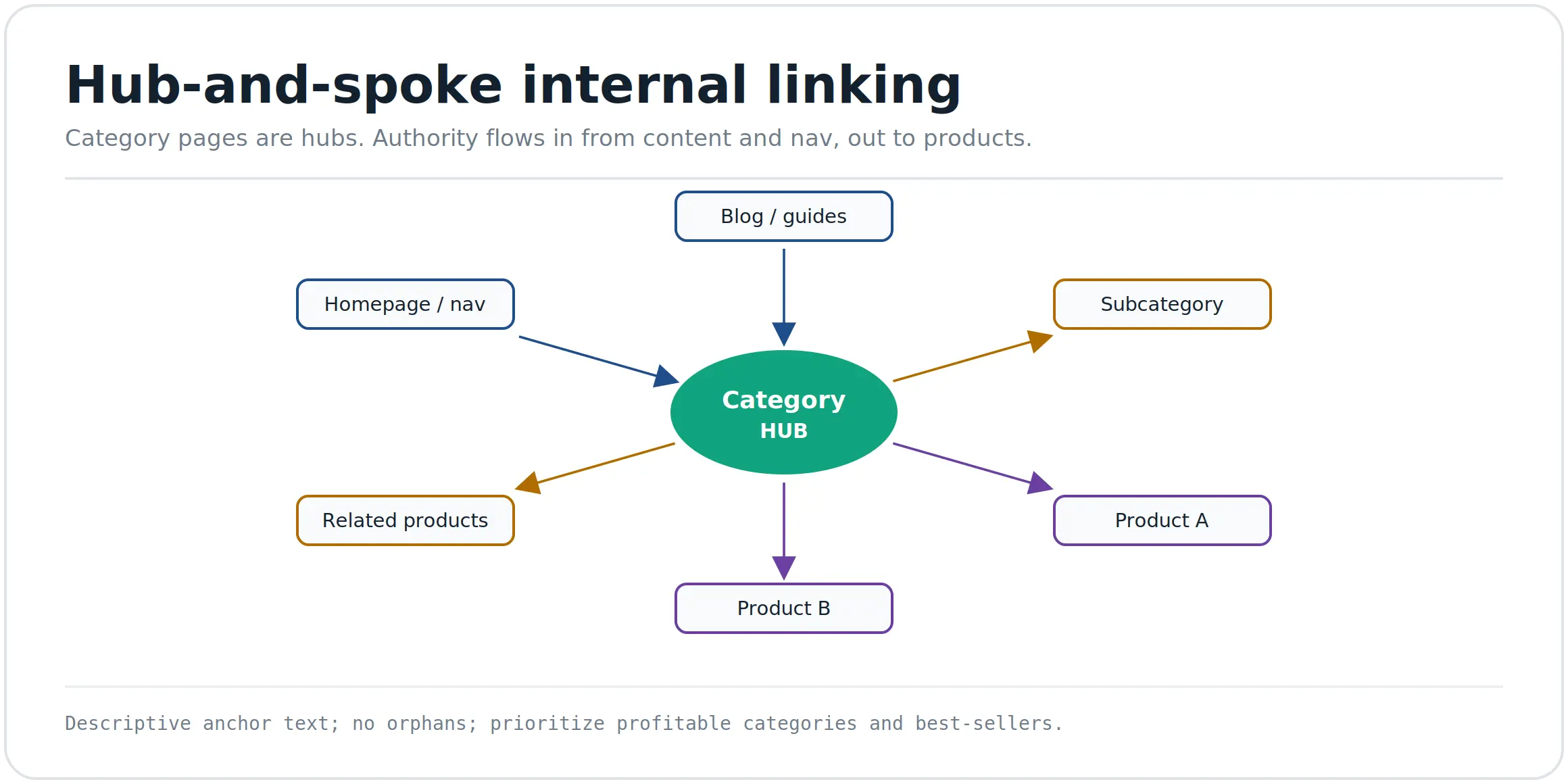
Category pages are hubs. Authority flows in from content and nav, out to products.
How should I link categories, products, and content?
Each page type has a role: navigation and content link into category hubs; categories link to their subcategories and best products; products link to their parent category and related products; and blog content links contextually to the categories and products it discusses.
Here’s how the main page types should link:
Navigation and homepage link to your top categories, signaling their importance to Google.
Category pages link to their subcategories and to strategic products (best-sellers, high-margin, in-stock), and to relevant editorial content.
Product pages link back to their parent category (via breadcrumbs) and across to related or complementary products.
Blog and buying-guide content links contextually to the specific categories and products it mentions, with descriptive anchor text, this is powerful, under-used authority for commercial pages.
Breadcrumbs on every category and product page show the full path (Home > Shoes > Running > Product), reinforcing hierarchy and adding reliable internal links.
The principle throughout: link deliberately toward the pages you want to rank and toward what helps the shopper, not at random.
What anchor text should internal links use?
Descriptive, relevant anchor text that tells Google (and the shopper) what the linked page is about, “men’s running shoes” rather than “click here.” Keep it natural and varied, and maintain an anchor-text map for your key pages so linking stays consistent.
Anchor text is the label on each internal link, and it’s a real relevance signal. Vague anchors (“click here,” “this page,” “read more”) waste the opportunity; descriptive anchors that include the target page’s topic (“waterproof hiking boots”) tell Google what that page is about and reinforce its keyword relevance. Keep it natural, don’t stuff the exact keyword identically into every link, but do make anchors meaningful. For consistency at scale, maintain an anchor-text map: a simple document specifying the preferred anchor(s) for each key page, so everyone linking across the site uses consistent, sensible anchors rather than improvising. This small discipline compounds across hundreds of links.
How do I find and fix internal linking problems?
Crawl your site to find orphan pages (no internal links) and pages buried too deep, then link them into the structure. Prioritize your profitable categories and best products. Most stores have significant untapped internal-linking opportunity.
Diagnosing internal linking is straightforward with a crawl. Run a site crawler and look for: orphan pages (pages with zero internal links, they can’t rank), pages buried too many clicks deep, and important pages that receive very few internal links relative to their value. Compare the crawl against your full product and category list to spot gaps. Then fix deliberately, and prioritize: link your profitable categories and strategic products first (best-sellers, high-margin, stable stock), since that’s where better linking returns the most. Internal linking is rarely “done”, as you add products, publish content, and change navigation, new opportunities and new orphans appear, so revisit it periodically. The payoff is real: better internal linking strengthens rankings across the whole catalog at no media cost.
How does internal linking connect to conversion?
Directly. The same links that flow SEO authority also guide shoppers toward products and related items, so good internal linking lifts both rankings and on-site navigation. Links to best-sellers and complementary products help shoppers buy, not just help Google crawl.
This is why internal linking is worth doing well beyond pure SEO. Every internal link is also a path a shopper can take, so linking from a buying guide to the right product, or from a product to its complements, both passes authority and moves the shopper closer to purchase. Prioritizing links to best-sellers and high-margin products serves SEO (concentrating authority where it pays) and conversion (surfacing the products most likely to sell) at once. It even overlaps with merchandising tactics like cross-selling. So treat internal linking as serving two masters that happen to want the same thing, and where it feeds product discovery, it connects to the conversion optimization work that turns those visits into sales.
We wire authority to the pages you want to rank, with descriptive anchors and no orphans.
We build a hub-and-spoke structure, category hubs fed by navigation and content, linked down to strategic products, use descriptive anchor text via an anchor-text map, and fix orphan pages, prioritizing your profitable categories and best-sellers.
It’s part of our SEO work, and because internal links also guide shoppers toward products, it feeds the conversion optimization side too.
// we would rather show up in your reporting than in your inbox
Frequently asked questions
What is the best internal linking structure for ecommerce?
The hub-and-spoke model: category pages as hubs that receive links from navigation and content and distribute authority to subcategory and product spokes, which link back up and across to related products. Supporting content links into the relevant categories and products. This concentrates authority on your commercial pages.
What anchor text should I use for internal links?
Descriptive, relevant anchor text that describes the linked page (“men’s running shoes”), not vague phrases like “click here.” Keep it natural and varied rather than stuffing the identical keyword everywhere. Maintaining an anchor-text map for key pages keeps linking consistent across a large site.
How do I find orphan pages?
Crawl your site with an SEO crawler and look for pages with no internal links pointing to them, then compare against your full product and category list. Orphan pages can’t rank because Google struggles to find them and they get no internal authority. Link them into the structure or remove them.
Does internal linking really improve rankings?
Yes. Internal links distribute your site’s authority to the pages you link to, so deliberately linking toward the pages you want to rank (with descriptive anchor text) strengthens them. It’s one of the most controllable and under-used SEO levers, and it helps shoppers navigate at the same time.
Sources
Hub-and-spoke internal linking (category hubs, product/subcategory spokes, content linking in), descriptive anchor text and anchor-text maps, breadcrumbs, orphan-page detection, prioritizing profitable pages: consistent across multiple 2026 ecommerce internal-linking sources. https://dynecom.com/the-ultimate-ecommerce-seo-geo-guide-for-2026/ ; https://www.lawrencehitches.com/ecommerce-internal-linking-strategy/ ; https://www.clickrank.ai/effective-internal-linking-structure/
Google’s John Mueller has said that click depth matters more than URL structure: the number of slashes in a URL does not count, but how many clicks it takes to reach a page from the homepage does, and pages closer to the homepage are treated as more important (Google Webmaster Central hangout, reported by Search Engine Journal). The related point that linking to a category page when multiple products exist helps Google recognise its importance comes from the same body of Mueller guidance. We cite the reported source rather than the SEO blogs that paraphrase it.