SEO / On-page
Ecommerce Category Page SEO: The Pages That Rank
// your category pages rank for the money terms, if you let them

By Fracto Solutions
September 28, 2026
The short answer
Category page SEO is optimizing your collection pages, not just product pages, because categories rank for the high-value, high-intent head terms shoppers search (like “men’s running shoes”). The essentials: a keyword-matched title and H1, unique intro copy, strong internal linking in and out, and faceted navigation controlled so filters don’t bury your pages in duplicate URLs.
Head
~3
Hub
Why do category pages matter more than product pages for SEO?
Because category pages target the head terms with the most search volume and commercial intent, while product pages target narrow long-tail queries. A ranking category page captures far more qualified traffic, and it sits in the middle of your site, distributing authority to the products beneath it.
Think about how people search. They type “running shoes” or “men’s waterproof jackets” far more than any single product name, and those broad, commercial searches are exactly what category pages are built to match. Product pages target the long tail (a specific model), which matters, but has far less volume. On top of that, category pages occupy the central layer of your site’s hierarchy, below the homepage, above products, so they both receive authority from your homepage and navigation and pass it down to the products they list. Get category pages ranking and you capture the biggest, highest-intent searches and strengthen the whole catalog beneath them. Neglect them, and you’re competing for scraps on product long-tail while your most valuable terms go unranked.
How do I optimize a category page for SEO?
Cover the on-page essentials: a title tag and single H1 with the primary commercial keyword, unique intro copy that describes the range, a crawlable product grid, controlled faceted navigation, and strong internal links in and out. Each element helps Google understand and rank the page.
Here’s the category-page checklist and what each element does:
Element
What to do
Why it matters
Title tag & H1
Include the primary commercial keyword naturally; one H1
Signals the page's topic to Google and shoppers
Intro copy
Short, unique paragraph describing the range
Adds relevance and context; avoids thin pages
URL
Clean, keyword-relevant (/category/subcategory/)
Reinforces hierarchy and topic
Product grid
Crawlable (not JS-only); enough products
Lets Google reach products; justifies a unique page
Faceted navigation
Canonicals/noindex on low-value filters
Prevents duplicate-URL bloat and crawl waste
Internal links
Receive from nav/home; link to sub-cats & products
Distributes authority; central to ranking
Breadcrumbs
Show full path (Home > Shoes > Running)
Aids crawling and shows hierarchy
Element roles are consistent across 2026 category-page SEO sources.
The two most-neglected of these are unique intro copy (many category pages have none) and faceted-navigation control (which quietly wrecks large catalogs), so start there.
- Category page SEO checklist
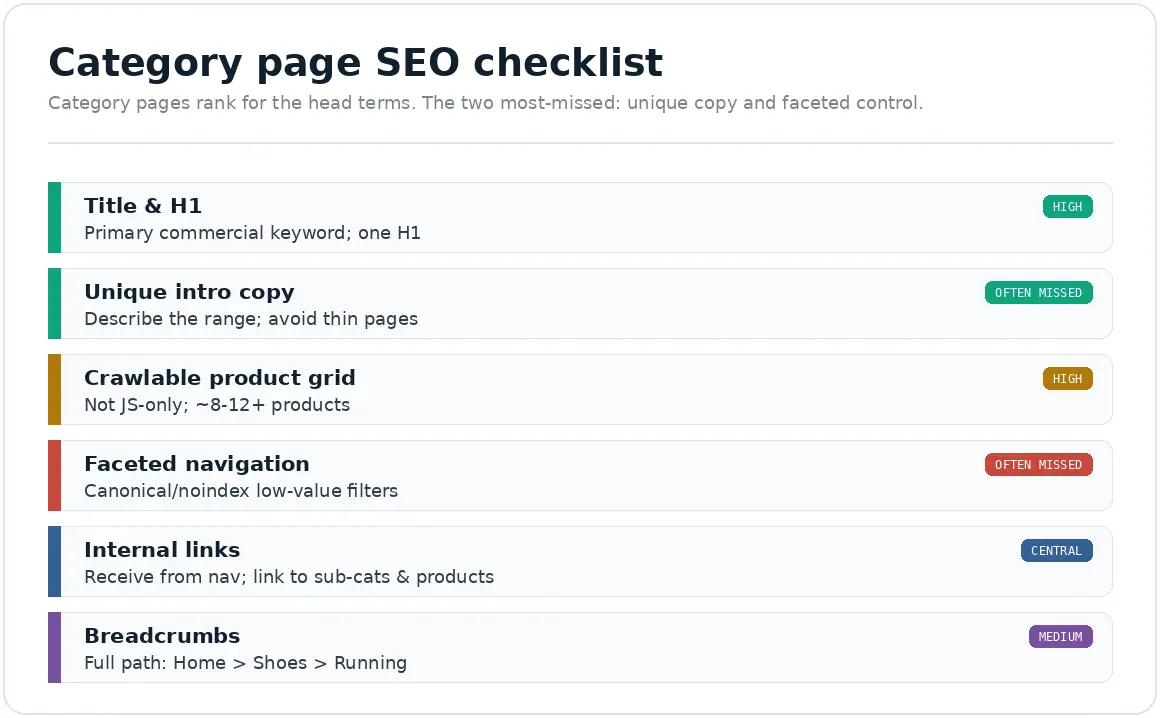
Category pages rank for the head terms. The two most-missed: unique copy and faceted control.
How much content does a category page need?
Enough unique copy to give context and relevance, without burying the products. A short, genuinely useful intro paragraph (and sometimes supporting content lower down) is plenty; you don’t need a wall of text above the grid. And include enough products (commonly around 8 to 12 minimum) to justify the page as its own indexable URL.
Category-page content is a balance. On one side, a page with zero unique copy is thin and gives Google little reason to rank it over competitors; on the other, a giant block of keyword-stuffed text pushed above the product grid hurts the shopper experience (they came to browse products, not read an essay). The right answer: a concise, unique intro that describes the category and naturally includes the primary keyword, with any deeper content (buying guidance, FAQs) placed below the products where it doesn’t obstruct browsing. On product count, a category needs enough items to warrant being its own page, commonly cited as around 8 to 12 minimum, or you risk thin, near-empty pages that shouldn’t be indexed at all.
How does faceted navigation hurt category SEO?
Filters (size, color, price) can generate thousands of near-duplicate URLs, which waste crawl budget, split ranking signals, and bury your real category pages. Controlling which filter combinations get indexed is one of the highest-impact and most-missed category SEO fixes.
Faceted navigation is the silent killer of large-catalog SEO. Every filter a shopper can apply (color, size, price, brand) can create a unique URL, and combinations multiply fast, a category with a handful of filters can spawn thousands of URL variations. Left uncontrolled, this does real damage: Google wastes crawl budget on redundant filtered pages instead of your important ones, ranking authority splits across dozens of near-identical URLs, and your clean category page struggles to stand out. The fix is deliberate control: set canonical tags on filtered pages pointing back to the main category, noindex (or block) low-value filter combinations, never index pages with zero products, and only give a filter combination its own indexable page when there’s genuine, recurring search demand for it. This connects to the crawl and indexation work in the technical SEO checklist.
How do internal links make category pages rank?
Category pages rank partly because of the authority they receive and pass on. Link to them from your homepage and navigation (so Google sees their importance), link them down to subcategories and products, and link relevant blog content to them. This flow of internal authority is central to category ranking.
Internal linking is where category SEO is won or lost, and it’s the most under-done part of ecommerce SEO. Category pages should be authority hubs: they receive links from the homepage, main navigation, and breadcrumbs (signaling to Google that they matter), and they distribute that authority down to subcategories and key products. Google’s own John Mueller has noted that linking to a category page when multiple products exist helps Google recognize the category’s importance. Practically: make sure every category is reachable from navigation (no orphan categories), link category pages to their best subcategories and products with descriptive anchor text, and point relevant buying guides and blog posts at the category they support. The full method is in internal linking for ecommerce sites, and the site-wide structure in ecommerce site architecture.
Do category pages need schema and clean URLs?
Yes to both. A clean, hierarchical URL (/category/subcategory/) reinforces topic and structure, and BreadcrumbList schema (plus any genuinely applicable schema) helps Google understand the page’s place in your site. Neither is optional for a well-optimized category page.
These are the technical finishing touches that many stores skip. URLs should be clean and reflect the hierarchy (yourdomain.com/category/subcategory/), which reinforces the page’s topic and its place in the structure, and you should avoid changing them (or 301-redirect if you must, to preserve ranking). On schema, BreadcrumbList markup on category and product pages helps Google display and understand the site hierarchy, and it should mirror the visible breadcrumb trail. Keep schema honest and matched to visible content, the same rule from the broader ecommerce SEO work. These aren’t dramatic levers on their own, but they remove friction and ambiguity, letting the bigger levers (content, internal links, faceted control) do their job.
How do I know if my category pages are optimized?
Check that each key category ranks for its target head term, receives internal links (no orphans), has unique copy and controlled faceted navigation, and is reachable within about three clicks of the homepage. Audit these regularly, because catalog changes quietly break them.
A practical audit for your category pages: – Rankings: does each important category rank for its primary commercial keyword? If not, it’s usually a content, internal-linking, or faceted-navigation problem. – Orphans: does every category receive internal links, or are some reachable only through site search? Orphaned categories can’t rank. – Uniqueness: does each category have unique intro copy, or are they thin and near-identical? – Faceted control: are filter URLs canonicalized/noindexed so they’re not diluting the page? – Crawl depth: are key categories within about three clicks of the homepage?
Run this periodically, because adding products, renaming collections, and changing navigation all quietly break category SEO over time. Getting it right multiplies the ranking potential of the whole catalog.
We treat category pages as the ranking hubs they are, and fix the two things most stores miss.
Rather than pouring effort into product-page long-tail alone, we optimize the category pages that target your highest-value head terms, unique intro copy, clean titles and URLs, controlled faceted navigation, and a deliberate internal-linking structure that funnels authority to them and down to products. Then we audit regularly, because catalogs drift.
It’s the same measurement-first discipline behind our SEO work, and it connects straight to conversion, because a ranking category page only pays off if it converts, the conversion optimization side, because a category page that ranks and then fails to convert has only moved the problem one step further down the funnel.
// we would rather show up in your reporting than in your inbox
Frequently asked questions
Why are category pages important for ecommerce SEO?
Because they target the high-volume, high-intent head terms (like “running shoes”) that product pages can’t, and they sit at the center of your site’s authority flow, receiving links from the homepage and passing authority to products. A ranking category page captures far more qualified traffic than a single product page.
How do I optimize an ecommerce category page?
Cover the essentials: a title and single H1 with the primary commercial keyword, unique intro copy describing the range, a clean URL, a crawlable product grid, controlled faceted navigation (canonicals/noindex on low-value filters), strong internal links in and out, and breadcrumbs. The two most-missed are unique copy and faceted-navigation control.
How much content does a category page need?
Enough unique copy for context and relevance, a concise, useful intro paragraph, with any deeper content placed below the products so it doesn’t obstruct browsing. Avoid both thin (no copy) and bloated (keyword-stuffed walls of text) pages. Include enough products (commonly ~8 to 12 minimum) to justify a unique indexable page.
Does faceted navigation hurt SEO?
It can, badly, if uncontrolled. Filters generate thousands of near-duplicate URLs that waste crawl budget and split ranking signals. Control it: canonicalize filtered pages to the main category, noindex low-value combinations, never index zero-product pages, and only give a filter combination its own page when there’s real, recurring search demand.
How many internal links should a category page have?
Category pages act as hubs, so they carry many links (they receive from navigation and breadcrumbs, and link out to subcategories and products). There’s no exact number, but they should never be orphaned (no incoming links) and should link out to their key subcategories and products with descriptive anchor text.
Sources
Category pages target head/commercial terms and sit in the middle authority layer; on-page essentials (title/H1, unique copy, clean URL, crawlable grid, breadcrumbs); ~8 to 12 products to justify a page; faceted-navigation control (canonicals, noindex low-value filters, no zero-product pages): consistent across multiple 2026 category-page SEO sources. https://keytomic.com/blog/ecommerce-category-page-seo-best-practices ; https://www.earlyseo.com/blogs/ecommerce-category-page-seo-guide ; https://inomadigital.com/blog/seo-ecommerce-category-pages
Google’s John Mueller has said that click depth matters more than URL structure: the number of slashes in a URL does not count, but the number of clicks from the homepage does, and pages closer to the homepage carry more weight (Google Webmaster Central hangout, reported by Search Engine Journal). The related guidance to link to a category page when multiple products exist, so Google recognises its importance, comes from the same source. We cite the reported hangout rather than the SEO blogs that paraphrase it.
Keep key pages within about 3 clicks, a widely used industry convention rather than a stated Google threshold, since Google says only that important pages should be reachable in few clicks; hub-and-spoke internal linking; breadcrumbs: https://dynecom.com/the-ultimate-ecommerce-seo-geo-guide-for-2026/ ; https://www.incremys.com/en/resources/blog/ecommerce-seo