Strategy / Growth
Should You Focus on Traffic or Conversion First?
// fix the leaky bucket before adding water

By Fracto Solutions
September 15, 2026
The short answer
For most stores that already get traffic, fix conversion first: it makes every existing visitor and ad dollar worth more immediately, and it’s fully in your control while traffic costs keep rising. Focus on traffic first only if your store already converts well but genuinely lacks qualified visitors.
Fix
One-time
Segment
Why does the order matter so much?
Because the two compound differently. Improving conversion lifts the return on all your traffic at once, while buying more traffic into a store that converts poorly just pays to lose more people. Getting the order wrong wastes money for months.
Think of your store as a bucket and traffic as water. If the bucket leaks (poor conversion), pouring in more water just means more spills out, you pay for visitors who don’t buy. Fixing the leak first means every drop you add afterward counts. That’s why sequencing matters: the same budget spent on conversion versus traffic can produce very different results depending on which you do first. And because acquisition costs keep climbing, the cost of pouring water into a leaky bucket rises every year, which sharpens the case for fixing conversion before scaling spend. There’s a second-order effect too: a store that converts well can afford to bid more for traffic and still stay profitable, so fixing conversion doesn’t just save money now, it expands the range of traffic you can profitably buy later. The two levers aren’t rivals; a stronger conversion rate makes your traffic spending work harder whenever you do scale it.
Why does conversion usually come first?
At fixed traffic, improving conversion multiplies your revenue directly, and it’s often cheaper than buying the equivalent traffic. A worked example shows why conversion frequently wins on pure economics.
Here’s the comparison at a glance. Say you get 50,000 visitors a month at a 2% conversion rate and a $100 average order:
Scenario
Change
Result
Baseline
50,000 visitors, 2% CVR, $100 AOV
1,000 orders, $100,000
Add 25% more traffic
62,500 visitors, 2% CVR
1,250 orders, $125,000
Improve CVR 25%
50,000 visitors, 2.5% CVR
1,250 orders, $125,000
*Illustrative arithmetic. Both routes reach the same revenue, but the traffic route requires paying for 12,500 more visitors every month, while the conversion gain is a one-time fix that keeps paying.*
The point isn’t that traffic never works, it’s that the conversion route delivers the same lift without an ongoing traffic bill, and it stacks on top of whatever traffic you later add. That recurring-versus-one-time difference is why conversion usually wins on economics.
- Traffic vs conversion
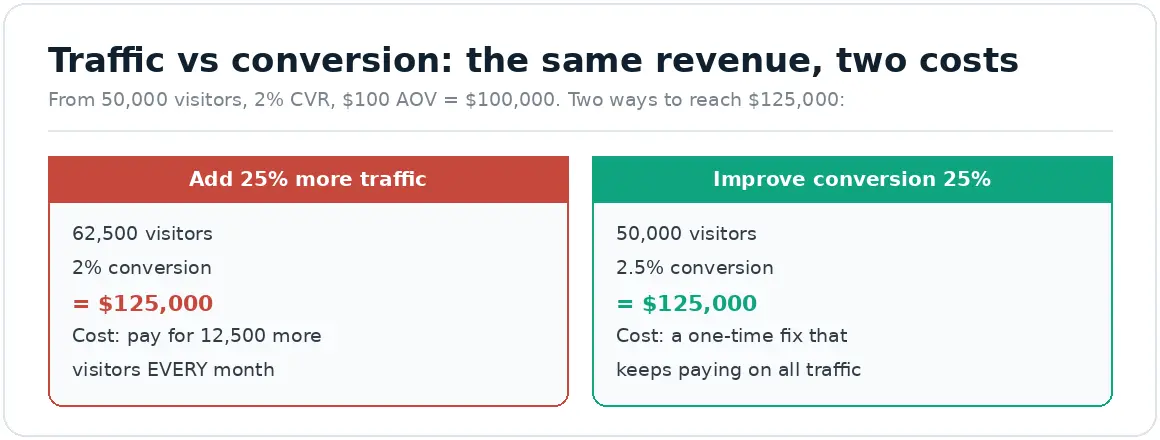
The same revenue, two costs. The conversion route avoids an ongoing traffic bill.
When should I focus on traffic first instead?
When your store already converts well but genuinely doesn’t have enough qualified visitors to work with. If conversion is strong and traffic is thin, more optimization has little left to give, and traffic becomes the real constraint.
Conversion-first isn’t a universal law; it’s the right call for the common situation (a store with traffic that underperforms on conversion). The honest exception is a store that already converts at or above its category norm but simply isn’t getting enough qualified visitors, there, you’ve largely picked the conversion fruit, and growth genuinely requires more traffic through SEO and paid. There’s also a practical floor: a brand-new store with almost no traffic can’t reliably test conversion changes (not enough data), so early on it needs some traffic before conversion work becomes measurable. The rule of thumb: if you have traffic that isn’t converting, fix conversion; if you convert well but lack visitors, get traffic. And in practice most stores sit clearly on one side or the other once they actually look at the numbers, the paralysis usually comes from not having segmented the data, not from a genuinely close call. Measure first, and the answer is often obvious.
How do I tell which situation I'm in?
Compare your conversion rate to your category norm and your traffic to your goals. Below-par conversion with decent traffic means fix conversion; strong conversion with thin traffic means get more. Your own data decides, not a generic rule.
The diagnosis is straightforward. First, check your conversion rate against your category (see what is a good conversion rate for a Shopify store), if it’s below par and you have meaningful traffic, conversion is your constraint. Second, check whether you have enough qualified traffic to hit your revenue goals and to test reliably, if conversion is strong but traffic is thin, traffic is the constraint. Most stores that ask this question have the first problem (traffic that doesn’t convert), which is why conversion-first is the usual answer, but let your own numbers, not a blog’s rule, make the call. This is the core of the broader growth-strategy diagnosis.
The steepest mobile drop-off, confirmed by what you see in recordings, is your priority fix. This is the same diagnostic method as how to diagnose Shopify conversion issues, applied device-first.
We tell you honestly which lever is your constraint, then fix it.
We segment your data to see whether conversion or traffic is actually holding you back, then focus there, usually conversion for stores that already get traffic, because it compounds and lowers effective CAC.
It’s part of our conversion optimization work, grounded in your own analytics so the diagnosis is real, not a guess.
// we would rather show up in your reporting than in your inbox
Frequently asked questions
Is it better to increase traffic or conversion rate?
For most stores with existing traffic, conversion first, it makes every visitor and ad dollar worth more immediately, compounds across all channels, and is fully in your control. Focus on traffic first only if you already convert well but genuinely lack qualified visitors.
Why is conversion optimization often cheaper than buying traffic?
Because a conversion improvement is largely a one-time fix that keeps paying on all future traffic, while buying more traffic is a recurring cost that only helps while you keep paying. At the same revenue target, the conversion route usually avoids an ongoing traffic bill.
Can a new store with little traffic do conversion optimization?
Only partly, reliable A/B testing needs enough traffic to reach significance, which very new stores lack. Early on, focus on fixing obvious problems and getting some qualified traffic, then move to systematic conversion work once you have the data to measure it.
How do I know if traffic is my real problem?
Keep reading
Sources
Rising CAC makes wasted traffic more expensive; conversion improvements lower effective CAC (see the CRO-CAC cluster).