Retention / DTC
How to Reduce Ecommerce Customer Churn
//catch them before they are gone

By Fracto Solutions
September 12, 2026
The short answer
To reduce ecommerce customer churn, fix the causes that push customers away, poor post-purchase experience, bad delivery, irrelevant communication, and re-engage customers before they lapse. Spot at-risk customers by watching time since last order against your normal purchase cycle, then win them back with timely, relevant outreach rather than blanket discounts.
2×
the normal cycle = effectively churned
Silent
ecommerce churn has no cancellation, infer it
Prevent
beats win-back, and costs far less
What is customer churn in ecommerce?
Churn is when customers stop buying from you, they lapse after one or a few orders and don’t return. Unlike subscription churn, ecommerce churn is usually silent: there’s no cancellation, just a customer who quietly never comes back.
This silence is what makes ecommerce churn tricky. A subscription business knows exactly when someone cancels; a typical store just has customers who gradually go quiet. That means churn has to be inferred from behavior, specifically, how long it’s been since a customer’s last order compared to how often they’d normally buy. A customer who usually reorders every 45 days and hasn’t ordered in 120 has effectively churned, even though nothing formally ended. Defining churn for your store (based on your normal purchase cycle) is the first step to reducing it, because you can’t fix what you can’t see.
What causes customers to churn?
Mostly preventable things: a poor post-purchase experience, delivery problems, a product that didn’t meet expectations, irrelevant or excessive communication, and simply being forgotten. Price is a factor, but less often the main one.
The common churn drivers, roughly in order:
A weak post-purchase experience. Silence after the sale, no onboarding, no reason to return. The customer forgets you.
Delivery or product problems. A bad first experience is the fastest way to lose a customer for good.
Irrelevant or excessive email. Blasting everyone the same generic promotions trains customers to ignore you, or unsubscribe.
No timely reorder prompt. For consumables, missing the reorder window means the customer buys elsewhere out of convenience.
Being forgotten. Often churn is just neglect: you never gave the customer a reason or reminder to come back.
Notice how many of these are within your control. Churn is rarely about price alone, it’s usually about experience and communication, both fixable. It’s worth stress-testing your own store against this list honestly: place a real order, wait, and watch what actually arrives in your inbox and when. Many stores discover their post-purchase sequence is thin or silent, or that reorder prompts never fire, which is churn being manufactured by neglect rather than anything the customer chose.
Churn driver
What it looks like
The fix
Weak post-purchase experience
Silence after the sale, no onboarding
A proper post-purchase email sequence
Delivery or product problems
Bad first experience, complaints
Fix fulfillment and expectations first
Irrelevant or excessive email
Generic blasts, rising unsubscribes
Relevant, timed communication
No timely reorder prompt
Consumable runs out, buys elsewhere
Replenishment reminders and subscriptions
Being forgotten
No reason or reminder to return
Stay present with useful, timed outreach
Source: The common thread: most churn is caused by experience and communication gaps, both within your control, not by price.
How do I spot customers about to churn?
Watch time since last order against your normal purchase cycle. A customer who’s overdue for their usual reorder is your clearest at-risk signal, and the best moment to intervene, before they’re truly gone.
The single most useful churn signal is recency relative to your cycle. Work out your typical time between orders (for the store overall, and ideally by category), then flag customers who’ve passed it without reordering. Someone at 1.5x their normal cycle is drifting; someone at 2x or more is likely gone. Other early signals include declining engagement (opening fewer emails, visiting less) and a drop in order frequency or value. The point of spotting this early is timing: a nudge to a customer who’s just overdue works far better than a win-back to someone who left months ago.
- Spotting churn early
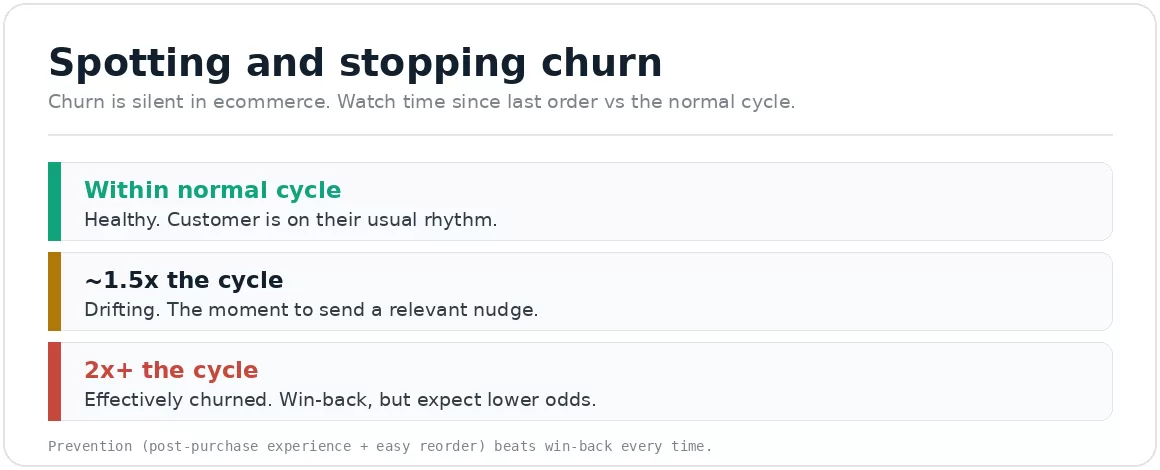
Churn is silent in ecommerce. Time since last order vs the normal cycle is the clearest signal.
How do I win back customers who've lapsed?
With timely, relevant outreach, ideally before they’re fully gone, and a genuine reason to return rather than a reflexive discount. Reserve discounts for customers who won’t return without one.
A win-back sequence targets lapsed customers with messages designed to re-engage:
Time it to the lapse. Trigger win-back when a customer passes their normal reorder window, not on a fixed calendar.
Lead with relevance, not a discount. Remind them what they bought, suggest a natural reorder or complement, or share what’s new. Many return without any incentive.
Escalate carefully. If relevance alone doesn’t work, a modest incentive in a later message can help, but leading with a discount trains customers to lapse on purpose to trigger one.
Know when to stop. Some customers are genuinely gone; endless win-back emails just drive unsubscribes. Cap the sequence.
The email mechanics for this live in email and lifecycle marketing.
What's the best way to prevent churn in the first place?
Prevention beats win-back: a strong post-purchase experience, effortless reordering, and relevant communication stop most churn before it starts. It’s cheaper and more effective to keep a customer than to win one back.
Win-back is the safety net; prevention is the real solution. The highest-leverage preventions are the same levers that drive retention generally: a post-purchase sequence that keeps you present and useful, replenishment or subscription options that make reordering automatic for consumables, and communication timed to when customers are actually due to buy. Get these right and far fewer customers reach the at-risk stage at all. A useful way to think about it: every customer you keep is one you do not have to reacquire at full cost, so churn prevention quietly lowers your effective acquisition burden even though it never touches an ad account. That’s why churn reduction and retention improvement are two sides of the same work, covered fully in the retention pillar, and why they pay off directly in the LTV:CAC math that decides whether paid growth is sustainable.
We define churn for your store, catch at-risk customers early, and prevent more than we win back.
We set a churn threshold based on your real purchase cycle, flag customers who pass it, and build the prevention that stops most churn upstream: a strong post-purchase sequence and effortless reordering, with win-back as the safety net.
It’s part of our conversion optimization work, measured against your own cohort analytics rather than a generic benchmark.
Frequently asked questions
How is ecommerce churn different from subscription churn?
Subscription churn is explicit, customers cancel. Ecommerce churn is silent: customers just stop buying with no formal cancellation. So ecommerce churn has to be inferred from behavior, mainly time since last order compared to the normal purchase cycle.
How do I know when a customer has churned?
Compare their time since last order to your normal purchase cycle. A customer well past their usual reorder window (say 2x the normal gap) has effectively churned. Define this threshold for your store based on how often customers typically buy.
Do discounts reduce churn?
Sometimes, but they’re overused. Leading every win-back with a discount trains customers to lapse deliberately and erodes margin. Lead with relevance (reminders, reorder prompts, what’s new); reserve discounts for customers who genuinely won’t return otherwise.
What's the most effective way to reduce churn?
Prevention: a strong post-purchase experience, effortless reordering, and relevant, well-timed communication. These stop customers reaching the at-risk stage. Win-back sequences catch those who slip through, but preventing churn is cheaper and more effective than recovering it.
Keep reading
Sources
Churn is largely driven by post-purchase experience, delivery/product issues, and communication rather than price alone; recency-vs-cycle is the primary at-risk signal; prevention outperforms win-back. Reflects established retention practice, corroborated across 2026 retention analyses. See the linked retention pillar and its sources. Existing customers have a substantially higher repurchase probability than new prospects (widely cited, e.g. HubSpot), treated here as directional support for prioritizing retention.