White-label / Agencies
How to Build a Post-Purchase Email Sequence
// the second purchase starts here

By Fracto Solutions
September 5, 2026
The short answer
A post-purchase email sequence is the flow you send after an order to build loyalty and drive the second purchase: order confirmation, shipping and what-to-expect, a how-to-use or onboarding message, a review request, and later a replenishment or cross-sell prompt. It’s where one-time buyers become repeat customers.
A post-purchase email sequence is the flow you send after an order to build loyalty and drive the second purchase: order confirmation, shipping and what-to-expect, a how-to-use or onboarding message, a review request, and later a replenishment or cross-sell prompt. It’s where one-time buyers become repeat customers.
The moment after someone buys is one of the most valuable and most wasted in DTC. The customer is engaged, excited, and highly likely to open your emails, yet most brands send a bare confirmation and go quiet. A good post-purchase sequence uses that window to build loyalty and set up the next purchase. This guide covers what to send and when. It’s the post-purchase deep-dive under the email and lifecycle pillar.
Why does the post-purchase moment matter so much?
Because a customer who just bought is at peak engagement, and because the second purchase is where DTC profit really begins. Nurturing that moment costs little and lifts lifetime value directly.
Two things make this window valuable. First, engagement: people who just purchased open post-purchase emails at very high rates, they’re invested and waiting for their order, so your messages get read. Second, economics: turning a one-time buyer into a repeat buyer is far cheaper than acquiring a new customer, and it’s the mechanism that lifts lifetime value and, with it, your LTV:CAC ratio (covered in what is a good LTV:CAC ratio). A brand that ignores post-purchase is paying full acquisition price for every sale. One that nurtures it compounds each customer into several.
What emails should a post-purchase sequence include?
Five common stages: order confirmation, shipping and what-to-expect, how-to-use or onboarding, a review request, and later a replenishment or cross-sell prompt. Not every brand needs all five, but this is the full menu.
Stage
Sends when
Job
Order confirmation
Immediately
Reassure and set expectations
Shipping / what-to-expect
At dispatch
Reduce anxiety, build anticipation
Review request
Around delivery
Ensure a good first experience
How-to-use / onboarding
After enough time to use it
Gather social proof
Replenishment / cross-sell
Timed to the product cycle
Drive the next purchase
The order matters: reassure first, deliver a good experience, then ask for a review, then invite the next purchase. Asking for a review or a repeat order before the customer has even used the product falls flat.
- The post-purchase sequence
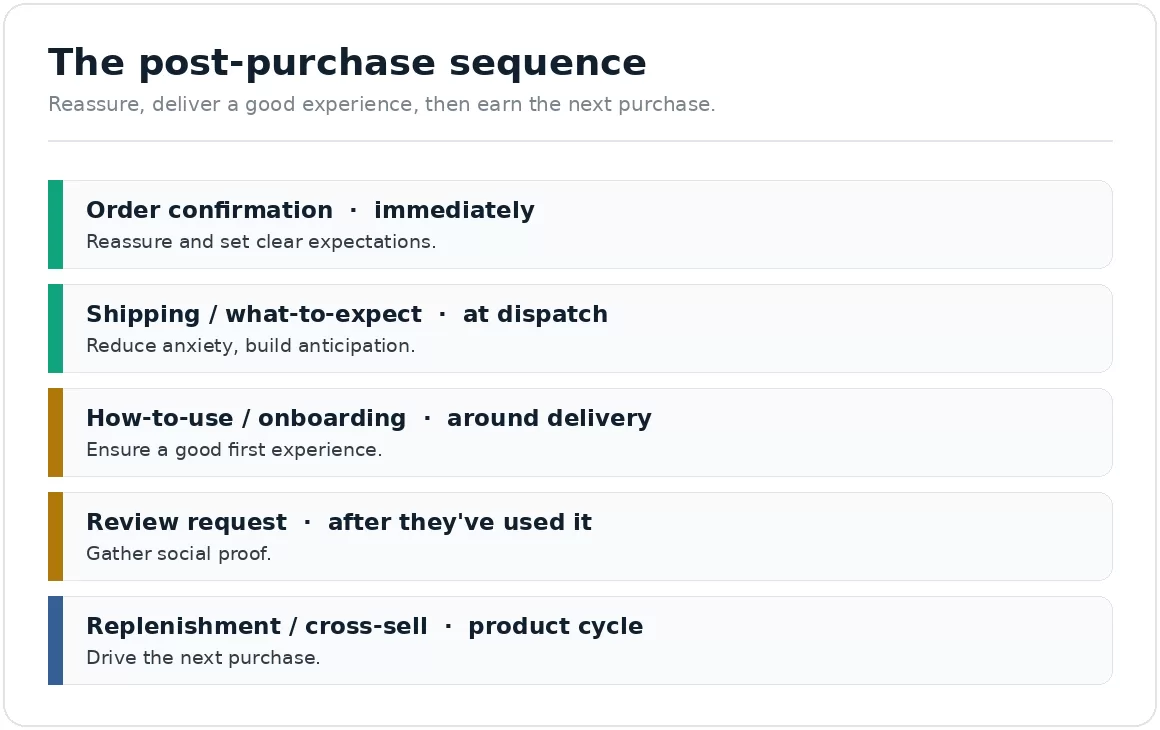
Reassure, deliver a good experience, then earn the next purchase.
What should the three-email sequence say, and when?
More than confirm. It should reassure the buyer they made a good choice, set clear expectations on shipping, and reinforce your brand, all while getting the practical details right.
The confirmation email has the highest open rate you’ll ever get, because everyone checks that their order went through. Don’t waste it on a bare receipt. Confirm the essentials clearly (what they bought, total, when to expect it), then use the attention to reduce buyer’s remorse (remind them why the product is great), reinforce your brand voice, and set accurate expectations so the wait feels shorter. Keep it useful first, everything else is a bonus layered on a message they were going to open anyway.
How do I use post-purchase emails to drive repeat purchases?
Time the ask to the product’s natural cycle, and earn it first. Deliver a good experience, gather a review, then invite the next purchase with genuine relevance, not a generic “buy again.”
The repeat-purchase prompt is the payoff, but it only works if you’ve earned it. For consumable products, a replenishment reminder timed to when they’d be running low is highly effective, it’s genuinely helpful, not pushy. For non-consumables, a relevant cross-sell (something that complements what they bought) works better than asking them to rebuy the same item. The key is relevance and timing: a well-timed, relevant prompt feels like service; a generic early one feels like spam. This is where lifecycle marketing quietly does its LTV work.
When should each post-purchase email send?
Anchor the timing to the order and delivery, not fixed calendar dates. Confirmation immediately, shipping updates at dispatch, onboarding around delivery, review request after they’ve used it, replenishment timed to the product cycle.
The sequence should track the customer’s actual experience of the order:
Confirmation: instantly, while they’re checking it went through.
Shipping / what-to-expect: at dispatch and in transit, to reduce “where is it?” anxiety.
How-to-use: around delivery, so it lands when they have the product in hand.
Review request: after enough time to actually use it, asking too early gets thin reviews or none.
Replenishment / cross-sell: timed to the product’s cycle, when a repeat purchase is genuinely relevant.
Tying sends to order and delivery events (rather than “day 1, day 2”) keeps every message contextually right.
We find where value leaks, fix the highest-impact issue first, and prove the gain in your own numbers.
That is the same baseline-first method behind our conversion optimization work: confirm the data is trustworthy, fix the biggest leak, then prove the gain in your own reporting.
Frequently asked questions
How many emails should a post-purchase sequence have?
It varies by product, but a common set is four to five: confirmation, shipping/what-to-expect, how-to-use, review request, and a later replenishment or cross-sell. Consumable products lean on replenishment; considered purchases lean on onboarding and cross-sell.
What's the most important post-purchase email?
The order confirmation, because it has the highest open rate and sets the tone. Beyond confirming details, use that guaranteed attention to reassure the buyer and reinforce your brand, rather than sending a bare receipt.
When should I ask for a review?
After the customer has had time to actually use the product, timing depends on what you sell. Asking too early produces thin reviews or none. A well-timed request, once they’ve experienced the product, gets better and more useful social proof.
Does a post-purchase sequence really increase repeat purchases?
It’s one of the most effective ways to, because it nurtures customers at peak engagement and times relevant prompts to their actual product cycle. It lifts lifetime value, which is where DTC profitability comes from. Measure repeat-purchase rate to confirm the effect for your store.
Keep reading
Sources
Post-purchase flows have among the highest open rates of any email type, reflecting high engagement immediately after purchase. Source: Klaviyo flow benchmark reporting, based on 2023 performance data published in 2024. Note that post-purchase flows earn high open rates but among the lowest revenue per recipient of the common flows, so treat engagement and revenue separately here. Exact figures vary by source and sample.
Repeat-purchase economics: selling to an existing customer costs less than acquiring a new one, lifting LTV and the LTV:CAC ratio. (See LTV:CAC pillar and its sources.)